
304 Stainless Steel Thermal Expansion Coefficient

Alright, settle in, grab your latte (or something stronger – no judgment here!), because we're about to dive headfirst into the wild and wacky world of 304 stainless steel. Specifically, its thermal expansion coefficient. Sounds intimidating, doesn't it? Like something you'd find scribbled on a blackboard in a mad scientist's lab next to diagrams of world-domination robots. But trust me, it's not that scary.
Think of it this way: everything, and I mean everything, changes size when you heat it up or cool it down. Okay, maybe not your profound sense of existential dread – that seems pretty constant. But metals, definitely. They get bigger when hot, smaller when cold. Duh, right? But how much bigger or smaller? That, my friends, is where our buddy the thermal expansion coefficient comes in. He's like the metal's personal growth chart.
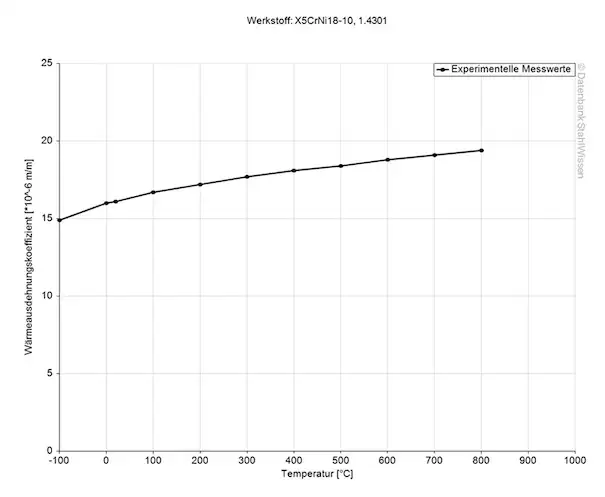
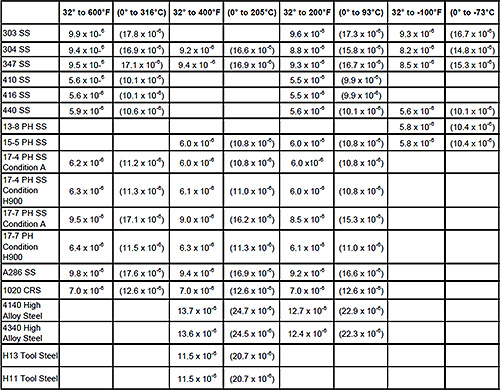
So, what is the thermal expansion coefficient of 304 stainless steel? Well, it's around 17.3 x 10⁻⁶ per degree Celsius (or 9.6 x 10⁻⁶ per degree Fahrenheit for those stubbornly clinging to the imperial system). Now, I know what you're thinking: "Numbers! Exponents! Aaaargh!" Relax! Let's break it down.
Must Read
Imagine This: The Expanding Spatula
Let's say you have a 304 stainless steel spatula. A perfectly ordinary spatula, ideal for flipping pancakes or rescuing grilled cheese sandwiches from a fiery death. It's exactly 1 meter (or about 3.3 feet, if you're feeling particularly foot-y) long at room temperature (let's say 20°C or 68°F). Now, you decide to use it in a forge… because, why not?
You heat it up to, oh, let's say 300°C (or 572°F). That's pretty toasty! Now, using some magical math (and that handy-dandy thermal expansion coefficient), we can figure out how much longer your spatula gets.

The formula is simple (don't run away!): Change in Length = Original Length x Thermal Expansion Coefficient x Change in Temperature.
So, in our case: Change in Length = 1 meter x 0.0000173 per °C x (300°C - 20°C) = 0.004844 meters. That's about 4.8 millimeters, or roughly the width of a few stacked pennies. So, your spatula is now about 1 meter and 4.8 millimeters long. Impressive, eh? You've single-handedly expanded the world of spatula technology!
Why Should I Care About Spatula Growth (or Lack Thereof)?
Okay, maybe you're not that invested in spatula expansion. But thermal expansion is crucial in a ton of real-world applications. Think about bridges. They're made of steel, and they get blazing hot in the summer and freezing cold in the winter. If engineers didn't account for thermal expansion, those bridges would buckle and crumble like a cheap cookie. Imagine the traffic jam! The horror!
Here's a mind-blowing fact: The Eiffel Tower gets about 6 inches taller in the summer due to thermal expansion. Six inches! That's like the height of a particularly ambitious hamster. So next time you're in Paris, remember that the Eiffel Tower is secretly stretching itself, just like your yoga instructor told you to.

304 stainless steel is popular for all sorts of things, from kitchen sinks to surgical instruments to chemical processing equipment, precisely because it has a relatively low thermal expansion coefficient. This means it doesn't change size too much, even with significant temperature swings. This makes it stable, reliable, and less likely to cause problems like leaks or structural failures.
The Devil's in the Details (and Alloying Elements!)
Now, before you go around quoting spatula-lengthening equations at cocktail parties, remember that this is just a simplified explanation. The actual thermal expansion coefficient can vary slightly depending on the specific composition of the 304 stainless steel. Tiny amounts of other elements can nudge it up or down. It's like baking a cake – a little extra vanilla extract can make a big difference!
Plus, temperature isn't the only thing that matters. Stress, manufacturing processes, and even the alignment of the planets (okay, maybe not that last one) can influence how a material behaves. Engineering is complicated, folks! That’s why engineers get paid the big bucks (or at least, slightly bigger bucks than spatula-flippers).
In conclusion: 304 stainless steel has a thermal expansion coefficient that's important for all sorts of engineering applications. It's not the most exciting topic in the world, but it's essential for ensuring that things don't fall apart when they get hot or cold. And who knows, maybe knowing about spatula expansion will save the world someday. You never know!
Now, if you'll excuse me, I have a date with a forge and a very long spatula… for science, of course!