
28 24 As A Product Of Two Factors

Okay, let's talk numbers, but not in a scary, back-to-algebra-class kind of way. We're diving into the surprisingly fascinating world of factorization, specifically focusing on the number 24 and its cool connection to the factors 28, or should I say how 24 is a product of two factors.
Think of 24 as the star of our show. It's a relatively small number, easy to grasp, yet it holds a universe of possibilities when we start breaking it down. To say it is a product of 28 as its factors is incorrect, that is because the two numbers multiplied cannot exceed 24.
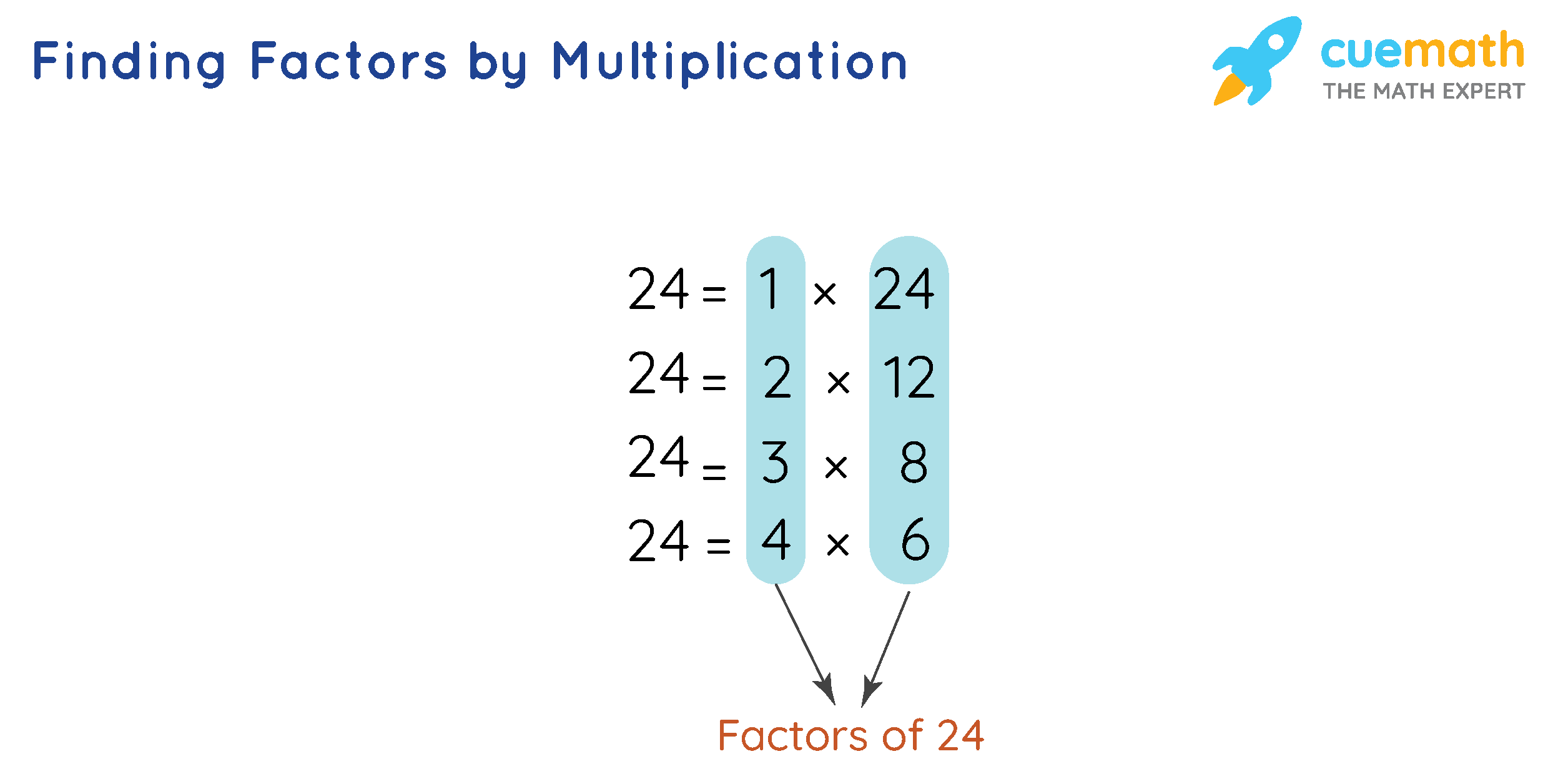
But what are factors, anyway? Simply put, factors are numbers that divide evenly into another number. Imagine you're dividing a pizza (because who doesn't love pizza?). The number of slices you can cut it into equally represents the factors. For 24, some of its factors include 1, 2, 3, 4, 6, 8, 12, and 24. Each of these numbers divides into 24 without leaving a remainder.
Must Read
So, instead of 28, what numbers multiplied together could be 24? Like, 4 x 6 = 24. 2 x 12 = 24. Easy, right?
Why Does This Even Matter?
You might be thinking, "Okay, this is mildly interesting, but how does it relate to my life?" Well, understanding factors and factorization has surprisingly practical applications. Think of it as a foundational skill that pops up in unexpected places.
Budgeting: Planning a trip with friends? Factoring can help you split costs fairly. If your total expense is $240, you can easily figure out how much each person owes if there are 4, 6, or even 8 of you.
Cooking: Scaling a recipe? If a recipe for 4 people calls for 2 cups of flour and you're cooking for 8, you quickly realize you need to double the recipe, thanks to your understanding of factors.

Design and Organization: Arranging furniture in a room? Factoring (in a spatial sense) comes into play when deciding how to best utilize the space, ensuring everything fits and looks aesthetically pleasing.
Beyond the practical, understanding factors enhances your problem-solving skills. It trains your brain to think about numbers in different ways, fostering a more analytical and creative approach to problem-solving in general.
Fun Factor(ial) Facts
Let's inject some fun into this numerical exploration:

- Did you know that 24 is a factorial? More specifically, it's the factorial of 4 (denoted as 4!), which means 4 x 3 x 2 x 1 = 24. Factorials are used in many areas of mathematics, including probability and combinatorics.
- In some cultures, the number 24 holds symbolic significance. It can represent completeness or wholeness, as it is divisible by so many numbers.
- Think of the TV show "24" starring Kiefer Sutherland. The entire season is structured around 24 episodes, each representing an hour of a single day.
Knowing the multiples and factors also makes it easier to understand and manage other real-life problems. For instance, the factors of 24 are 1, 2, 3, 4, 6, 8, 12 and 24. If you want to distribute, say, 24 cookies, you can do it fairly to each friend so they have equal parts!
The Art of Breaking Things Down
Ultimately, understanding the concept of factors is about understanding how to break things down into their fundamental components. It's about seeing the underlying structure and relationships that exist within numbers. The important thing to remember is that 24 cannot be produced by the factor 28.

We often approach problems in life by tackling them head-on, sometimes without fully understanding the contributing elements. By taking a step back and analyzing the "factors" involved – the various contributing factors, influences, or perspectives – we can gain a more complete and nuanced understanding of the situation.
Just as we can break down 24 into its constituent factors, we can also break down complex problems into smaller, more manageable components. This allows us to address each aspect individually, ultimately leading to a more effective and satisfying solution.
So, next time you encounter a problem, remember the power of factorization. Break it down, identify the contributing factors, and you might be surprised at how much easier it becomes to solve. And remember, even seemingly simple numbers like 24 hold hidden depths and valuable lessons.