Young's Modulus Of Steel In Mpa

Ever gazed up at a towering skyscraper, driven across a magnificent bridge, or simply admired the sleek design of a modern car? What holds these marvels of engineering together? It's not magic, but rather a fascinating science rooted in understanding material properties. One of the coolest and most fundamental of these is Young's Modulus, especially when we talk about that versatile workhorse of the modern world: steel. Understanding Young's Modulus isn't just for engineers; it’s a peek behind the curtain at how our world is built, making it surprisingly fun and incredibly useful!
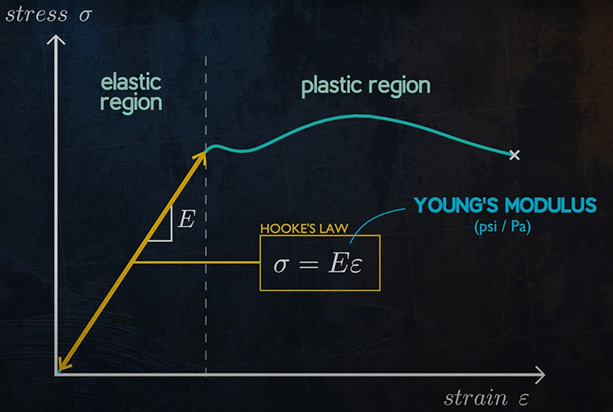
So, what exactly is this fancy-sounding term? In simple words, Young's Modulus (often denoted as 'E') is a measure of a material's stiffness or its resistance to elastic deformation under stress. Imagine trying to stretch a rubber band versus trying to stretch a steel rod. The rubber band stretches easily, meaning it has a low Young's Modulus. The steel rod barely budges, indicating a very high Young's Modulus. It quantifies how much a material will deform elastically (stretch or compress) when a certain amount of force is applied to it. It’s calculated by dividing the stress (force per unit area) by the strain (the proportional change in length). Think of it as the material's "springiness" report card – how much it wants to return to its original shape after being pushed or pulled.
Why focus on steel, and why in MPa? Steel is simply indispensable. From the skeleton of buildings to the frame of your bicycle, its strength, durability, and versatility are unmatched. When we talk about Young's Modulus for steel, we're typically looking at values around 200,000 MPa (Megapascals). MPa is the standard unit of pressure or stress in the metric system. It might sound like a huge number, but it simply means that steel requires a tremendous amount of force per unit area to cause even a tiny bit of elastic deformation. This high value is precisely what makes steel so incredibly useful for structures that need to be rigid and strong.
Must Read
The benefits of knowing steel's Young's Modulus are immense and directly impact our daily lives. Firstly, it's crucial for design and safety. Engineers use this value to predict exactly how much a steel beam will sag under a specific load, or how much a bridge will deflect when heavy traffic crosses it. This ensures that structures are not only safe but also perform as intended, without unexpected deformations. Without this knowledge, buildings could wobble, and bridges could become unsafe.

Secondly, it plays a vital role in material selection. Different types of steel have slightly different Young's Moduli, allowing engineers to choose the perfect variant for specific applications. For instance, a very stiff steel might be preferred for a structural column, while a slightly less stiff but perhaps more ductile steel might be better for parts that need to absorb impact. It also allows for comparison with other materials; if you need a lighter, but less stiff material, you might opt for aluminum, whose Young's Modulus is much lower.
Finally, understanding Young's Modulus drives innovation and quality control. Researchers can develop new alloys with optimized stiffness for specialized applications, pushing the boundaries of what's possible in aerospace, automotive, and construction. In manufacturing, testing for Young's Modulus ensures that the steel used in products meets rigorous standards, guaranteeing quality and reliability. So, the next time you see a crane lifting a massive steel beam, remember Young's Modulus – the invisible force ensuring our world stands tall and strong!