
Which Of The Following Is Not Characteristic Of Metals
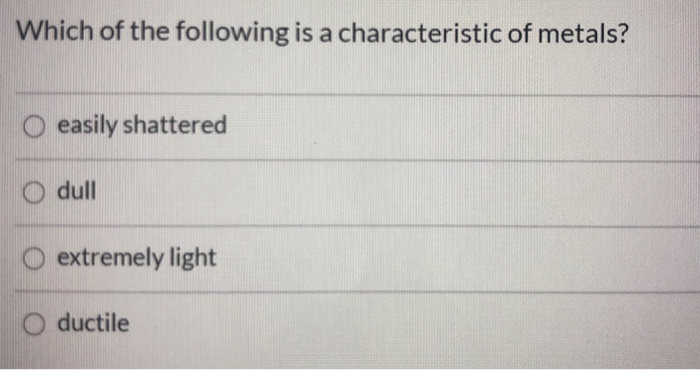
Okay, let's play a game! Imagine a world made of metal. Cars? Metal. Spoons? Metal. Your grandma’s prized teacup? Metal. Even... fluffy kittens? Okay, maybe not fluffy kittens. But still, a LOT of metal! Now, let's think about what makes metal...well, metal. We all have a general idea, right?
So, which of the following is NOT something you'd typically associate with a shiny, clangy piece of metal?
A) Being a good conductor of electricity.
Must Read
B) Being malleable (able to be hammered into shape).
C) Being ductile (able to be drawn into wires).
D) Being easily shattered into tiny pieces.
Think about it for a second. Imagine trying to make a wire out of something that shatters easily. Not exactly going to work, is it?
The Metal Mindset: More Than Just Shiny Things
We often think of metals as strong and durable, the building blocks of our world. Bridges, skyscrapers, even the tiny components inside our phones rely on the unique properties of metals. But sometimes we take these properties for granted.
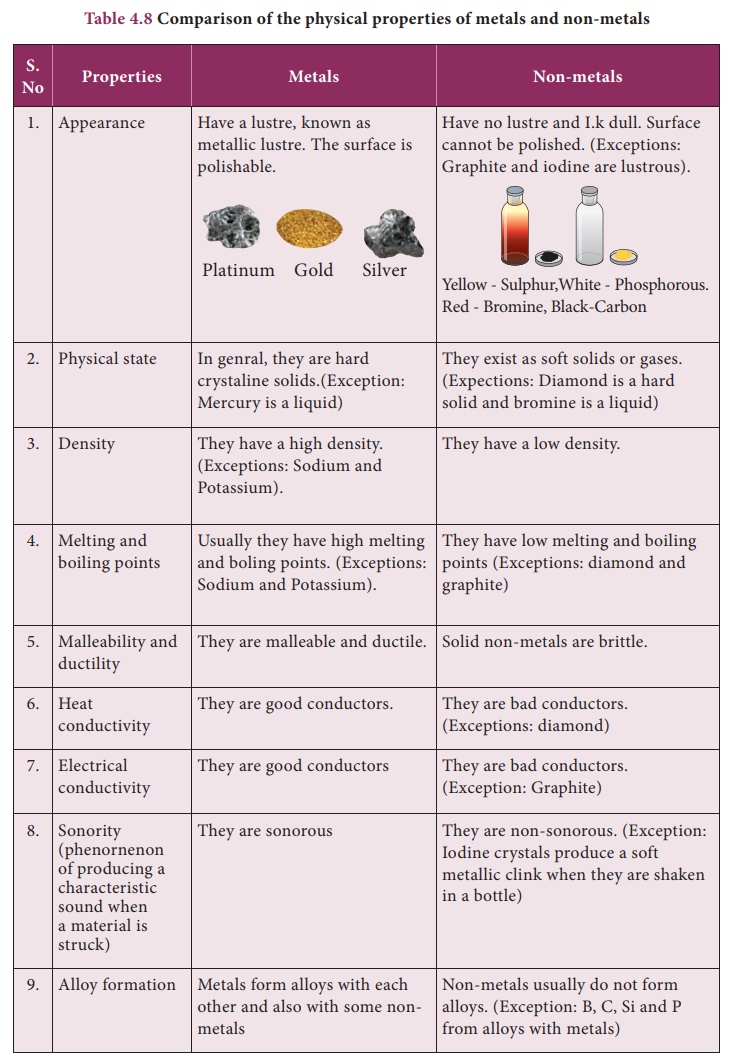
Let's dive a little deeper. Option A, being a good conductor of electricity, is a big one. Think about the wires in your walls, the circuits in your computer. They're almost always made of metal, usually copper, because metals are fantastic at letting electricity flow through them. It's like a super-fast highway for electrons!

What about being malleable (option B)? Imagine a blacksmith, hammering away at a piece of red-hot iron. He's shaping it, bending it, turning it into something new. That's malleability in action. It's the ability of a metal to be deformed without breaking. Thank goodness for malleable metals, or every time we bumped our cars, they'd just crumble into dust!
And ductility (option C)? That's the metal's ability to be stretched into wires. Without ductile metals, we wouldn't have the miles and miles of cabling that connect our world. Think about the internet cables under the ocean – those are all made possible by the ductility of metals like copper and aluminum. It's pretty amazing when you think about it!
So that leaves us with option D: being easily shattered into tiny pieces. And that’s our winner! While some metals can be brittle under certain conditions (like extreme cold), the overall characteristic of a metal is definitely NOT being easily shattered. Imagine building a skyscraper out of something that shatters easily! That's a recipe for disaster.
Metals: A Love Story?
Maybe "love story" is a bit strong, but we certainly have a deep and lasting relationship with metals. They're the unsung heroes of our modern world, quietly supporting us in countless ways. From the mundane (pots and pans) to the extraordinary (spacecraft), metals play a vital role.
And think about the artistry involved in working with metals. From delicate jewelry to monumental sculptures, artists have long been drawn to the beauty and versatility of these materials. The ability to shape and mold metal allows them to create incredible works of art that can last for centuries.
So next time you see a piece of metal, whether it's a gleaming stainless steel appliance or a rusty old bicycle, take a moment to appreciate its unique properties. Remember its strength, its conductivity, its malleability, and its ductility. And remember that, thankfully, it's probably not going to shatter into tiny pieces anytime soon! And remember also that not every metal can be considered precious metal like gold.
![[ANSWERED] 5 One of the characteristic properties of non metals is that](https://media.kunduz.com/media/sug-question-candidate/20200726044131851714-1892516.jpg?h=512)
And let's be honest, kittens made of metal would be pretty terrifying. So, we should be grateful that fluffy and shatter-resistant aren't usually associated with the same substance!
Ultimately, understanding the basics of materials like metals allows us to appreciate the world around us on a deeper level. It’s not just about memorizing facts; it's about seeing the interconnectedness of things and marveling at the ingenuity of human innovation. It really is amazing!