
Which Of The Following Is A Source Of Monopoly Power
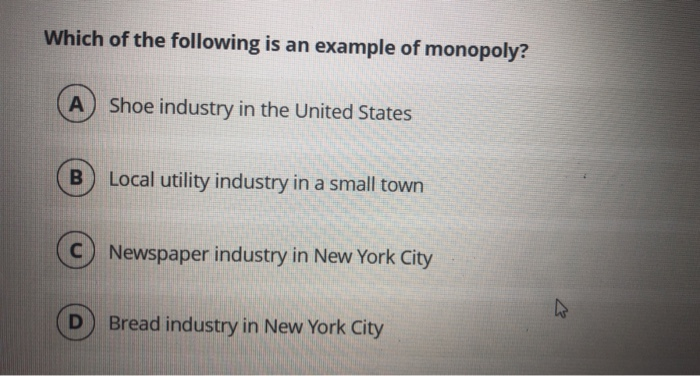
Okay, folks, gather 'round! Let's talk about monopolies. Not the board game where your relatives get suspiciously good at buying up Park Place every. single. time. We're talking real-world monopolies, the kind that can make your wallet weep. The question on the table, and it’s a burning one: Which of the following is a source of monopoly power?
Before we dive in, let’s imagine a world run entirely by monopolies. Picture this: you want coffee? Too bad, "Mega Coffee Corp." is the only option, and they decided today's special is lukewarm mud at $20 a cup. Need internet? "CompuGlobalHyperMegaNet" is your sole provider, and their speeds are slower than a snail doing the tango. Sounds bleak, right? That's why understanding monopolies is crucial. It's about preventing this lukewarm-mud-internet-hellscape.
So, What Gives a Company This Superpower?
Think of monopoly power as a company having a ridiculously unfair advantage. Like if I showed up to a hotdog eating contest with a stomach lined with industrial-strength elastic. Totally unfair, right? These "unfair advantages" come in several flavors.
Must Read
1. Control of a Scarce Resource: The 'I Own All The Diamonds' Play
Imagine I discover the only source of glitter that actually makes you fly. And I buy it. All of it. Boom! I control the flying glitter market. This is what happens when a company controls a scarce and essential resource. De Beers and diamonds are the classic example. They didn't invent diamonds, but they historically controlled a significant chunk of the diamond mines, giving them enormous pricing power. It's like finding the only well in the desert and charging everyone a fortune for a sip. Not cool, man. Not cool.
2. Government Granted Monopoly: The 'King's Decree' Gambit
Sometimes, the government intentionally creates a monopoly. Say what?! Why would they do that? Well, there can be reasons, even if they're sometimes debatable. Think about patents and copyrights. The government grants you a limited-time monopoly on your invention or creative work. This is meant to incentivize innovation. Without it, someone could steal your brilliant idea for a self-folding laundry machine (I'm working on it!), and you'd get nothing. But, of course, there's a fine line between encouraging innovation and creating a permanent, bloated corporate overlord. It's a tricky balancing act.

3. Natural Monopoly: The 'One Wire to Rule Them All' Scenario
This one's a bit different. A natural monopoly occurs when it's just more efficient to have a single provider. Think about your local water company. Imagine if ten different companies ran water pipes under your street. Total chaos! It's just more economical for one company to handle the infrastructure. The downside? They could charge you $50 for a glass of water if left unchecked. That's why natural monopolies are often heavily regulated by the government. It's like having a referee at a toddler soccer game – necessary, but potentially annoying.

4. Network Effects: The 'Everyone's Doing It' Phenomenon
This is the cool, modern one. Network effects occur when a product becomes more valuable as more people use it. Social media is the poster child for this. Why is Facebook still kicking? Because everyone is on it. It's hard to switch to a new platform when all your friends and family are already somewhere else. This gives existing platforms a huge advantage and makes it difficult for new competitors to break in. It's like trying to start a new language; good luck getting the world to switch!

So, Which One Is It? (The Big Reveal!)
Alright, drumroll please... All of the above! Control of a scarce resource, government-granted monopolies, natural monopolies, and network effects are all sources of monopoly power. Each one grants a company the ability to exert significant control over the market and, potentially, to charge higher prices and offer lower quality products. And nobody wants to drink lukewarm mud, right?
Remember, a healthy economy needs competition. Competition keeps prices down, quality up, and prevents companies from becoming too powerful. So, next time you see a company acting suspiciously monopolistic, raise an eyebrow (or maybe write a strongly worded letter). Because fighting for competition is fighting for your wallet. And for the right to drink decent coffee at a reasonable price.
And on a final note, always check the ingredients of your glitter. Just in case. You never know when you might start floating.