Which Of The Following Components Converts Ac To Dc

Ever wonder how that wall wart charger magically keeps your phone alive? Or how your laptop manages to run off a battery even when it's plugged into the wall? The secret lies in a little piece of electronic wizardry: something that converts AC to DC. It might sound technical, but understanding this process is surprisingly fun and incredibly relevant to our modern, gadget-filled lives.
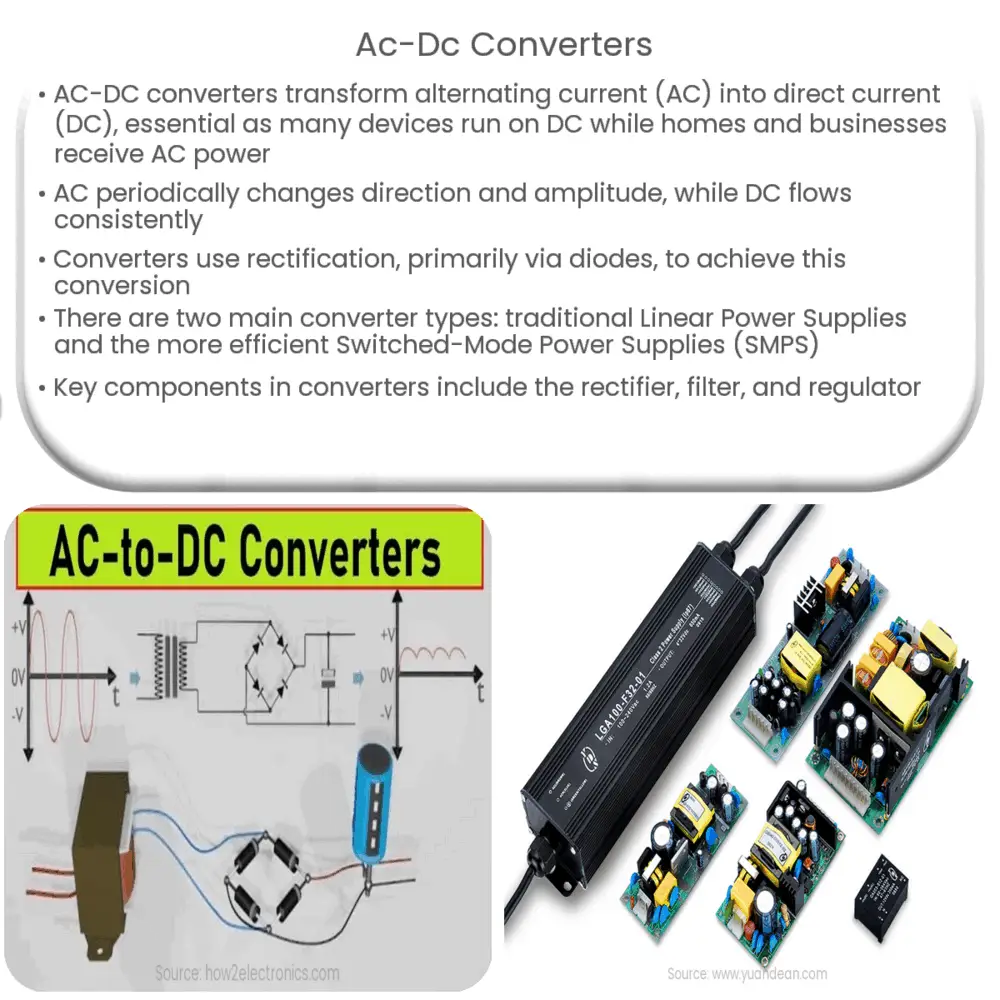
So, what exactly are we talking about? AC, or Alternating Current, is the electricity that comes out of your wall socket. It's called "alternating" because the direction of the current flow changes periodically. DC, or Direct Current, on the other hand, flows in one direction only. Batteries, for example, provide DC power. Most electronic devices need DC to function properly. They are designed to work with a constant, stable flow of electrons. That's where the magic converter comes in!
The purpose of an AC-to-DC converter is quite simple: to transform the AC electricity from your power outlet into the DC electricity your electronics require. This conversion is crucial because directly plugging a DC device into an AC outlet could damage it, potentially frying its delicate internal circuits. The benefits are numerous. Firstly, it allows us to use a vast array of battery-powered devices without constantly replacing batteries. Secondly, it allows devices that require very precise DC voltage (like computers) to function reliably even though the AC voltage from the wall might fluctuate slightly.
Must Read
Think about it: AC-to-DC converters are everywhere! They're hidden inside your phone charger, your laptop adapter, your television, your computer power supply, and even some LED light bulbs. In education, they are fundamental to understanding electronics and circuits. Students use power supplies (which are basically sophisticated AC-to-DC converters) to power their projects and experiments. In daily life, they power our smartphones, tablets, laptops, and many other electronic devices we rely on every day.

So, how can you explore this concept further? While disassembling your chargers isn't recommended (electricity is dangerous!), you can investigate the specifications printed on the charger. Look for the input voltage range (which will typically be AC, often 100-240V) and the output voltage (which will be DC, such as 5V or 12V). This tells you how the charger is transforming the AC power from your wall into the DC power your device needs. You can also research rectifiers and diodes, which are key components in many AC-to-DC converters. There are tons of resources online, including videos and diagrams, that explain how these components work together to "rectify" the AC waveform into a DC waveform.
Understanding the AC-to-DC conversion process isn't just about technical knowledge; it's about understanding the world around us. It’s about appreciating the ingenuity that allows us to power our increasingly complex and interconnected lives. And who knows, maybe it will even spark an interest in electronics and engineering!