
Which Direction Should A Ceiling Fan Turn To Cool
:max_bytes(150000):strip_icc()/ceiling-fan-rotate-direction-1907533-v4-5ba94e6346e0fb002576cebf.png)
Let's talk ceiling fans. Not the most glamorous topic, I know. But trust me, we've all stood beneath one, sweat dripping, silently questioning its life choices. Is it even trying to cool me down? Or is it just mocking me with its gentle breezes?
The big debate, of course, is direction. Clockwise? Counter-clockwise? It's like a secret code known only to HVAC engineers and particularly nerdy squirrels. And honestly, the "official" answer always felt… wrong.
The "Official" Line: Counter-Clockwise for Summer
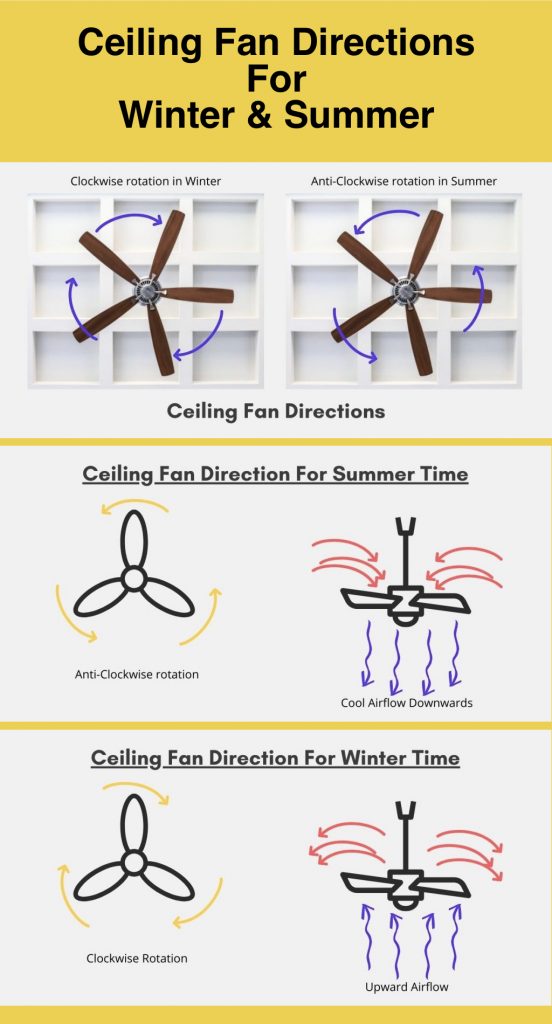
They say, these experts (who probably live in temperature-controlled bunkers, by the way), that in the summer, your ceiling fan should be spinning counter-clockwise. This supposedly pushes air straight down, creating a wind chill effect that makes you feel cooler.
Must Read
Okay, fine. Makes sense on paper. But here's my unpopular opinion: it's often underwhelming. Sometimes, it just feels like the fan is…stirring the hot air around. Like a giant, electric whisk in a bowl of misery.
My Radical (Maybe Wrong) Stance: Clockwise is Where It's At!
Hear me out. I'm not saying the experts are completely wrong. Just…mostly. For me, the clockwise direction is where the real magic happens. And before you click away in disgust, consider this: what if the goal isn't just to feel a direct breeze? What if it's about overall air circulation?

Think about it. Clockwise rotation pulls air up. This, in my humble (and possibly delusional) opinion, helps to circulate the air in the room more effectively. It's like a gentle, invisible hand pushing the warm air upwards and away from your precious, heat-sensitive body.
Now, I know what you're thinking: "But I want to feel the breeze!" I get it. Instant gratification is addictive. But sometimes, a more subtle approach is better. Consider it the difference between a slap in the face (the counter-clockwise blast) and a gentle caress (the clockwise circulation).
Which would you prefer on a hot, sticky day? I rest my case.

The Case of the Stuffy Room: Clockwise to the Rescue
I've also noticed something else. In rooms that tend to feel stuffy, a clockwise fan seems to work wonders. Maybe it's pulling up that stale air and replacing it with…fresher air from somewhere? Look, I'm not a scientist. I just know it works.
And let's be honest, sometimes you just want the fan to move the air away from you. Maybe you're feeling a bit sweaty. Maybe you just don't want the full force of the fan directed at your face. Clockwise gives you that option.
Testing the Theory: A Scientific (Sort Of) Experiment
Okay, I admit my "experiment" involved standing under the fan in both directions and seeing which felt better. Not exactly Nobel Prize-winning stuff, I know. But for me, the results were clear: clockwise won, hands down. Or, rather, sweaty armpits down.
Maybe it depends on the room. Maybe it depends on the individual. Maybe I'm just weird. But I encourage you to try it. Switch your fan to clockwise for a day or two. See if it makes a difference. You might be surprised.
The Bottom Line: Do What Feels Good!
Ultimately, the best direction for your ceiling fan is the one that makes you the most comfortable. Don't let the experts tell you otherwise. They're probably sitting in their temperature-controlled bunkers anyway, judging your life choices.

So, crank up that fan, experiment with directions, and find your personal sweet spot. And if that sweet spot happens to be clockwise, welcome to the club! We're a small, but dedicated group of rebels, defying the conventional wisdom one gentle, air-circulating breeze at a time.
Now, if you'll excuse me, I'm going to go stand under my clockwise-spinning fan and bask in its subtle, yet effective, coolness. And maybe eat a popsicle. Because it's hot. Really hot. And my way works for me.
Just remember, the esteemed Albert Einstein once said, "The only source of knowledge is experience." Okay, he probably didn't say that about ceiling fans, but the principle applies! Now go forth and experiment!