
Where Are The Metalloids In The Periodic Table
Ever looked at the periodic table and felt a little… lost? Don't worry, you're not alone! It's a fascinating map of all the elements, but sometimes it can feel like you need a secret decoder ring to understand it.
Today, let’s talk about some of the trickiest characters on the periodic table: the metalloids. These elements are like the chameleons of the element world. They're not quite metals, not quite non-metals, but something in between!
Finding the "Semi-Metal" Sweet Spot
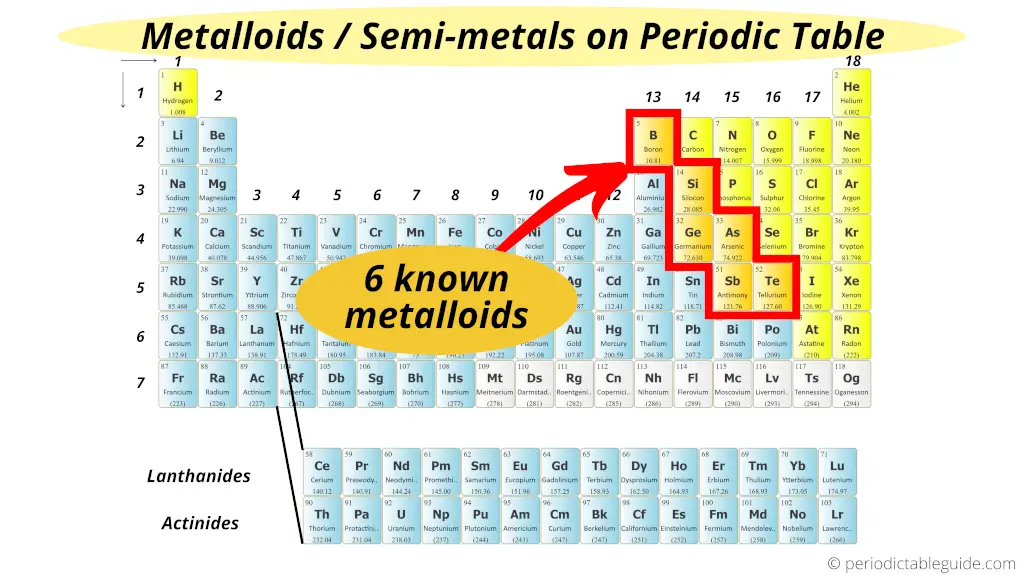
So, where do you find these enigmatic elements? Think of them as living along a zigzag line that separates the metals from the non-metals. It's like they're fence-sitters, observing the element party from a unique vantage point.
Must Read
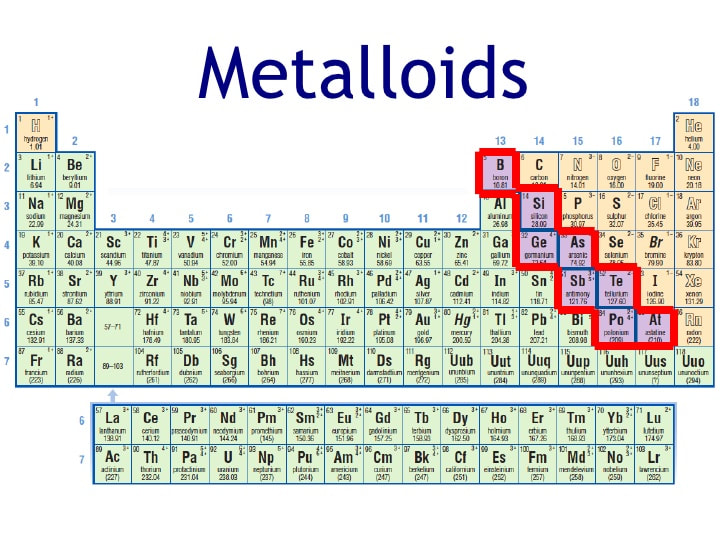
This line usually starts between boron (B) and aluminum (Al), then zigzags its way down towards polonium (Po) and astatine (At). Think of it as a staircase on the periodic table!
But here's a fun fact: Not everyone agrees on which elements exactly belong to the metalloid club. It's a bit like deciding who gets to be in the cool kids' club in chemistry class. Debate abounds!
The Usual Suspects: Metalloid Edition
Generally, you’ll find these elements considered metalloids: Boron (B), Silicon (Si), Germanium (Ge), Arsenic (As), Antimony (Sb), and Tellurium (Te). Some also include Polonium (Po) and Astatine (At). But the core six are the rock stars of the metalloid world.
These elements have properties of both metals and non-metals. This "in-between" nature is what makes them so special and useful!
For example, Silicon (Si) acts as a semiconductor, making it vital for computers. Because of their nature, metalloids often act as semiconductors.
Why Are Metalloids So Entertaining?
What's so great about these ambiguous elements? Well, it's their versatility! Their unique properties mean they can do things that metals and non-metals can't.
Think of them as the multi-tool of the element world. Need something that conducts electricity but not too much? A metalloid might be your answer!
This ability to conduct electricity under certain conditions is called semiconductivity. This property is extremely useful for electronics.
Metalloids: The Tech World's Best Friend
Our modern world owes a huge debt to metalloids. They're the backbone of the tech industry.
Silicon, especially, is found in computer chips, smartphones, and countless other electronic devices. Without silicon, our digital world would look very, very different.
Germanium is another metalloid essential for electronics and optics. You might find it in fiber optic cables and solar cells.
Metalloids: More Than Just Tech
But metalloids aren't just about gadgets! They also play important roles in other fields.

Boron is used in everything from cleaning products to strengthening glass. Antimony can be found in flame retardants, helping to keep us safe.
Arsenic, although toxic, has been used in medicine in the past. Even Tellurium finds use in rubber production and solar cells.
Metalloids: The Element World's Mystery
Perhaps the most intriguing thing about metalloids is that they blur the lines. They force us to rethink our neat and tidy categories of metals and non-metals.
Their very existence reminds us that the world is rarely black and white. There are always shades of gray, and that's where the metalloids reside.
By exhibiting both metallic and non-metallic properties, they show the diversity of the elements.
Embrace the Ambiguity
So, the next time you glance at the periodic table, take a moment to appreciate the metalloids. These elements occupy the space between categories.
They are a reminder that things aren’t always one thing or the other. Sometimes, the most interesting things happen in the in-between spaces.

Who knows, maybe understanding the metalloids will help you understand something new about the world!
A Little More to Explore
The properties of metalloids can change based on temperature and other conditions. It's like they have different personalities depending on the environment!
This responsiveness makes them ideal for a variety of applications. They are able to adapt based on various needs and environment changes.
So, are you ready to dive deeper into the metalloid world? There's so much more to discover!
The Metalloid Challenge
Why not try a little metalloid challenge? Look around your home and see if you can find any products that contain these elements.
From your computer to your cleaning supplies, you might be surprised where they pop up. It's like a metalloid scavenger hunt!

Who knows what you might discover as you learn about these elements! There are many different applications for these mysterious elements.
Metalloids: More Than Just Elements
Metalloids are more than just elements on a chart. They're a testament to the complexity and beauty of chemistry.
They show that the boundaries aren't always clear and that the in-between spaces can be the most exciting. Their nature gives way to various potential uses in real world application.
So, go forth and explore the fascinating world of metalloids! Who knows, you might just find your new favorite element.
A Parting Thought
Remember, the periodic table is more than just a list of elements. It's a map of the universe, a story of creation, and a playground for curious minds.
And the metalloids? They're the intriguing characters that make the story even more captivating. They stand between metals and nonmetals in the periodic table.
So embrace the ambiguity, celebrate the diversity, and keep exploring the wonders of chemistry!