
What Was The First 3d Printer
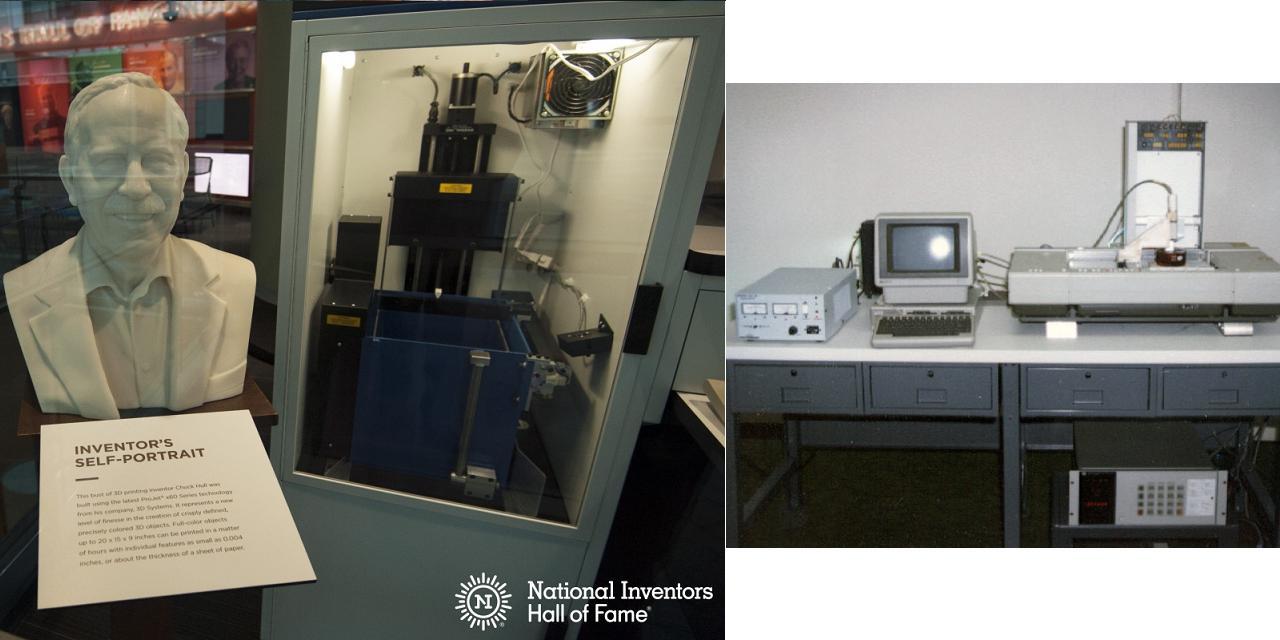
Alright, grab a coffee, pull up a chair, and let's talk about something truly wild: the very first 3D printer. Forget what you think you know from sci-fi movies or your cousin's DIY projects. We're going way back, to a time when shoulder pads were king and dial-up internet was a futuristic dream.
See, when most people hear "3D printer," they picture sleek, whirring machines churning out intricate plastic gizmos with laser precision. But let me tell you, the genesis of this magical technology was a little less "Star Trek" and a lot more "mad scientist in a garage... with a really good idea."
Before our story begins, let's set the scene. Back in the day, if you wanted to create a physical prototype of something – say, a new gear for a widget, or a tiny model of a new car part – you had two main options. One, you'd carve it out of a big hunk of material, which was slow, wasteful, and often ended up looking like a toddler's attempt at sculpture. Or two, you'd make a mold, which was also slow, expensive, and rigid. Basically, it was like trying to bake a cake by chiseling it out of a block of ice.
Must Read
There was a massive bottleneck in manufacturing. Designers would spend weeks, sometimes months, just getting a physical model of their ideas. It was enough to make even the most patient engineer want to throw their drafting table out the window.
Enter Our Hero: Chuck Hull
Our story's protagonist is a fellow named Chuck Hull. He wasn't wearing a cape, or even particularly flashy glasses, but he was about to change the world. Hull was working for a company called UVP, Inc., back in the early 1980s, tinkering with UV lamps and coatings. He was trying to figure out a way to rapidly produce small, custom plastic parts.
Imagine him there, probably fueled by lukewarm coffee and an unwavering sense of curiosity. He's looking at these liquid photopolymers – special resins that harden when exposed to ultraviolet light. And a little lightbulb, possibly literally, went off above his head.
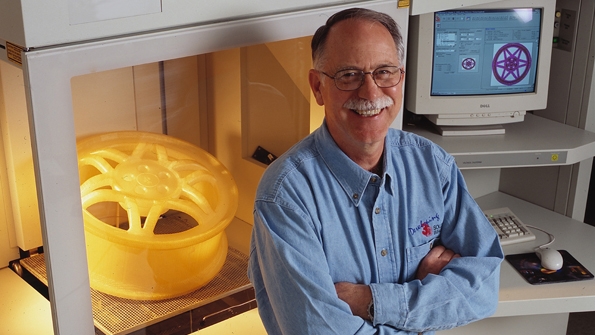
What if, he mused (probably with a dramatic flourish, in my imagination), instead of just coating things with this stuff, you could build an object layer by ultra-thin layer, from the ground up, using a focused beam of UV light?
The Big "Aha!" Moment: Stereolithography
This wasn't just a casual thought; this was the birth of Stereolithography (SLA). In essence, Chuck's brilliant idea was to have a vat of liquid photopolymer resin. Then, he'd use a UV laser to draw the shape of the first layer onto the surface of the liquid. Wherever the laser hit, the liquid instantly cured and solidified.
Once that layer was done, a platform would dip ever so slightly into the vat, allowing a fresh film of liquid resin to flow over the hardened layer. The laser would then draw the next cross-section, solidifying it onto the first. Rinse, repeat, thousands of times, and boom – you've got a solid 3D object emerging from a goo bath!
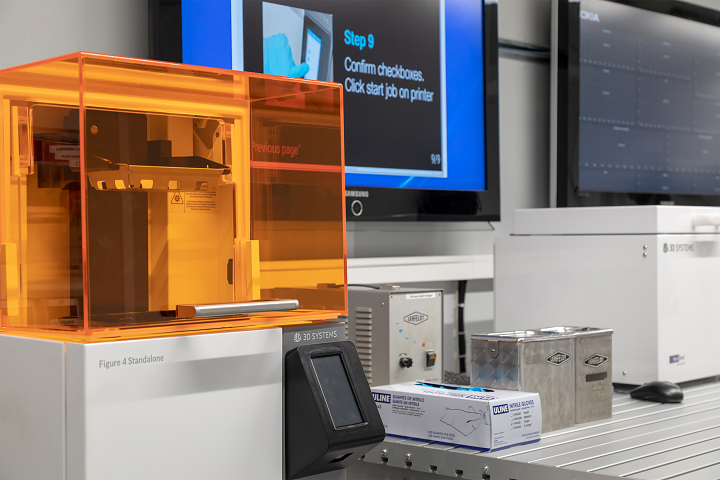
It sounds simple when you explain it over a latte, but trust me, at the time, this was pure wizardry. People were still using floppy disks, for crying out loud!
What Was The First Thing Printed? Prepare To Be Underwhelmed (And Amused!)
So, what magnificent, groundbreaking item did Chuck Hull conjure with his revolutionary new machine? Was it a scale model of the Eiffel Tower? A prosthetic limb? A miniature spaceship?
Nope. It was a tiny cup. A little, unassuming, probably slightly wonky, plastic cup. Not exactly the stuff of science fiction epics, right? It wasn't designed to hold your morning espresso, nor was it capable of surviving re-entry from space. But it was proof of concept, and for Chuck, it was probably the most beautiful tiny cup ever made.
Imagine the excitement! "Behold! My invention! It can make... a vessel for microscopic beverages!" It was a humble beginning, but every skyscraper starts with a single brick, right?
The Patent and 3D Systems
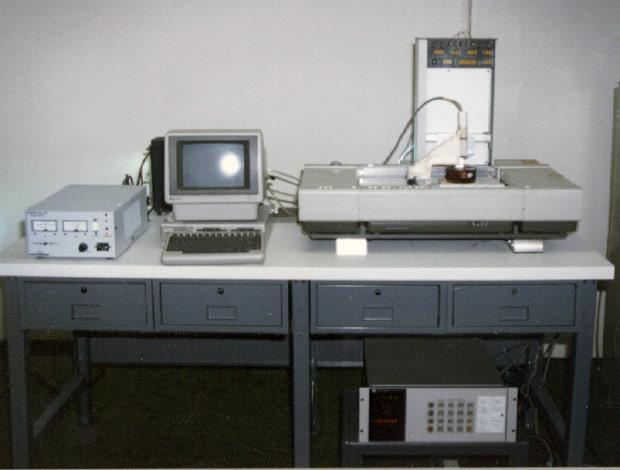
Chuck Hull filed his patent for "Apparatus for Production of Three-Dimensional Objects by Stereolithography" in 1984. Yes, you read that right. 1984! While everyone else was busy worrying about Big Brother and listening to Duran Duran, Chuck was laying the groundwork for a technological revolution.
A couple of years later, in 1986, he co-founded 3D Systems, the very first company dedicated to commercializing 3D printing technology. This wasn't just a hobby; this was serious business, even if the "tiny cup" felt a bit like a prank.
Why Was This a Big Deal?
The impact of Chuck's invention was monumental. Suddenly, engineers and designers didn't have to wait months for a physical prototype. They could send a digital design to a machine and have a physical model in hours or days. This wasn't just faster; it fundamentally changed the design process.
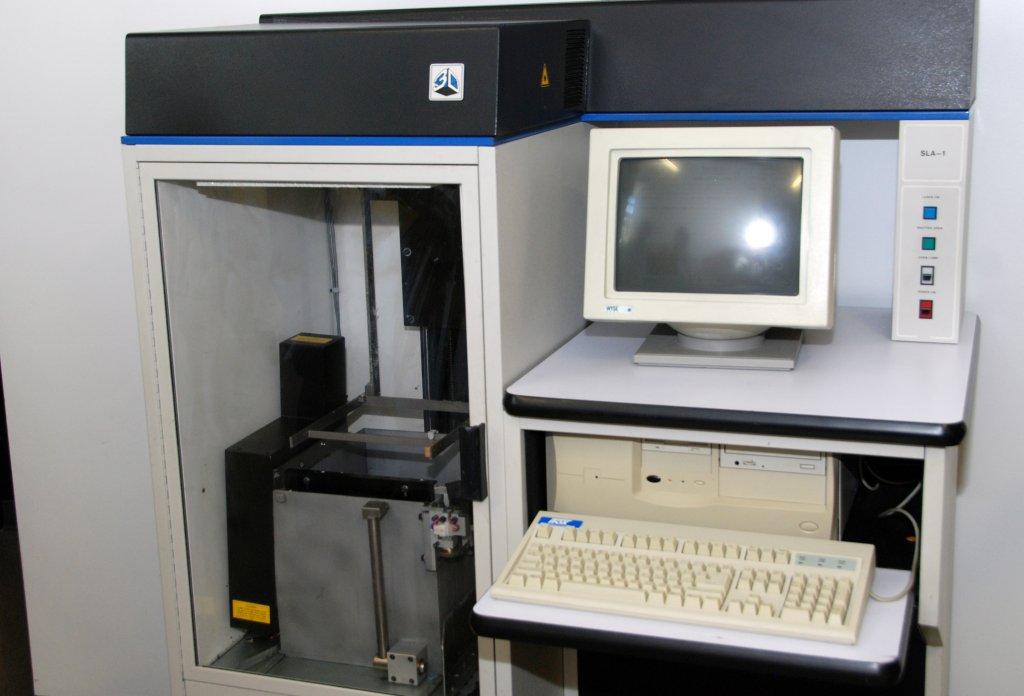
It meant faster iterations, lower development costs, and the ability to test complex designs much earlier. It basically hit the fast-forward button on innovation. Before Hull, building a prototype felt like an archaeological dig; after Hull, it was like instant gratification, albeit a bit slow by today's standards. Early machines were about as speedy as a sleepy snail trying to outrun molasses.
From Humble Cup to Space-Age Marvels
Of course, early SLA machines were big, clunky, and expensive. You couldn't just pop down to your local electronics store and pick one up. They were industrial behemoths, costing hundreds of thousands of dollars. But from that single, tiny, plastic cup and that flash of genius in the 80s, an entire industry was born.
Today, 3D printers are everywhere. They're making everything from custom dental implants and intricate jewelry to rocket parts and even entire houses. They're churning out replacement parts for classic cars and printing edible desserts. They've gone from zapping liquid goo to creating structures from metal, ceramics, and even living cells!
So, the next time you marvel at a complex 3D-printed object, spare a thought for Chuck Hull and his pioneering work. He didn't just invent a machine; he sparked a revolution, all starting with a tiny, probably slightly wobbly, but incredibly significant, first 3D-printed cup. Cheers to that, Chuck!