
What Size Generator To Run A 1500 Sq Ft House
Okay, let's talk generators. Specifically, generators for your humble 1500 sq ft abode. It's bigger than a breadbox, but smaller than a mansion, right?
And frankly, figuring out generator size can feel like deciphering ancient hieroglyphics. So many watts! So many amps! My brain hurts just thinking about it.
The Great Generator Guessing Game
Everyone seems to have an opinion. Your neighbor Bob, the self-proclaimed handyman? He'll swear you need a generator the size of a small car.
Must Read
Then there's your tech-savvy cousin, who thinks a tiny battery pack is all you require. Honestly, who do you believe?
Here's my unpopular opinion: most people overestimate their generator needs. Gasp!
Reality Check: What Do You Really Need?
Think about it. Do you actually need to run everything in your house simultaneously during a power outage? Probably not.
Are you going to be baking cookies, watching a 4K movie, and running the central AC all at the same time? I doubt it. Maybe one of the appliance, and you can just sit down and read.
Let's be honest. Most of us want to keep the fridge cold, maybe power a light or two, and charge our phones. Survival mode, not luxury living.
Watts Up, Doc? (The Math-ish Part)
Now, before you completely dismiss Bob's giant generator idea, let's talk watts. This is where things get slightly technical, but I promise to keep it simple.
Every appliance has a wattage rating. This tells you how much power it consumes. Usually, it's printed somewhere on the appliance itself.
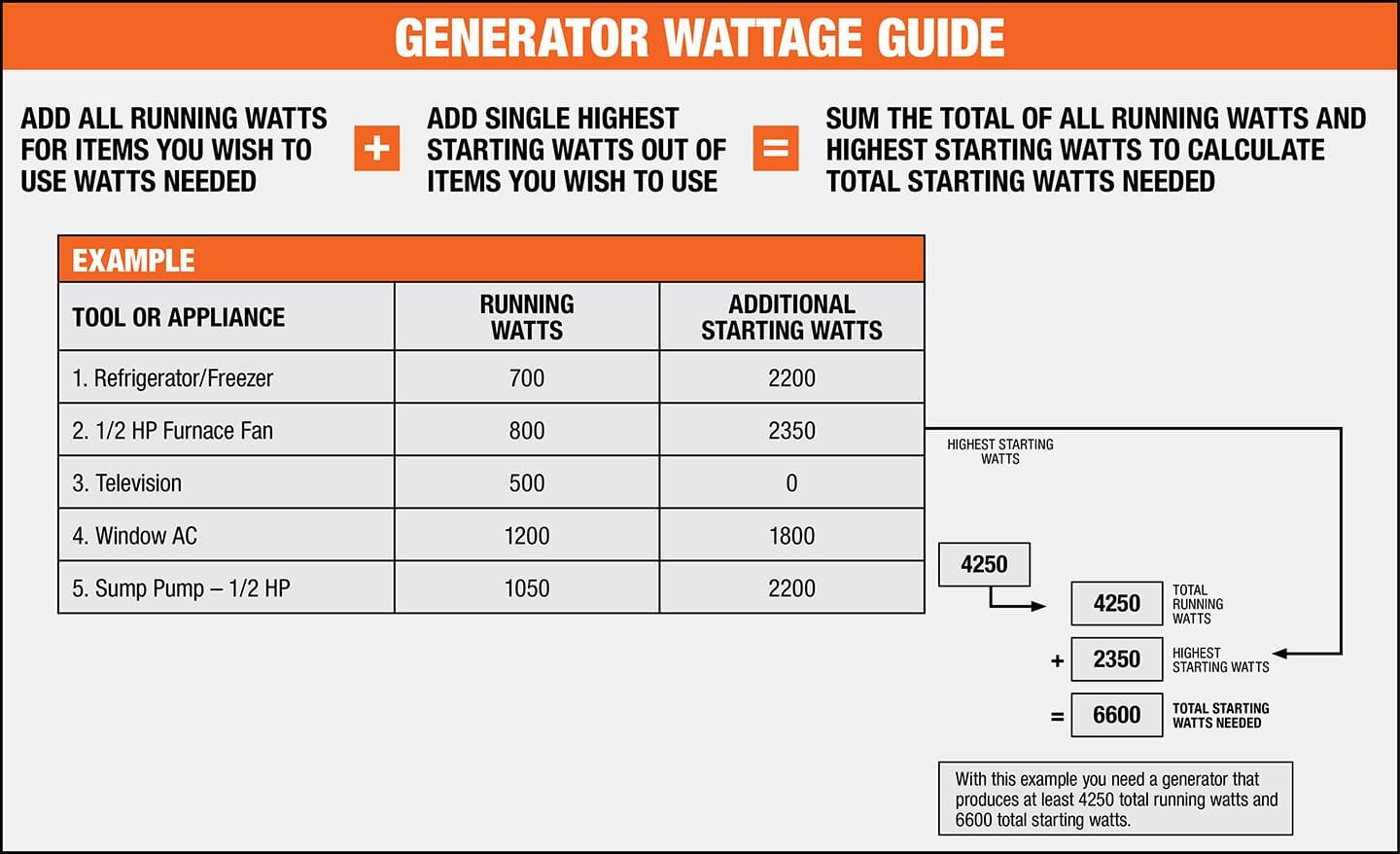
Add up the wattage of everything you absolutely need to run at the same time. This is your minimum generator size.

Example Time! (No Calculators Required... Mostly)
Let's say you want to run your fridge (600 watts), a couple of lights (100 watts each), and charge your phone (20 watts).
That's 600 + 100 + 100 + 20 = 820 watts. So, you'd need a generator that can handle at least 820 watts, plus a little extra for safety.
Most experts recommend adding a 20% buffer. So, 820 x 1.2 = 984 watts. Round it up to 1000 watts for good measure. See? Not so scary.
The "Starting Watts" Curveball
Ah, but there's a twist! Some appliances, like your fridge and air conditioner, require extra power to start up. This is called "starting watts."
Starting watts can be significantly higher than running watts. Your fridge might need 1800 starting watts, even though it only uses 600 watts while running.
Make sure your generator can handle the highest starting watt requirement of any appliance you plan to use. This is crucial.
Sizing It All Up: My (Possibly Wrong) Recommendation
Okay, drumroll please... For a 1500 sq ft house, focusing on essential needs, I'd suggest a generator in the 3000-4000 watt range.
This should be enough to cover your fridge, some lights, phone charging, and maybe even a small window AC unit, one at a time of course.
![What Size Generator for a 1500 Sq Ft Home? [2025 Guide] | Premier](https://www.premiergenerators.com/wp-content/uploads/sites/2/2024/12/iStock-2183674360.jpg)
But remember, this is just a general guideline. Your specific needs may vary. Consult with an electrician if you're unsure. Please.
Beyond the Watts: Other Things to Consider
Generator size isn't the only factor. Think about fuel type. Gas, propane, and diesel each have their pros and cons.
Gas generators are generally cheaper, but gasoline can be difficult to store long-term. Propane is more stable, but you'll need a propane tank.
Also, consider noise levels. Some generators are quieter than others. Your neighbors will thank you.
The Transfer Switch Debate
Want to avoid running extension cords all over your house? A transfer switch is your friend.
A transfer switch allows you to safely connect your generator directly to your home's electrical panel. It's a more convenient and safer option.
However, installation usually requires a qualified electrician. Safety first, always!
The Bottom Line (According to Me)
Don't get caught up in generator size hysteria. Assess your actual needs and choose accordingly.
![What Size Generator for a 1500 Sq Ft Home? [2025 Guide] | Premier](https://www.premiergenerators.com/wp-content/uploads/sites/2/2024/08/how-a-whole-home-generator.webp)
A smaller, more fuel-efficient generator might be all you need to weather most power outages. Think smart, not big.
And remember, Bob might be wrong. (Sorry, Bob.)
Unpopular Opinions, Part 2: Overkill is Overrated
I'm going to say it again: many people buy generators that are way too big for their needs.
They end up wasting fuel and money. It's like driving a semi-truck to pick up a loaf of bread. Excessive!
A smaller generator, used strategically, can be just as effective. Plus, it's easier to move around and store.
Generator Safety 101 (Seriously, Pay Attention)
Generators produce carbon monoxide, a deadly gas. Never run a generator indoors or in an enclosed space.
Always operate your generator in a well-ventilated area, away from windows and doors. Install carbon monoxide detectors in your home.
Read the generator's instruction manual carefully before using it. This is not optional.

Maintenance Matters: Keep Your Generator Happy
Generators need regular maintenance to keep them running smoothly. Check the oil level, clean the air filter, and replace the spark plug as needed.
Run your generator periodically, even when there's no power outage. This helps prevent fuel from gumming up the engine.
Treat your generator with respect, and it will treat you well in return.
The Future of Power: Battery Backup Systems
Okay, let's be real. Generators are a bit old-school. The future of backup power is battery-based systems.
These systems are quieter, cleaner, and more efficient than generators. They can even be paired with solar panels for a truly sustainable solution.
However, battery backup systems are still relatively expensive. But the price is coming down. Keep an eye on them.
So, What Size Generator is Right for You? (One Last Time)
After all that, the answer is... it depends! On your needs, your budget, and your tolerance for noise and fumes.
Do your research, consult with an electrician, and choose wisely. Don't let Bob bully you into buying a generator the size of a small car.
And remember, my unpopular opinion still stands: most people can get by with a smaller generator than they think. Good luck, and may your power always be on!