
What Size Charge Controller For 400w Solar Panel

So, you're thinking about harnessing the sun's power, eh? Good for you! Solar panels are like tiny, electricity-making wizards. And a 400w solar panel? That's a pretty decent wizard. But before you just slap that thing on your roof (or RV, or tiny house…), let's talk about the unsung hero of your solar setup: the charge controller.
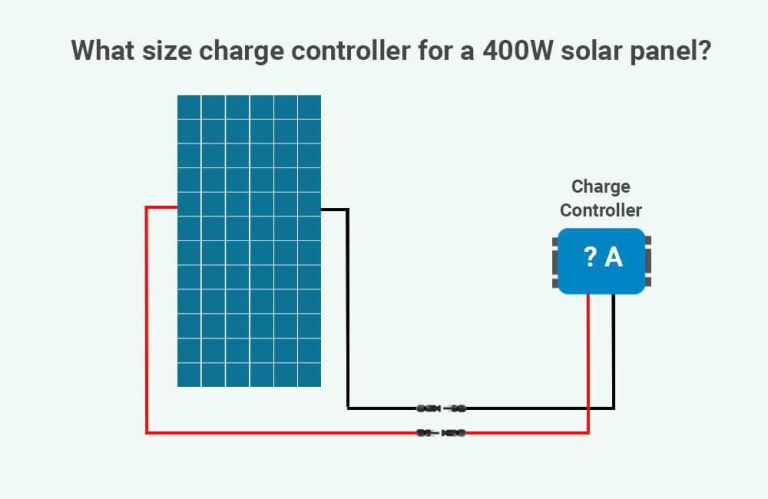
Now, the question on everyone's mind (or at least, the reason you clicked on this article): What size charge controller do I need for a 400w solar panel? Buckle up, buttercup, because it's not as scary as it sounds. And, dare I say, maybe even a little fun!
The (Slightly) Mathematical Part
Okay, deep breaths. We're going to use a little math. Just a teensy bit. The basic idea is that your charge controller needs to be able to handle the maximum current (amps) coming from your solar panel. Think of it like a bouncer at a club. You don't want him to let in more people than the club can handle, right?
Must Read
Solar panels have two important numbers: Voltage (V) and Amperage (A). We care mostly about amps. A typical 400w solar panel might have a voltage of around 40V and a current of around 10A. These numbers are usually printed on a sticker on the back of the panel. Go find yours! Don't worry, I'll wait.
Found it? Great! Now, here's the "calculation": Check the amps of your 400W panel. Then add a 25% safety margin. This is because solar panels can sometimes produce a little more power than they're rated for, especially on a super sunny day. So, if your panel is rated for 10 amps, 25% of that is 2.5 amps, meaning you're looking for a charge controller that can handle at least 12.5 amps.

So, in this example, a 15 amp charge controller would do the trick!
MPPT vs. PWM: The Plot Thickens (Slightly)
There are two main types of charge controllers: PWM (Pulse Width Modulation) and MPPT (Maximum Power Point Tracking). MPPT controllers are generally more efficient, especially with higher voltage panels. They're like the super-efficient accountants of the solar world. PWM controllers are simpler and cheaper, but less efficient, especially if there is shading on your solar panels.
For a 400w panel, especially if you're using a higher voltage panel, an MPPT controller is usually the way to go. It'll squeeze every last drop of power out of that sunbeam. Think of it as getting the most bang for your buck.

My Unpopular Opinion (Prepare Yourselves!)
Okay, here it comes. I think that when in doubt, it's better to oversize your charge controller. There, I said it! Hear me out. A slightly larger charge controller won't hurt anything. It just means you have some extra capacity if you ever decide to add another panel later on.
Think of it like buying a bigger suitcase than you need for a weekend trip. Sure, it might be a little overkill, but you'll be glad you have the extra space if you decide to buy a bunch of souvenirs (or, you know, add another solar panel to your system). Plus, a bigger controller usually runs cooler and lives longer.
But What About...? (Addressing Your Anxieties)
I know, I know. You're probably thinking, "But what if my battery voltage is different?" Or "What if I live on Mars?" (Okay, maybe not that last one.)
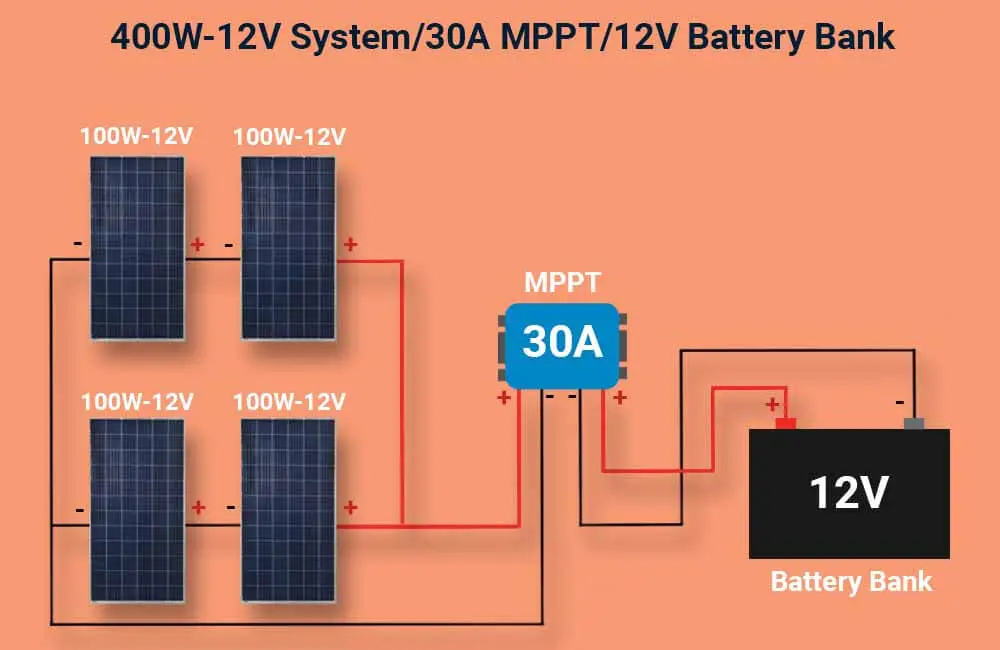
The good news is, most charge controllers can handle a range of battery voltages (12V, 24V, 48V, etc.). Just make sure the charge controller you choose is compatible with your battery bank. It's like making sure you have the right kind of plug for your phone.
And as for living on Mars... well, you're probably on your own with that one. But I'm sure there's a solar panel for that too!
The Bottom Line (Finally!)
So, to recap: For a 400w solar panel, start by checking the maximum current (amps) rating on the panel. Add a 25% safety margin. Choose an MPPT charge controller if possible, especially for panels with higher voltage. And don't be afraid to go a little bigger than you think you need.
Ultimately, choosing the right charge controller is about finding the right balance between cost, efficiency, and future-proofing. And remember, a little bit of sunlight goes a long way. Now go forth and conquer the sun!
And hey, if you're still feeling confused, don't hesitate to ask a professional. They're the Yoda of the solar world. May the solar force be with you!