
What Is The Past Tense For Tear

Ever found yourself pausing mid-sentence, scratching your head over a word that just feels right, but also completely wrong at the same time? Welcome to the wonderful, wild world of English homographs – words that look the same but might have vastly different meanings and, you guessed it, different past tenses! Today, we’re unraveling one of those delightful little linguistic puzzles: the past tense of tear.
Hold tight, because this one’s a bit of a two-for-one deal. The word "tear" is actually two distinct words, each with its own pronunciation and, therefore, its own journey into the past. Ready to dive in?
"Tear" as in To Rip (rhymes with "air")
Let's start with the action verb. When you're talking about pulling something apart, making a rip, or forcefully separating something, you're using "tear" pronounced with an "eh" sound, like you're saying "care" or "bear." Think about tearing a piece of paper, tearing down an old building, or even tearing up the dance floor (in a good way!).
Must Read
For this version of tear, it’s an irregular verb, which means it doesn't just add "-ed" to go back in time. Nope, it does its own thing, just like "sing, sang, sung" or "go, went, gone."
- Present Tense: tear
- Past Simple Tense: tore
- Past Participle Tense: torn
So, if you accidentally rip your jeans, you'd say, "Oops! I tore my jeans." If those jeans were already ripped, you'd say, "My jeans are torn." See how that works? Think of that classic idiom, "I was torn between two choices," meaning you were pulled in two different directions, much like something physically ripped apart.
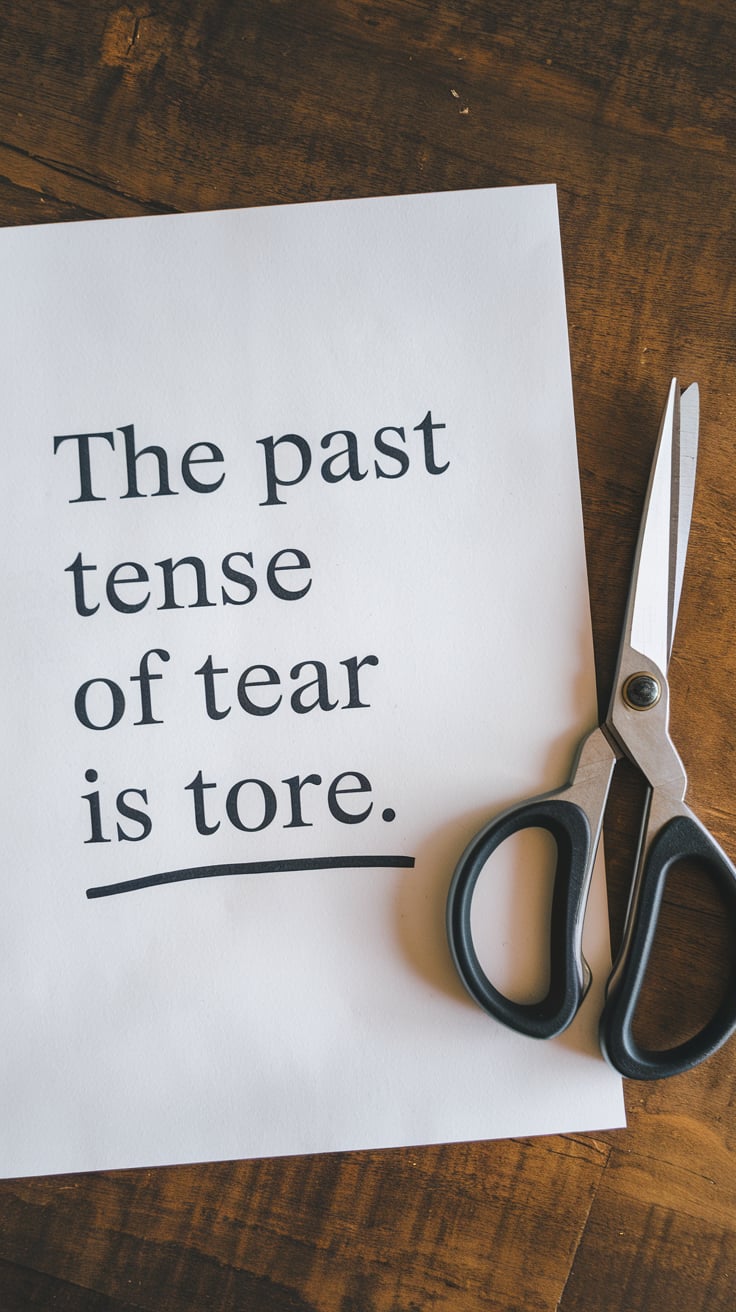
Fun Fact: The phrase "tear down the house" doesn't usually mean demolition (unless you're literally demolishing it). It often means to give an incredible performance that gets wild applause! You tore it down, you absolute superstar!
"Tear" as in A Droplet From the Eye (rhymes with "ear")
Now, let's switch gears. When you're talking about those salty drops that roll down your cheek when you're feeling emotional – happy, sad, or just chopping onions – you're talking about tears, pronounced with an "ee" sound, like "fear" or "dear."

Here’s the trick: this "tear" is primarily a noun. And nouns, my friend, don't have past tenses! A chair doesn't have a past tense, and neither does a tear-as-a-noun. What we do is use a verb with the noun to describe the action.
The most common verbs you'd use with "tear" (the noun) are "shed" or "cry."

- Present Tense (with a verb): I shed a tear / I cry tears.
- Past Simple Tense (with a verb): I shed a tear / I cried tears.
Notice "shed" is also an irregular verb, but its past tense is the same as its present: "shed, shed, shed." So, if you watched a super emotional movie last night, you might say, "That movie was such a tear-jerker; I shed a few tears!" Or, "After hearing the news, she cried tears of joy."
Practical Tip: The simplest way to remember the difference? Listen to the pronunciation! If it sounds like "air" (like a bear), it’s about ripping, and the past is tore or torn. If it sounds like "ear" (like a deer), it’s about crying, and you're likely talking about shedding or crying tears.

Why the Confusion? Blame English!
Seriously, English loves to keep us on our toes with words that look identical but have different sounds and meanings. It's a delightful quirk of our language, born from its rich history and blend of influences. Understanding this difference isn't just about acing a grammar quiz; it's about clear, confident communication.
So next time you're talking about ripping a band-aid off or feeling a little misty-eyed during a heartwarming commercial, you'll know exactly which "tear" you're dealing with and how to gracefully take it back in time.
Life, much like language, often presents us with situations that look similar but require different approaches. Sometimes we need to tear down old habits (tore them down yesterday!), and sometimes we shed tears of relief or growth (and we're better for it). Embracing these nuances, whether in words or in daily experiences, makes the journey all the more interesting. Keep exploring, keep learning, and don't be afraid to occasionally get a little torn figuring things out!