What Is The Least Common Multiple Of 8 And 18

Ever find yourself dividing up candies or planning a party and thinking, "There has to be a better way to make this even?" That's where a little mathematical magic called the Least Common Multiple (LCM) comes in handy! It might sound intimidating, but trust me, it's actually pretty cool, and even... fun! Let's explore the LCM of 8 and 18. What is it and why should you care?
The LCM is simply the smallest number that two or more numbers both divide into evenly. In our case, we want to find the smallest number that both 8 and 18 can divide into without leaving a remainder. Why is this useful? Well, imagine you're a baker making cupcakes. You want to arrange them in rows of 8 for one customer and in rows of 18 for another. What's the smallest number of cupcakes you can bake so that both orders can be fulfilled exactly? That's the LCM at work!
Knowing the LCM has some serious benefits. In education, it’s a crucial tool for working with fractions. When adding or subtracting fractions with different denominators, you need to find a common denominator, and guess what? The LCM is often the easiest common denominator to work with! This makes simplifying those pesky fraction problems much less of a headache. Think of it as finding the perfect "translator" between different fractional languages.
Must Read
In daily life, the LCM pops up in unexpected places. Consider planning a synchronized event. Suppose one alarm goes off every 8 minutes, and another every 18 minutes. When will they both go off together again? You guessed it – the LCM! This also extends to planning schedules, figuring out travel times, and even understanding repeating patterns in music.
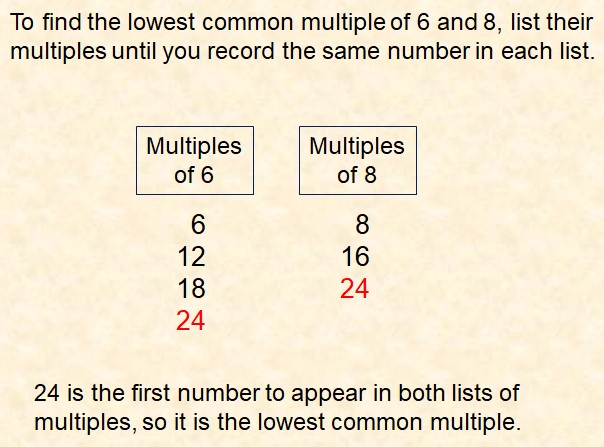
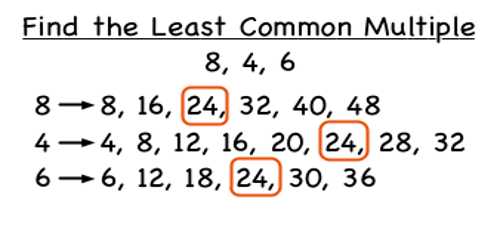
So, how do we actually find the LCM of 8 and 18? There are a couple of simple methods. One way is to list out the multiples of each number until you find a common one:
- Multiples of 8: 8, 16, 24, 32, 40, 48, 56, 64, 72, 80...
- Multiples of 18: 18, 36, 54, 72, 90...
Notice that 72 appears in both lists! This means 72 is a common multiple of 8 and 18. Is it the least common multiple? Yes! Therefore, the LCM of 8 and 18 is 72.
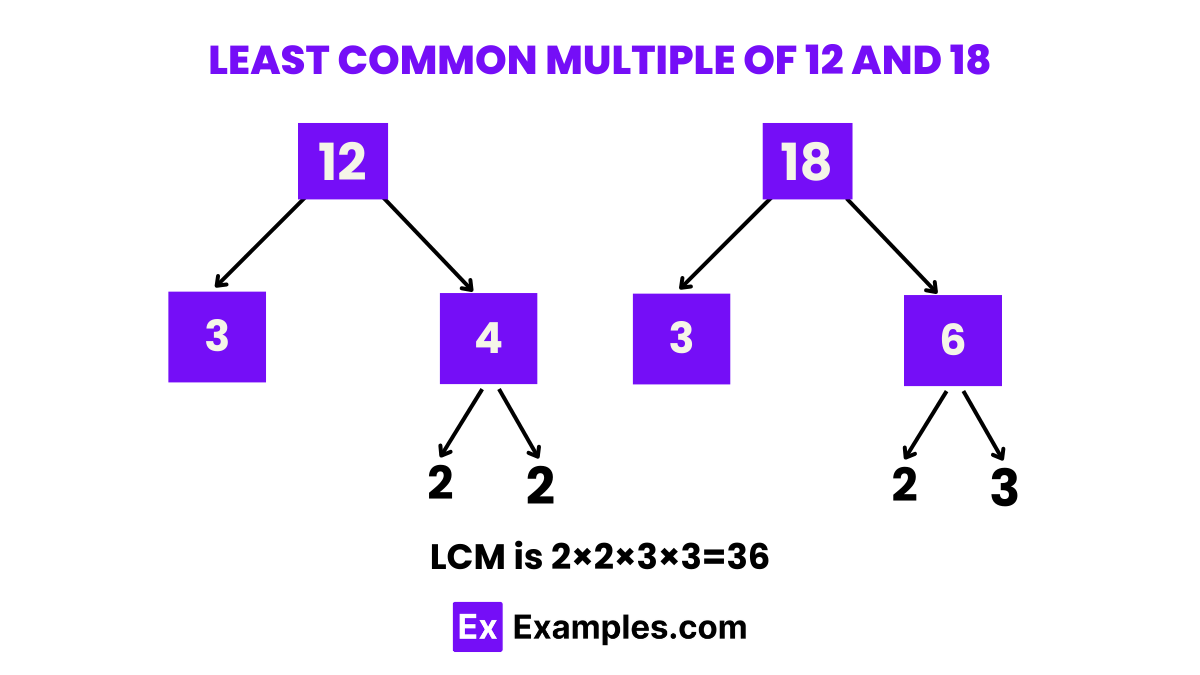
Another method, often considered more efficient for larger numbers, involves prime factorization. First, break down each number into its prime factors:
- 8 = 2 x 2 x 2 = 23
- 18 = 2 x 3 x 3 = 2 x 32
Then, take the highest power of each prime factor that appears in either factorization. In this case, we have 23 and 32. Multiply these together: 23 x 32 = 8 x 9 = 72. Again, we arrive at the same answer: the LCM of 8 and 18 is 72.
Want to explore further? Try finding the LCM of other pairs of numbers. Use online calculators to check your answers and experiment with different techniques. You can even apply the LCM to real-life scenarios. For instance, if you're tiling a floor with tiles of different sizes, the LCM can help you figure out the smallest area you can cover without having to cut any tiles. The possibilities are endless! So, embrace the power of the LCM – it's a surprisingly useful and fun mathematical concept!