What Is The Least Common Multiple Of 30 And 20
Alright, math enthusiasts (and math-curious folks!), let's dive into a concept that might sound a little intimidating but is actually super useful and, dare I say, even a bit fun: the Least Common Multiple, or LCM. We're going to tackle finding the LCM of 30 and 20, and trust me, by the end of this, you'll feel like a math whiz! Why is this fun? Well, it's like solving a puzzle! And why is it useful? Think about coordinating schedules, measuring ingredients, or even understanding how gears work. LCM pops up in all sorts of unexpected places.
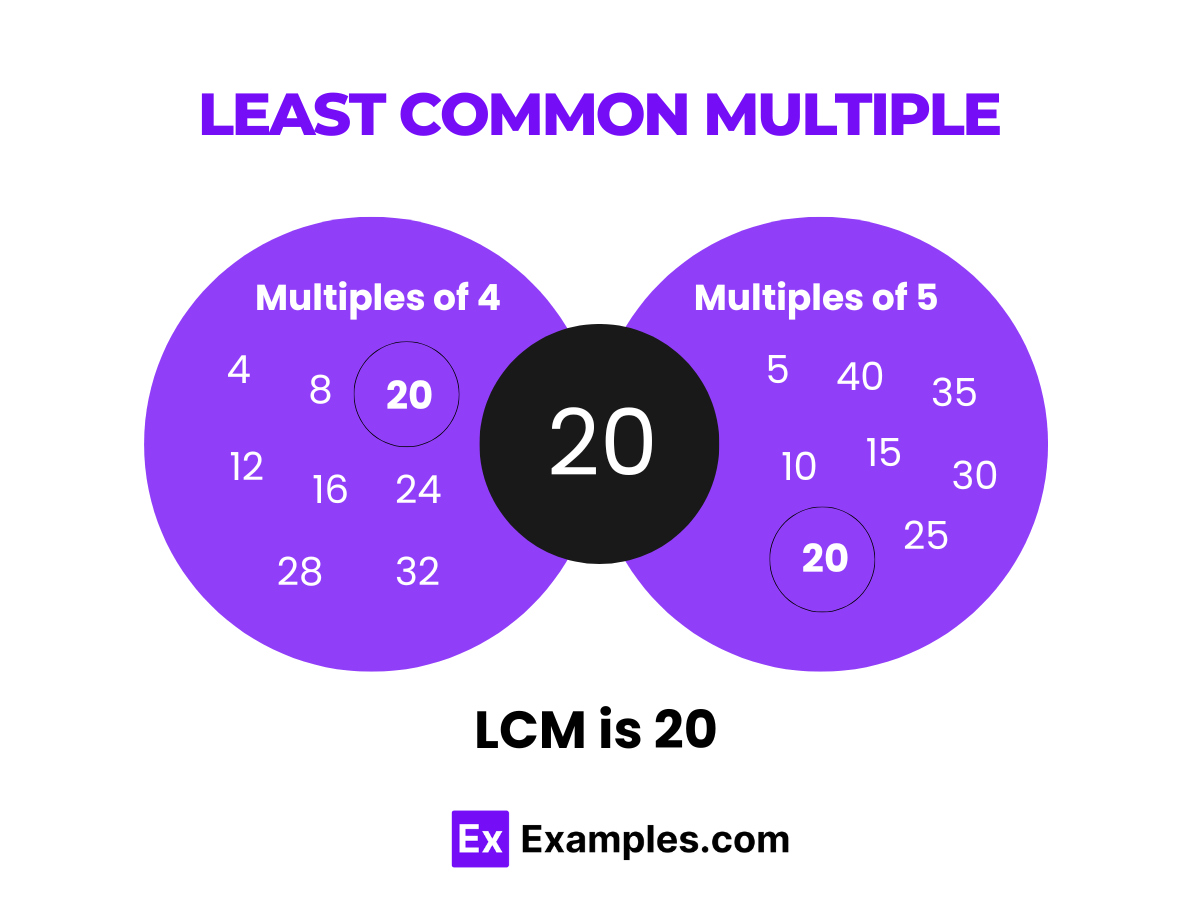
So, what exactly is the purpose of finding the Least Common Multiple? Simply put, it's the smallest number that both 30 and 20 divide into evenly. Imagine you're baking cookies. You want to make sure you have enough for everyone. Knowing the LCM helps you figure out the smallest batch size that will perfectly use up both bags of your favorite chocolate chips. Or picture planning a party where every third guest gets a red balloon and every fifth guest gets a blue balloon. The LCM will tell you which guest will be lucky enough to get both!
Now, for the benefits! Mastering the LCM opens doors to easier fraction calculations (adding and subtracting fractions becomes a breeze!), simplifies real-world problem-solving, and strengthens your overall understanding of number relationships. It's like a secret key that unlocks a whole new level of mathematical understanding.
Must Read
Okay, let's get down to business. How do we find the LCM of 30 and 20? There are a few methods, but we'll focus on two popular ones: listing multiples and prime factorization.
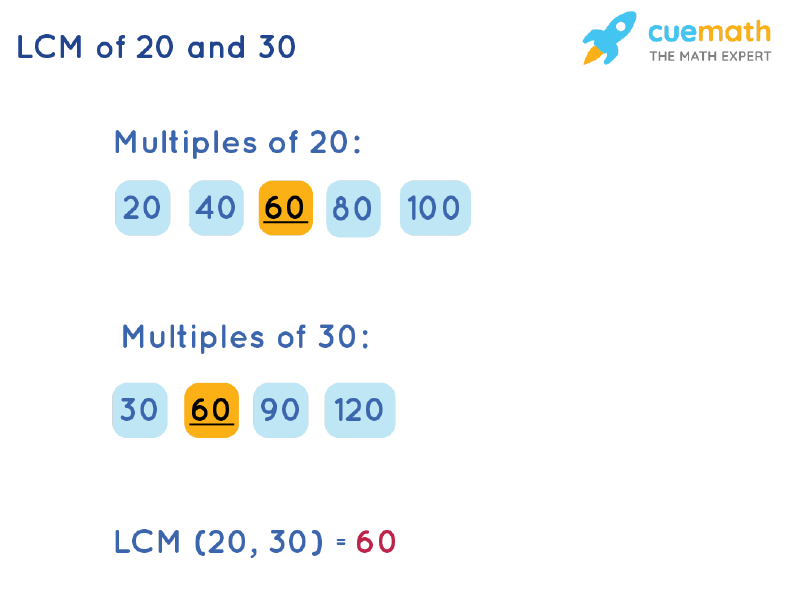
Method 1: Listing Multiples This is a straightforward approach. We simply list out the multiples of each number until we find a common one. * Multiples of 30: 30, 60, 90, 120, 150... * Multiples of 20: 20, 40, 60, 80, 100, 120... Aha! We see that both 30 and 20 share 60 as a multiple. And it's the smallest common multiple. So, the LCM of 30 and 20 is 60! This method is great for smaller numbers, but can become tedious with larger ones.
Method 2: Prime Factorization This method involves breaking down each number into its prime factors. Remember, prime numbers are only divisible by 1 and themselves (like 2, 3, 5, 7, etc.). * Prime factorization of 30: 2 x 3 x 5 * Prime factorization of 20: 2 x 2 x 5 (or 22 x 5) Now, to find the LCM, we take the highest power of each prime factor that appears in either factorization and multiply them together. * Highest power of 2: 22 (from 20) * Highest power of 3: 3 (from 30) * Highest power of 5: 5 (from both 30 and 20) So, LCM = 22 x 3 x 5 = 4 x 3 x 5 = 60. Again, we arrive at the same answer!
There you have it! The Least Common Multiple of 30 and 20 is 60. Whether you prefer listing multiples or prime factorization, understanding the concept of LCM is a valuable skill. So go forth, calculate those multiples, and conquer the world of math, one LCM at a time!