
What Is The Irradiance Of The Sun Dependent On

Ever walked outside on a summer day and thought, "Whoa, the sun's REALLY trying to bake me like a potato today"? Well, you're not wrong. The sun's intensity, or what scientists fancily call irradiance, isn't always the same. It's like your favorite coffee shop barista – some days they nail the latte art, other days it's... well, let's just say abstract.
So, what makes the sun decide how much sunshine-y goodness to fling our way? Think of it as a celestial dimmer switch. Here are the main knobs and dials controlling that solar brightness:
Distance Makes the Heart (and Irradiance) Grow Fonder (or Weaker!)
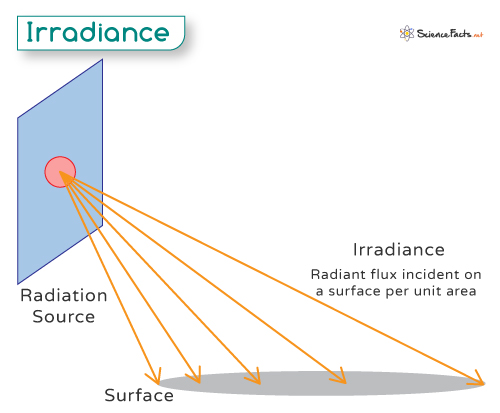
Imagine holding a flashlight. Shine it close to a wall, and you get a small, bright circle. Now back away. The circle gets bigger, but the light gets dimmer, right? That's because the same amount of light is spread over a larger area. Earth’s orbit around the sun isn't a perfect circle; it's slightly elliptical. This means sometimes we’re closer to the sun (perihelion) and sometimes further away (aphelion).
Must Read
When we're closer, BOOM! More intense sunlight. When we're further, it's a little more chill. Perihelion occurs around January 3rd and Aphelion around July 4th. That's why, even though the Northern Hemisphere experiences winter in January (being tilted away from the sun), we’re technically closer to the sun than in July. The difference in distance is only a few percent, so it doesn’t dramatically affect seasonal temperatures, but it does have a measurable impact on irradiance.
Angle of Incidence: It's All About the Tilt!
Think about lying on the beach. When the sun is directly overhead (high noon!), it feels way more intense than when it's low on the horizon in the late afternoon, right? That's the angle of incidence at play. When the sun's rays hit the Earth perpendicularly, the energy is concentrated on a smaller area. It's like focusing all your anger into a single, powerfully worded email versus scattering it around in a bunch of passive-aggressive sticky notes.

When the sun’s at an angle, the same amount of energy gets spread across a larger area. Plus, the sunlight has to travel through more of the atmosphere, which means more of it gets absorbed or scattered. That's why sunrises and sunsets are so pretty (all that scattered blue light is gone!), but they don't exactly give you a sunburn.
Atmospheric Interference: Cloud Cover is Your Friend (Sometimes)
Our atmosphere is like a bouncer at a really exclusive sunbeam party. It lets some rays in, but it blocks or scatters others. Clouds are particularly good at this. Ever noticed how much cooler it gets when a cloud passes in front of the sun? That's because the cloud is reflecting a good chunk of the sunlight back into space.
Pollution, dust, and even volcanic ash can also affect how much sunlight reaches the surface. After a major volcanic eruption, the amount of solar radiation reaching Earth can decrease for years. It’s like Mother Nature throwing a giant, smoky blanket over the planet.
Sunspots and Solar Flares: The Sun's Occasional Mood Swings
The sun itself isn't perfectly consistent. It has sunspots, which are cooler, darker areas on its surface, and solar flares, which are sudden bursts of energy. These phenomena are part of the sun's solar cycle, which lasts about 11 years. During periods of high solar activity, the sun emits slightly more energy, increasing irradiance.

Think of it like the sun having a bit of a temper tantrum every decade or so. It gets a little extra fired up, and we feel it down here on Earth. However, these variations are relatively small compared to the effects of distance and angle.
Putting It All Together
So, the next time you’re basking in the sun (or hiding from it!), remember that the irradiance you're experiencing depends on a combination of factors. It’s a cosmic dance between distance, angles, atmospheric conditions, and the sun's own internal activity. And just like that complicated coffee order you're trying to explain to the barista, it's a delicate balance of variables that determines just how sunny your day will be.
Keep slathering on that sunscreen! Stay sun-smart! And remember, the sun is always watching, even when it’s hiding behind a cloud.
