
What Is The Difference Between Stress And Strain

Ever tried squeezing a stress ball until your knuckles turned white? Or maybe you've stretched a rubber band until you feared for its life? You, my friend, have encountered both stress and strain, even if you didn’t realize it!
Think of them as two mischievous partners in a physics dance, forever intertwined but playing distinct roles.
Stress: The Internal Grumble
Imagine you're a perfectly stacked tower of cookies. Delicious, right? But then your little cousin comes along and starts poking at it.
Must Read
That poking – that's the external force. Stress is the internal grumbling the cookies feel as they resist being toppled over!
It's the force inside an object that’s resisting whatever is trying to change its shape.
Different Flavors of Grumbling
This internal grumbling comes in different flavors. There's tensile stress, like when you're gently (or not-so-gently) pulling apart a piece of taffy. It’s like the taffy yelling internally "No! I want to stay together!"
Then there's compressive stress, like when you’re squishing Play-Doh. The Play-Doh is grumbling internally "Stop! I don't want to be flat!"
And let’s not forget shear stress, think of using scissors to cut paper. The paper internally screams "You're tearing me apart!!"
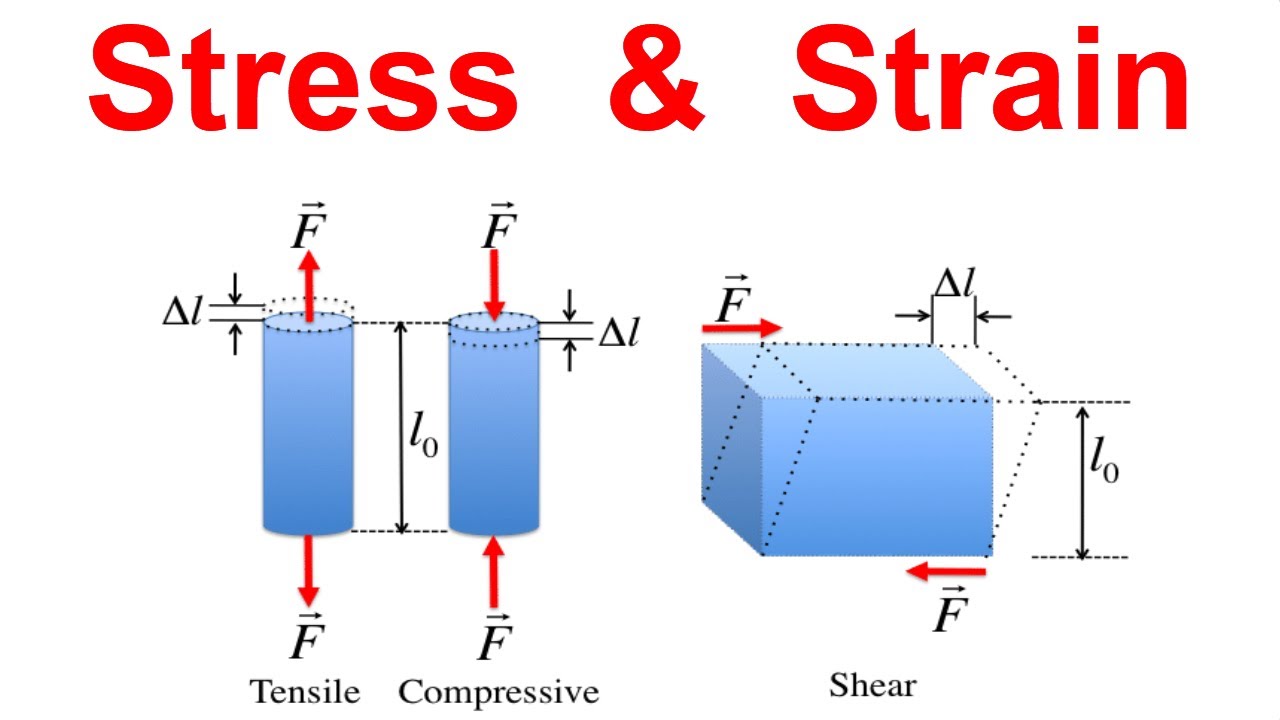
Strain: The Actual Change
So, the cookies are grumbling… but what happens next? Does the tower stay perfectly upright, or does it lean precariously, threatening a crumbly avalanche?
That leaning, that change in shape, that's strain. It's the visible result of the stress. It's what actually happens to the object.
It's the deformation, the stretching, the squishing, the bending, the breaking – all thanks to the force causing stress.
Measuring the Change
Strain is often expressed as a percentage. If you stretch a rubber band from 10 cm to 12 cm, the strain is 20% (2 cm change / 10 cm original length).
It's a way of quantifying just how much the object has changed shape compared to its original shape.
![Stress and Strain: Definition, Formula,Types in detail, [Notes & PDF]](https://themechanicalengineering.com/wp-content/uploads/2020/04/STRESS-STRAIN-CURVE.jpg)
The Hilarious (and Sometimes Heartbreaking) Relationship
Here's where things get interesting. Stress and strain are directly related. The more stress you apply, the more strain you’ll generally see... up to a point.
Think of it like trying to convince your cat to take a bath. The more you insist (stress), the more the cat squirms (strain) – until it finally snaps and unleashes its inner demon (failure!).
Everything can only take so much before it gives! This "giving" or breaking point is when the stress becomes too much for the object to handle, resulting in catastrophic strain.
Elasticity vs. Plasticity: The Bounce Back
Some materials are like really forgiving friends. You can stretch them, bend them, even mildly abuse them, and they bounce right back to their original shape. This is called elasticity.
Think of a good quality spring. It can handle being compressed and extended many times without changing its overall properties.

Other materials are less forgiving. They get bent out of shape and stay that way. This is called plasticity.
Imagine bending a paperclip. It won't return to its original shape!
Why Should We Care?
Okay, so we've got grumbling cookies and bath-hating cats. Why is this stress and strain business actually important?
Because it’s everywhere! Understanding these concepts helps engineers design bridges that don’t collapse, airplanes that don’t fall apart, and even comfy chairs that don’t sag after a week.
Even our bodies are constantly dealing with stress and strain. Our bones withstand compressive stress when we stand, and our muscles experience tensile stress when we lift something.

Stress & Strain in Everyday Life
Ever wonder why a glass shatters when dropped, but a rubber ball bounces? It all comes down to their ability to handle stress and strain.
The glass reaches its breaking point very quickly. The rubber ball can deform and return to its original shape.
Think of a building during an earthquake. Engineers design buildings to withstand specific amounts of stress and strain to ensure they remain standing.
A Final Thought
So, the next time you're feeling stressed, remember the difference between stress and strain. You are feeling stress! Hopefully, you are not showing too much strain!
And maybe, just maybe, appreciate the hidden physics at play in even the simplest of everyday actions.
Because everything, from the sturdiest skyscraper to the humblest cookie, is constantly dancing with stress and strain.