
What Is The Difference Between Pla And Petg
So, you're diving into the awesome world of 3D printing! That's fantastic! Get ready to create everything from tiny figurines to… well, slightly larger figurines. You'll quickly encounter two main contenders in the filament arena: PLA and PETG.
Think of them as the peanut butter and jelly of the 3D printing world. Both are popular, but wildly different in personality.
PLA: The Eco-Friendly Goody-Two-Shoes
PLA, or Polylactic Acid, is the responsible, earth-loving filament. It's derived from renewable resources like cornstarch or sugarcane. Basically, you're printing with… food. (Don't actually eat it, though!).
Must Read
This makes it biodegradable under specific industrial composting conditions. So, in theory, your failed prints won't haunt the planet forever. Though, your guilty conscience might still linger.
Pros of PLA: Easy Printing and Smells Like... Pancakes?
One of the biggest perks of PLA is how darn easy it is to print with! It's like the training wheels of 3D printing. It loves low temperatures and doesn't demand a heated bed (though it appreciates one).
Plus, it's far less prone to warping than some other filaments. Warping is when your print lifts off the build plate mid-print, turning your masterpiece into a sad, banana-shaped blob.
And the smell? Oh, the smell! Some say it smells like sweet candy or even… pancakes! Forget air fresheners; just start a print!

Cons of PLA: Heat Sensitivity and Structural Weakness
Okay, PLA isn't perfect. It's got a bit of a weakness for heat. Leave a PLA print in a hot car, and you might come back to find it has transformed into a modern art sculpture – unintentionally.
Imagine printing a phone stand, only to have it slowly melt and droop on a sunny day. Tragic!
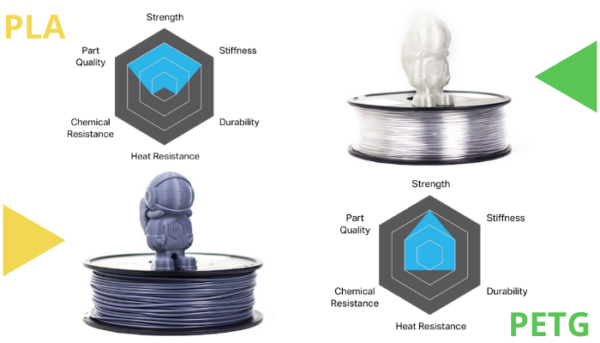
It's also not the strongest material. PLA is more brittle than PETG. Think of it like this: PLA is like a dry spaghetti noodle, while PETG is like a slightly bendy, cooked one.
Great for decorative items, not so great for anything that needs to withstand a lot of stress. PLA would fail you in the apocalyptic world. I can feel it.
PETG: The Tough and Reliable All-Star
Now, let's talk about PETG, or Polyethylene Terephthalate Glycol-modified. Say that five times fast!

This filament is the cooler, more resilient sibling of PLA. It's known for its strength, flexibility, and resistance to temperature changes. It's the action hero of the 3D printing world.
Think of it as the material you'd use to print a case for your Raspberry Pi that you plan to launch into space (okay, maybe just a slightly less ambitious project).
Pros of PETG: Strong, Flexible, and Heat-Resistant
PETG is significantly stronger than PLA. It can handle more stress and impact without breaking or shattering. You can print functional parts, like brackets, gears, or even drone components.
It also boasts much better heat resistance. It can withstand higher temperatures without deforming. Your prints won't melt into puddles on a sunny windowsill. Hooray!
Plus, PETG is more flexible than PLA, making it less prone to cracking under stress. It can bend a bit without snapping. Like a well-trained gymnast, or at least someone who can touch their toes after stretching.
Cons of PETG: Printing Challenges and Stringing
PETG can be a bit more finicky to print with than PLA. It requires higher temperatures and often a heated bed. It's like dating someone who needs a specific type of coffee every morning - high maintenance!
It's also prone to something called "stringing." This is when thin strands of filament are left behind as the print head moves between points, creating a cobweb-like effect. Imagine your prints suddenly becoming haunted with a very poor ghost.
Stringing can be minimized with proper settings and retraction adjustments. But, be prepared to spend some time tweaking your printer settings to get perfect PETG prints.
The Showdown: PLA vs. PETG - Which One Wins?
So, which filament is the ultimate champion? It depends on what you're printing! There's no single "best" filament.
Choose PLA for: Quick and easy prints, decorative items, prototypes, and anything where heat resistance and strength aren't critical. Think cute figurines, cookie cutters, or a stand for your rubber duck collection.
Choose PETG for: Functional parts, items that need to withstand stress or heat, outdoor projects, and anything requiring more durability and flexibility. Think phone cases, robot parts, or replacement knobs for your oven (but check the actual heat requirements first!).
Basically, if you're printing something that needs to survive the apocalypse, go with PETG. If you're printing something cute to sit on your desk, PLA will do just fine.
Ultimately, the best way to learn is to experiment! Buy a roll of each filament, try different settings, and see what works best for your printer and your projects. Don't be afraid to make mistakes; that's how you learn. Just try not to set the house on fire.
And remember, have fun! 3D printing is an amazing hobby, so embrace the process, be patient, and enjoy the satisfaction of creating something awesome. Happy printing!