What Is The Difference Between A Condo And Townhome
Alright, settle in, grab another imaginary latte, because we're about to untangle one of real estate's greatest head-scratchers: the difference between a condo and a townhome. Seriously, it's like trying to tell apart identical twins who occasionally swap wardrobes. Most people just shrug and say, "One's an apartment-y thing, the other's a mini-house, right?" And while that's not entirely wrong, it's also not entirely right. It's like saying a cat is just a small, furry dog. Close, but the details matter!
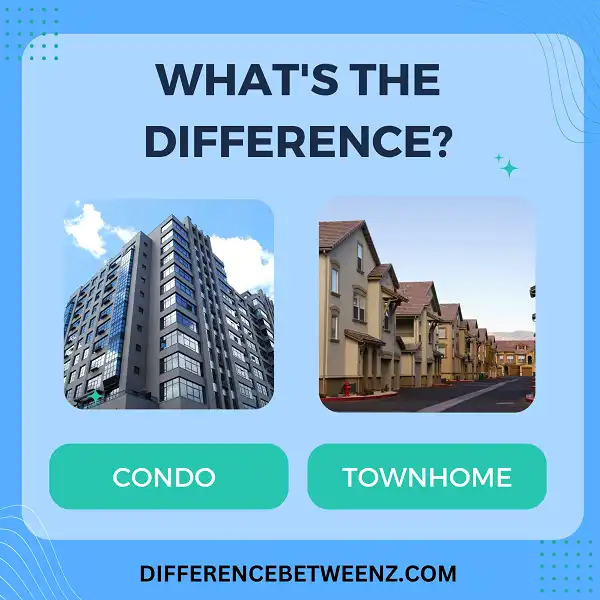
Let's kick things off with the one that feels like living in a very fancy, grown-up dorm: the condominium, or condo for short. When you buy a condo, you're not just buying a space, you're buying the airspace within your specific unit. Picture this: everything from the paint on your walls inward, and sometimes even the drywall itself. It's like buying a really cool, pre-decorated box in a much bigger building. You're the proud owner of that box, but the walls, the roof, the foundation, the lobby where you pretend you're a spy, the gym where you occasionally pretend to work out – that's all shared.
This shared goodness (and occasional headache) is managed by a Homeowners Association (HOA). And let me tell you, HOA fees are where the magic, and sometimes the mystery, happens. These fees cover the maintenance of all those common areas. We're talking landscaping, pool cleaning, roof repairs, building insurance, and sometimes even the heating of the infinity hot tub you never use. It’s like having a team of tiny, incredibly efficient ninjas keeping the exterior pristine, so you never have to wrestle a leaf blower again. The downside? You generally need permission to, say, paint your front door neon purple, because it affects the overall aesthetic. Your personal style might have to take a back seat to the HOA's vision of tasteful beige.
Must Read
Now, let's pivot to the townhome. Ah, the townhome. It often looks like a cute, individual house that just happens to be holding hands with its neighbors. Visually, this is where the confusion really sets in! Most townhomes are multi-story, have their own private entrance, and often come with a tiny patch of grass – just enough for a very confused squirrel to bury one nut. The crucial difference here, the big juicy secret, is about what you actually own.
When you buy a townhome, you typically own the structure itself (your particular unit, from the roof down to the foundation) and the small plot of land it sits on. Yes, that little postage stamp of a yard? That's yours! You're not just buying the airspace; you're buying the dirt beneath your feet. This means you might be responsible for things like repairing your own roof, maintaining your own mini-yard, or cleaning your own gutters. Suddenly, those leaf blowers look less like a distant memory and more like a potential Saturday morning activity. Townhomes also usually have an HOA, but their fees tend to be lower and cover less, focusing on shared roads, common recreational areas, or maybe exterior painting that is uniform.

But here's where it gets truly wild, like a plot twist in a low-budget indie film: the biggest difference isn't about what the property looks like at all. It's about the legal ownership structure. You see, "condominium" isn't just a type of building; it's a form of ownership. Any type of structure can be a condo! Think about it: you can have apartment-style condos, yes, but you can also have townhome-style condos. You can even have detached single-family houses that are legally structured as condos! Mind. Blown.
This means you could walk into a beautiful, two-story unit with its own private entrance and a tiny backyard, and think, "Aha! A townhome!" But then you look at the deed, and it clearly states, "Condominium." In this scenario, you still own just the interior air space, and that little yard might be a limited common element that you have exclusive access to, but don't technically own. You're still part of that grand condo association, paying for the shared roof, the shared foundation, and maybe even the shared feelings of mild frustration when your neighbor plays their music too loud.

So, the next time you're house hunting and the terms are flying around, remember this golden rule: don't judge a property by its architectural cover. If you see a multi-story unit that shares walls, don't automatically label it. To truly know the difference, you have to dig into the deed and the legal documents. That's where the truth hides! Is it a "condo regime," where you own air and share all the major structural elements? Or is it a traditional townhome, where you own the structure and the little patch of earth beneath it?
Ultimately, both condos and townhomes offer unique living experiences, often a great way to own property without the full-on responsibility of a detached single-family home. Just remember, a townhome can secretly be a condo, and a condo might just be a very spacious, multi-level box. The world of real estate, much like a good café conversation, always holds a few surprises!