What Is The Charge On Manganese

Ever gazed at the periodic table and wondered what makes each element tick? It's like a grand cosmic family album, full of diverse characters. Today, let's zoom in on one fascinating member: Manganese, or Mn for short. You might not think much about it, but understanding its "charge" is a surprisingly fun gateway into how the world around us works, from the batteries in your remote to the very enzymes in your body!
So, what exactly is the charge on manganese? Well, here's where it gets interesting – it's not just one thing! Unlike some elements that prefer a single, predictable charge, manganese is a bit of a chameleon. Its charge, also known as its oxidation state, tells us how many electrons an atom has gained or lost when it forms a chemical bond. This electron dance is crucial because it dictates how an element behaves, what other elements it can bond with, and what kind of compounds it creates. Think of it as an element's "mood" or "personality" when interacting with others. Knowing this helps us predict chemical reactions, understand material properties, and even explore biological processes.
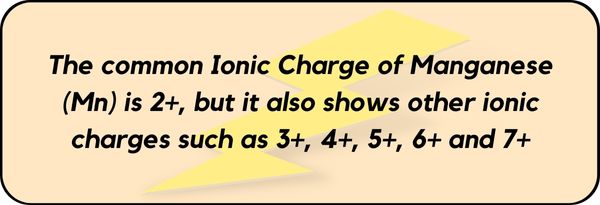
The beauty of manganese lies in its versatility. It can exhibit a wide range of charges, most commonly from +2 to +7. Why does this matter in our daily lives or education? In the classroom, manganese is a fantastic teaching tool for demonstrating concepts like redox reactions (where electrons are transferred) and balancing chemical equations. Its various oxidation states lead to dramatically different colors – from the pale pink of Mn²⁺ in solution to the deep purple of Mn⁷⁺ in potassium permanganate, a powerful antiseptic and dye. This visual transformation makes chemistry come alive!
Must Read
Beyond textbooks, manganese plays vital roles. For instance, in your alkaline batteries, you'll find manganese dioxide (MnO₂), where manganese is happily sporting a +4 charge. This compound is essential for the battery's energy production. As a trace mineral, manganese is crucial for human health, often found as Mn²⁺ ions, helping enzymes function properly in our bodies. It’s also used to strengthen steel alloys and as a pigment in ceramics. Each of these applications leverages a specific "charged" version of manganese, tailored for its particular job.
Want to explore this fascinating aspect yourself? Start by looking up manganese on an educational chemistry website. You'll often see lists of its common oxidation states. Next time you change batteries, remember the manganese working inside! Or, if you ever come across a brightly colored chemical solution in a science demo, like a vibrant purple, there’s a good chance it might be a manganese compound with a high oxidation state. It's a reminder that even something as seemingly abstract as an "ionic charge" is a fundamental principle underpinning so much of the world around us, just waiting for your curious mind to uncover its secrets!