
What Is A Fillet In Engineering

Alright, gather 'round, curious minds! Today, we're diving into a super cool, often-overlooked little hero in the world of engineering. It's something you see everywhere, something that makes our lives safer, stronger, and smoother, but you probably don't even know its name. Prepare to meet the mighty, the magnificent, the utterly essential: a fillet!
What in the world is a Fillet?
Now, if you're thinking of a delicious piece of boneless fish, you're not entirely wrong about the shape idea, but we're taking a sharp turn (pun intended!) into the realm of gadgets, gizmos, and gigantic structures. In engineering, a fillet is simply a fancy word for a rounded corner or edge. That's it! Instead of two surfaces meeting at a crisp, pointy 90-degree angle, they're gracefully curved, like a gentle slope easing between two cliffs.
Imagine your smartphone. Hold it. Feel those smooth, comfortable edges? Those, my friend, are glorious fillets at work! Or that sleek desk you're using, its corners aren't jagged enough to poke an eye out, are they? Thank the humble fillet!
Must Read
Why Do Engineers Love Fillets So Much? (Hint: It's Not Just for Looks!)
You might think, "Why bother? A sharp corner is easier to make, right?" And you'd be partly correct! But engineers aren't just about 'easy.' They're about 'awesome,' 'durable,' and 'not falling apart at the worst possible moment.' And that's where the fillet truly shines. It’s like the unsung superhero of structural integrity, battling against an invisible menace called stress concentration.
The Arch-Nemesis: Stress Concentration!
This is the big one. Picture a piece of paper. Now, try to tear it from the middle of an edge – it's a bit tough, right? Now, make a tiny V-notch in that edge. Suddenly, with just a little tug, Rrrrip! The paper tears easily from that notch. That little notch acted like a magnet for all the tearing forces, concentrating them into one tiny, vulnerable spot.

"Sharp corners are like stress magnets, pulling all the bad vibes to one tiny, breakable spot!"
That's exactly what happens in metals, plastics, wood, and virtually any material! A sharp internal corner in a component (like where the arm of a chair meets the back) is a hotspot where all the forces pushing and pulling on the object pile up. It's like having a bunch of people trying to get through one tiny door – congestion! This "stress concentration" makes the part much weaker at that precise point, making it prone to cracks, deformation, and eventual catastrophic failure.
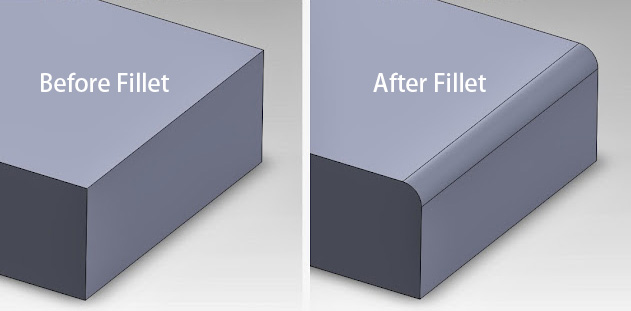
How Fillets Save the Day:
- Strength Supercharge: By rounding that corner with a fillet, engineers give those stresses a nice, smooth curve to distribute themselves along. Instead of everyone trying to squeeze through one tiny door, it’s like opening up a wide, inviting archway. The forces spread out, reducing the pressure at any single point, and making the entire component dramatically stronger and more resistant to breaking, cracking, or fatigue. It’s the difference between a flimsy stick that snaps easily and a sturdy, well-designed beam!
- Safety First (and Second, and Third!): Okay, this one's obvious! No one wants a pointy bit sticking out of their car dashboard, their kitchen appliance, or their kids' toys. Fillets remove those nasty sharp edges, making products safer, more comfortable to handle, and less likely to cause an "oopsie!" bump or scrape.
- Manufacturing Marvel: Believe it or not, sometimes fillets make things easier to manufacture. They can reduce tool wear and allow for smoother transitions in casting or molding processes. Plus, things just look better when they're smooth and intentional, don't they?
- Aesthetics with an "A+": Beyond the technical wizardry, fillets just look good! They give products a sleeker, more finished, and more appealing appearance. From the elegant curve of a modern bridge to the seamless design of your laptop, fillets contribute heavily to that polished look we all love.
Where Do Fillets Live? Everywhere!
Now that you know what to look for, you'll start seeing fillets absolutely everywhere!
- Look at the connection points on a sturdy metal shelf.
- Examine the joins inside the plastic casing of your TV remote.
- Feel the handle of a high-quality tool.
- Even the internal junctions of engine parts in your car rely heavily on meticulously designed fillets to withstand incredible forces without failing.
So, the next time you pick up a smooth, well-made product, give a little nod to the humble, yet incredibly mighty, fillet. It's a testament to the clever thinking of engineers who turn sharp problems into gracefully strong solutions. And that, my friends, is why a little curve can make a world of difference!
![What Is A Fillet Weld? [All You Need To Know] - Structural Basics](https://www.structuralbasics.com/wp-content/uploads/2023/09/Fillet-weld-1024x585.jpg)
![What Is A Fillet Weld? [All You Need To Know] - Structural Basics](https://www.structuralbasics.com/wp-content/uploads/2023/09/Fillet-weld-notation.jpg)