
What Does Fossil Fuel Come From

You know that feeling when you're at the gas station, the pump is clicking away, and you watch those digits climb faster than your anxiety on a Monday morning? Or maybe you flip a light switch, and poof, there's light! We use so much energy every day, powering our cars, charging our phones, heating our homes. But have you ever stopped for a second and really, truly wondered: where on Earth does all this stuff actually come from?
I mean, it's not like there's a giant fossil fuel factory humming away somewhere, churning out gasoline and coal, right? Nope. The answer, my friend, is far more dramatic, far older, and honestly, a little bit mind-blowing. We're talking about a story that spans millions of years, involving ancient life, a lot of dirt, and immense pressure. Buckle up, time travelers, because we're going on a trip!
The Name is the First Clue (Sort Of!)
Let's start with the name itself: fossil fuel. The "fuel" part is pretty self-explanatory; it burns, it gives us energy. Simple. But the "fossil" part? That's where the real magic (and science) happens. When we hear "fossil," we usually think of dinosaur bones in a museum, right? Well, you're on the right track! Fossil fuels are, essentially, the fossilized remains of ancient life.
Must Read
But instead of bones, we're talking about the squished, cooked, and highly concentrated remnants of ancient plants and tiny organisms. These aren't just old; they're geologically old. We're talking about stuff that lived and died anywhere from 50 to 350 million years ago. Imagine trying to explain that to your grandma!
Coal: The Great Earth Sandwich
Let's talk about coal first. Picture this: way back in the Carboniferous period (about 300 million years ago, give or take a few million), Earth was a much swampier, more tropical place. Think lush, gigantic ferns, massive trees, and dense vegetation everywhere. It was like a super-sized, prehistoric jungle.

Now, when these plants died, they didn't just rot away completely like leaves in your garden compost. Many of them fell into these vast, oxygen-poor swamps. Because there wasn't enough oxygen, they didn't fully decompose. Instead, they started to pile up, layer after layer, forming a squishy, peaty substance.
Over millions of years, sediment (stuff like sand, mud, and other rocks) piled on top of these peat layers. Imagine making a sandwich, but the bread is rock and the filling is dead plants. The immense weight of all that sediment created incredible pressure. Couple that with the Earth's natural heat from the core, and over eons, that peat was squeezed and cooked, transforming it into different grades of coal. From lignite to bituminous to the hard, shiny anthracite we sometimes see. So, when you see coal, you're literally looking at ancient sunlight stored in compressed plant matter. Pretty cool, huh?
Oil and Natural Gas: The Ocean's Deepest Secrets
Now, oil and natural gas have a slightly different origin story, but the core principles are similar. Instead of land plants, we're mostly talking about tiny marine organisms. Think microscopic algae, plankton, bacteria – the stuff that forms the base of the ocean food chain. They lived, they thrived, and then they died.

When they died, they sank to the bottom of ancient oceans and lakes. Just like the plants in the swamps, these organic goodies got buried under layers of sand and mud. Again, crucially, these environments were often oxygen-deficient, preventing full decomposition. So, they just piled up, forming a rich, organic ooze.
Over millions of years, as more and more sediment piled on top, the pressure increased dramatically. And as these layers sank deeper into the Earth's crust, the temperature rose. This combination of intense heat and pressure literally "cooked" that organic matter. It transformed into liquid hydrocarbons (crude oil) and gaseous hydrocarbons (natural gas).
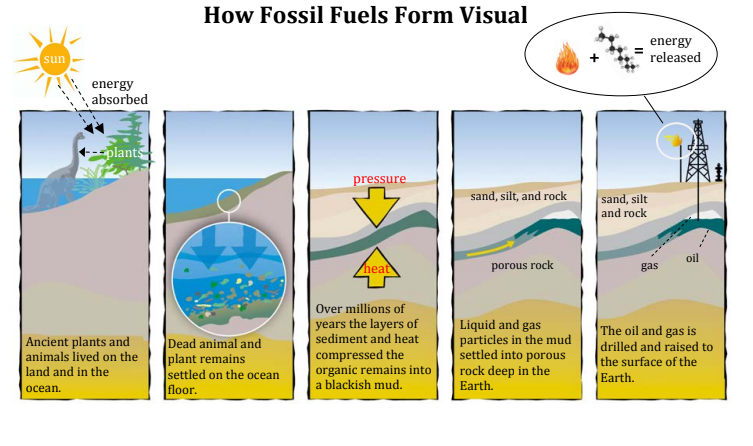
These liquids and gases then migrated upwards through porous rock layers until they hit an impermeable layer, getting trapped in reservoirs deep underground. So, next time you fill up your car, remember you're essentially pouring millions-of-years-old, highly processed ancient sea life into your tank. Wild, right?
The Undeniable Truth: It Takes AGES!
The common thread here, whether it's coal, oil, or gas, is the absolutely staggering amount of time involved. We're talking about processes that unfold over tens, if not hundreds, of millions of years. It requires specific geological conditions – the right kind of life, the right kind of burial, the right amount of pressure and heat, and the crucial absence of oxygen to prevent complete decay.
These resources are literally a snapshot of Earth's ancient ecosystems, captured and transformed into energy stores. They're a finite gift from a forgotten past, taking an unfathomable amount of time to create. And that, my curious friend, is where our fossil fuels come from. It's a story far grander than any factory, and one that really makes you think about every flick of a switch, doesn't it?
