
What Does Ac And Dc Stand For In Electricity
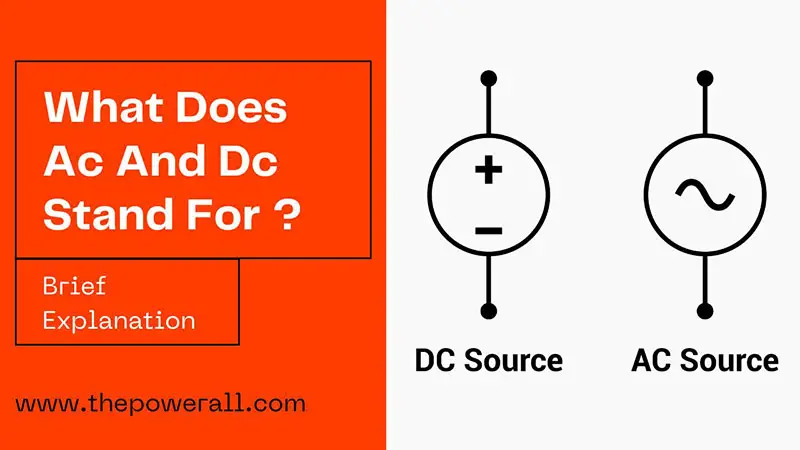
Okay, picture this: I'm at a friend's house, desperately searching for a phone charger. Every single one I find has a different shaped plug. And I’m like, “Seriously?! Why can't we just have one standard charger for everything?” Then it hits me: electricity itself is standardized, but comes in different "flavors". So, what are these "flavors"? We're talking about AC and DC, of course.
But what do AC and DC actually stand for? You've probably heard these terms thrown around, maybe even in a superhero movie (looking at you, The Flash!), but let's break it down without getting too technical.
Direct Current (DC) - The Steady Eddy
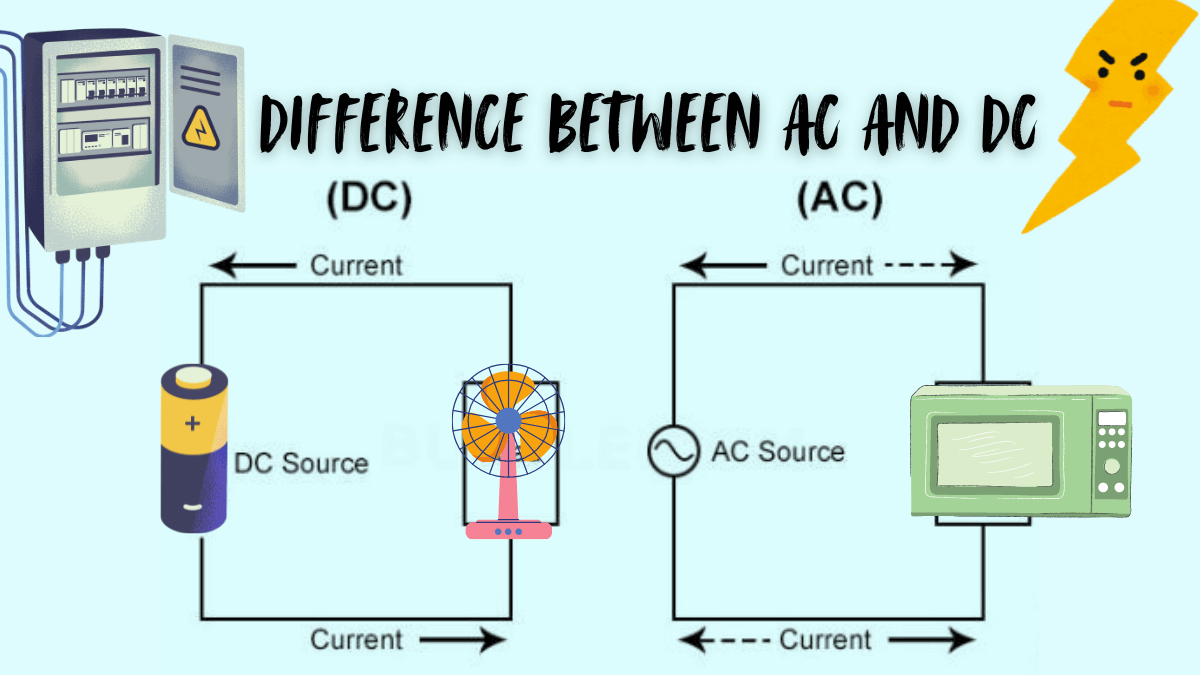
Let's start with DC, short for Direct Current. Think of DC as a one-way street for electrons. They flow in a single, constant direction. It’s like a river flowing smoothly downstream.
Must Read
Where do you find DC? Well, pretty much anything that runs on batteries. Your phone, your laptop, even a flashlight – they all use DC power. The battery provides a constant flow of electrons, keeping everything humming along. Pretty neat, huh?
And yeah, Thomas Edison championed DC back in the day. He envisioned a world powered by massive DC generators. Good idea...sort of.
Alternating Current (AC) - The Wave Rider
Now, let's talk about AC, which stands for Alternating Current. Forget the one-way street; AC is more like an electron dance party. The electrons constantly change direction, oscillating back and forth. It's like a wave crashing on the shore, then receding, then crashing again. This change in direction happens many times per second, measured in Hertz (Hz). In most of the US, it's 60 Hz, meaning the current changes direction 60 times a second! Woah!
Where do you find AC? Basically, your wall outlet. The power grid that brings electricity to your home is almost entirely AC. When you plug in your toaster, your TV, or your fancy coffee maker, you're using AC power.

You can thank Nikola Tesla for AC! Thank you, Nikola! He figured out that AC was much more efficient for transmitting power over long distances than DC. And you know what? He was right!
So, Why Two Types of Current?
This is where it gets interesting. DC is great for running small devices, but it's difficult to transmit over long distances without losing a lot of power. Imagine trying to send a river of electricity for miles and miles – it would weaken over distance!
AC, on the other hand, can be easily transformed to high voltages for long-distance transmission, and then stepped down to lower voltages for safe use in your home. Think of it like this: high-voltage AC is like a super-fast train, carrying lots of electricity efficiently. When it arrives at your town, it slows down to become a local train you can easily hop on.

AC/DC - Not Just a Band
Of course, this wouldn't be complete without mentioning the legendary rock band AC/DC. Their name is a brilliant play on words, implying raw, electrifying energy. Genius, right?
And what about those pesky chargers that plug into the wall? Well, they are doing something very important. Devices like your phone need DC power to operate. Your charger converts the AC power from the wall outlet into DC power that your phone can use. Those things are actually little AC-to-DC converters!
In a Nutshell
So, to recap:
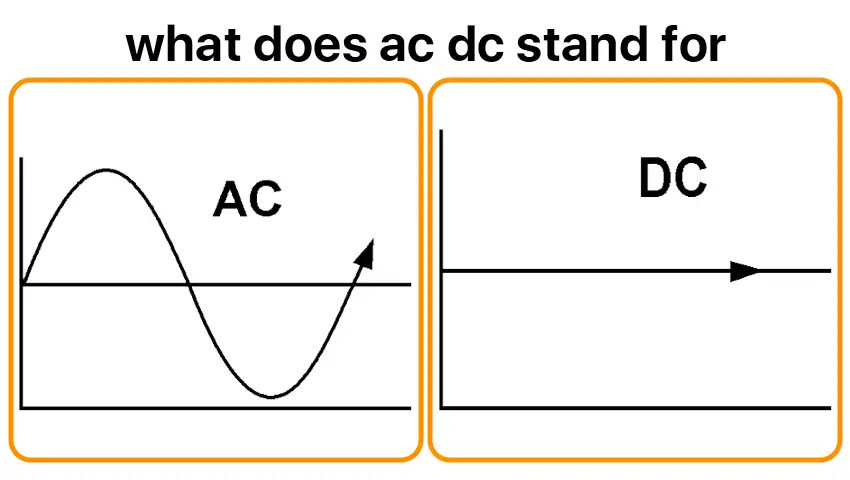
- DC (Direct Current): Steady, one-way flow of electrons. Found in batteries.
- AC (Alternating Current): Oscillating, back-and-forth flow of electrons. Found in wall outlets.
AC is better for long-distance transmission, while DC is better for running small devices. That's why we have both! And both are essential to powering our modern world. Now, the next time someone mentions AC or DC, you can confidently nod and say, "Ah yes, alternating and direct current. I know all about it!" And if they ask where you learned it, you can point them right here!
Now, if you’ll excuse me, I’m going to go find that universal charger…and maybe listen to some AC/DC!