
What Does A High Modulus Of Elasticity Mean

Hey friend! Ever heard someone throw around the term "high modulus of elasticity" and thought, "Huh? Sounds kinda...elastic?" Don't worry, you're not alone! It's actually a pretty simple concept, and I'm here to break it down for ya, easy-peasy lemon squeezy.
So, What IS This Modulus Thingy?
Okay, imagine you have a rubber band and a steel ruler. What happens when you try to stretch them? The rubber band stretches like crazy, right? The ruler? Not so much. That's because they have different "moduli of elasticity" (plural of modulus, because, you know, science likes to be fancy!).
Essentially, the modulus of elasticity, often represented by the letter 'E' (for…elasticity? Creative, right?), is a measure of a material's stiffness or its resistance to being deformed elastically when stress is applied. Think of it as how much the material pushes back when you try to squish it, stretch it, or bend it.
Must Read
Think of it like this: Stress is the annoying person poking you, and strain is how much you flinch. The modulus of elasticity is how much you don't flinch. A high modulus means you barely budge even when poked relentlessly!
High Modulus: Stiff City!
A high modulus of elasticity means the material is very stiff. It takes a lot of force to deform it even a little bit. Our steel ruler? High modulus. It takes serious muscle to bend that thing (and even then, it'll spring right back!). A diamond? Even higher modulus! Good luck trying to dent that, even with a really big hammer. (Disclaimer: Please don't actually hit a diamond with a hammer. I am not responsible for your actions...or lack of diamonds afterwards.)
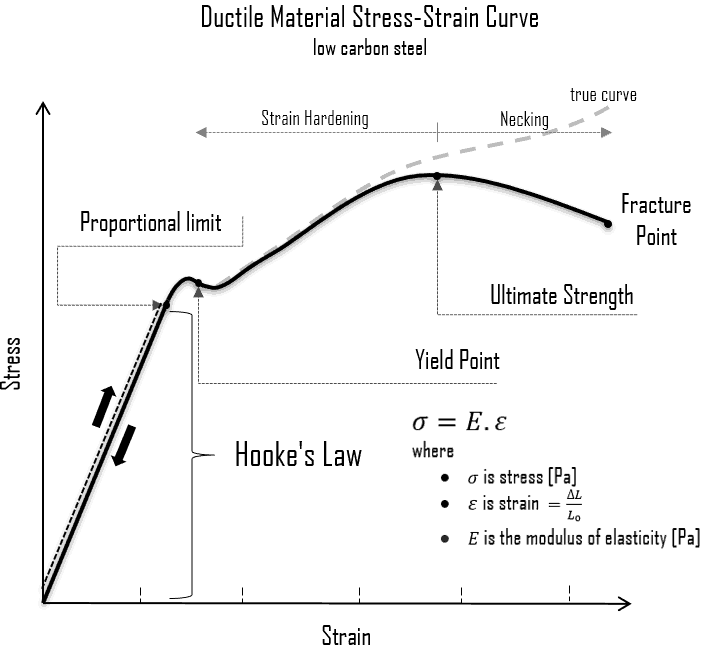
So, if something has a high modulus of elasticity, it's going to be:
- Strong: It can withstand a lot of force without breaking.
- Rigid: It doesn't bend or flex easily.
- Resistant to deformation: It holds its shape well.
Imagine trying to build a skyscraper out of rubber bands. That's a recipe for disaster! You need materials with a high modulus of elasticity, like steel and concrete, to hold everything up and keep it from swaying in the wind.

Examples in the Real World
Here are some common materials with high moduli of elasticity:
- Steel: Bridges, buildings, cars - it's everywhere! A real workhorse thanks to its high strength and stiffness.
- Diamonds: Jewelry, cutting tools, super-fancy drill bits. Because who doesn't want a drill bit that's practically indestructible?
- Ceramics: Tiles, insulators, fancy coffee mugs (that somehow still manage to break when you look at them wrong...go figure!).
- Certain composites (like carbon fiber): Airplanes, race cars, high-performance sports equipment. Lightweight but incredibly strong!
These materials are chosen for their ability to withstand significant stress without significant deformation. Think about it: you want the wings of an airplane to stay put while you're soaring through the sky, right? You don’t want them flapping around like a happy bird!

Why Does It Matter?
Understanding the modulus of elasticity is crucial in engineering and materials science. It helps engineers choose the right materials for specific applications. For example, when designing a suspension bridge, they need to consider the modulus of elasticity of the steel cables to ensure they can support the weight of the bridge and the traffic on it.
It’s also important for understanding how materials will behave under different conditions. Will that plastic chair hold up under the weight of your Uncle Barry? (No offense to Uncle Barry, but we've all been there!). Knowing the modulus of elasticity helps predict that.

In a Nutshell
So, to sum it all up: a high modulus of elasticity means a material is stiff, strong, and resistant to bending or stretching. It's the Hulk of the material world - takes a lot to move it!
Next time someone mentions the modulus of elasticity, you can confidently nod and say, "Ah yes, a measure of stiffness! Quite important, you know!" And then wink. They'll be thoroughly impressed (or slightly confused, but hey, at least you sounded smart!).
Keep learning, keep exploring, and remember that even the most complicated things can be understood with a little bit of curiosity and a dash of fun! Now go forth and conquer the world…or at least impress your friends with your newfound knowledge!