What Causes The Wind To Blow

Ever stepped outside on a blustery day, hair whipping around, feeling that invigorating rush of air, and wondered, "What on earth is causing all this?" You're not alone! Wind, that invisible force that powers sailboats, rustles leaves, and occasionally steals your hat, is one of nature's most dynamic and fascinating phenomena. And surprisingly, the science behind it is quite simple, once you break it down.
The Sun: Our Ultimate Wind Machine
At its heart, wind is simply moving air. And what gets that air moving? Our very own star, the sun. The sun doesn't just give us light and warmth; it's the primary engine driving Earth's atmospheric circulation. Think of it as a giant, cosmic heater.
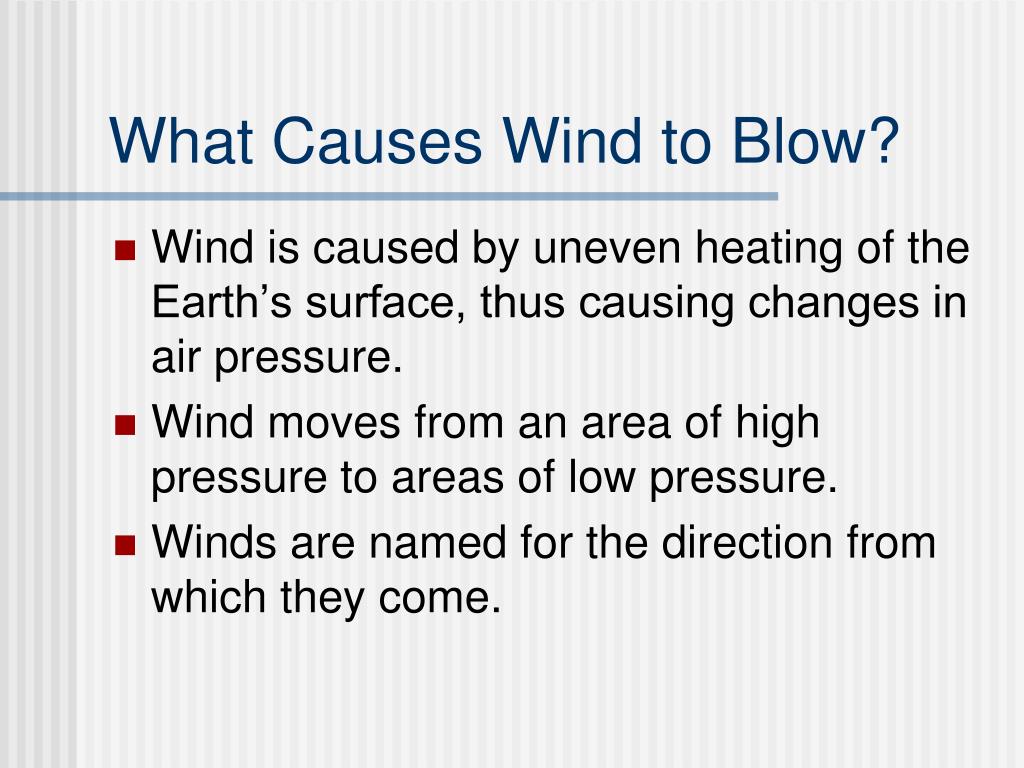
Here's the simplified version: The sun heats the Earth's surface unevenly. Land heats up faster than water, and different parts of the globe receive more direct sunlight than others. When air gets warm, it becomes lighter and rises. Imagine a hot air balloon; same principle. As that warm air rises, it creates an area of lower pressure beneath it.
Must Read
Nature, however, abhors a vacuum. Cooler, denser air from surrounding areas, which is heavier and sinking, rushes in to fill that space. This movement of air from an area of high pressure (cooler, sinking air) to an area of low pressure (warmer, rising air) is what we experience as wind.
Highs, Lows, and the Coriolis Tango
So, the sun starts the show, but there are other players. Meteorologists talk a lot about high-pressure systems and low-pressure systems, and these are key to understanding wind patterns. Wind essentially flows from where the pressure is high to where it's low, trying to equalize things. The bigger the pressure difference, the stronger the wind will be. It's like releasing air from a blown-up balloon – the greater the pressure inside, the faster the air rushes out.

But why isn't wind just a straight shot from high to low? Ah, that's where Earth's rotation comes in, bringing with it the Coriolis Effect. Because our planet is spinning, wind (and ocean currents) get deflected. In the Northern Hemisphere, winds are deflected to the right, and in the Southern Hemisphere, to the left. This is why you see those swirling patterns in weather maps and hurricanes! It's nature's invisible choreography.
Local Breezes and Global Gales
Beyond the big picture, local factors also play a huge role. Ever noticed a refreshing breeze near the ocean on a hot day? That's a sea breeze at work! During the day, land heats faster than the water, creating low pressure over land. Cooler air from over the ocean rushes in. At night, the opposite happens, giving us a land breeze.

Mountains, valleys, even city skyscrapers can influence wind direction and speed, creating gusts, sheltered areas, or channeling winds in particular ways. This is why some places, like Chicago, are famously windy (The Windy City, indeed!), while others remain relatively calm.
Fun Wind Facts & Practical Tips
- Did you know? The fastest wind speed ever recorded on Earth (outside of a tornado) was 253 mph (408 km/h) during Tropical Cyclone Olivia in Australia in 1996. Talk about a bad hair day!
- Cultural Connection: Many cultures have named their local winds. Think of the Mistral in France, the Santa Ana winds in Southern California, or the Sirocco from the Sahara Desert.
- Embrace the Wind: Wind is a fantastic source of renewable energy, powering wind turbines globally. It's also incredible for recreation – think kitesurfing, sailing, paragliding, or simply flying a kite with kids!
- Practical Tip: Always check the wind forecast if you're planning outdoor activities, especially near water or in mountainous areas. A gentle breeze can quickly become a strong gust. And remember to dress in layers – wind chill can make things feel much colder!
A Breath of Fresh Air
So, the next time you feel the wind on your face, take a moment to appreciate the complex yet beautiful dance happening above us. It's a constant reminder of the sun's power, Earth's rotation, and the atmosphere's never-ending quest for balance. It’s an invisible force that shapes our landscapes, influences our weather, and even inspires our dreams of flight. From a gentle whisper to a roaring gale, the wind connects us to the dynamic, living planet we call home. Pretty cool, right?