
What Are The Three Main Classes Of Elements
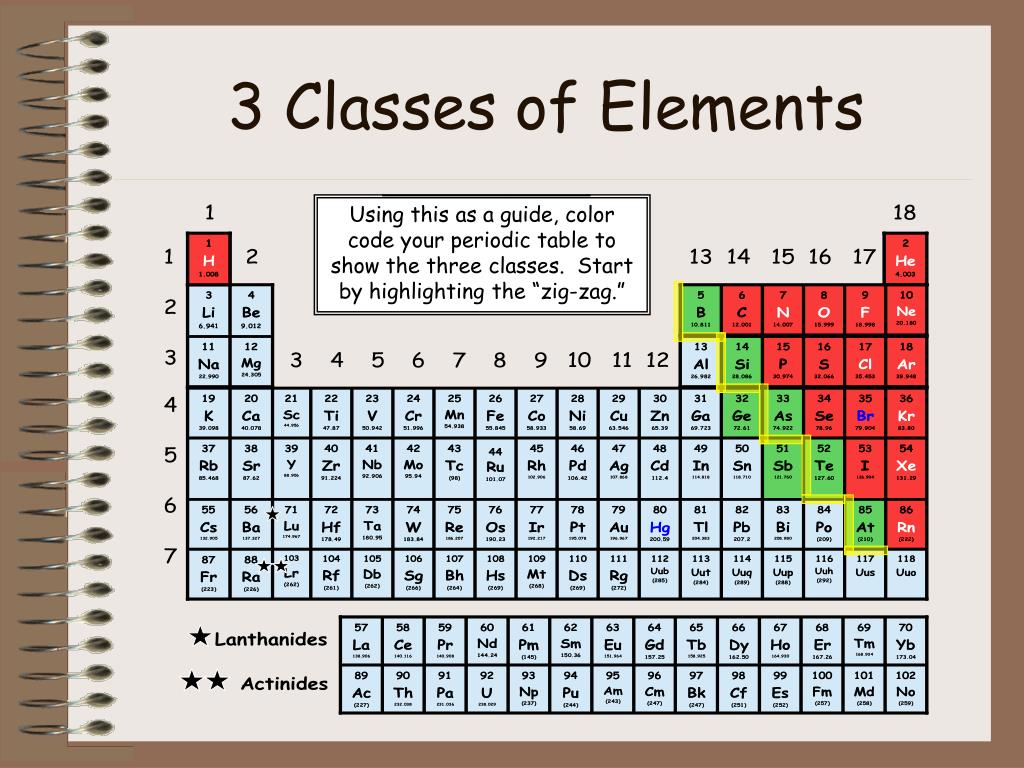
Ever looked around and thought, "Wow, that's a lot of stuff"? Well, you're not wrong! But what if I told you that practically everything you see, touch, and even breathe is made up of just a few basic ingredients? And those ingredients, the elements, can be sorted into three main groups, like the ultimate chemistry club with a really weird dress code.
Let's meet the club members:
The Shiny Superstars: Metals
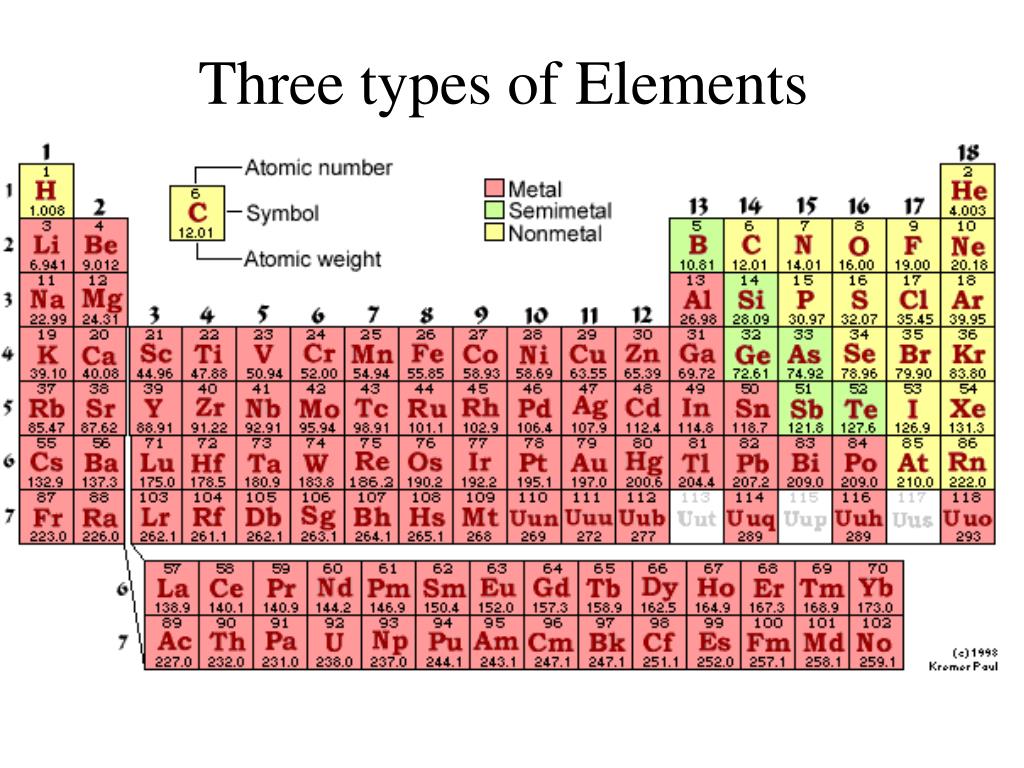
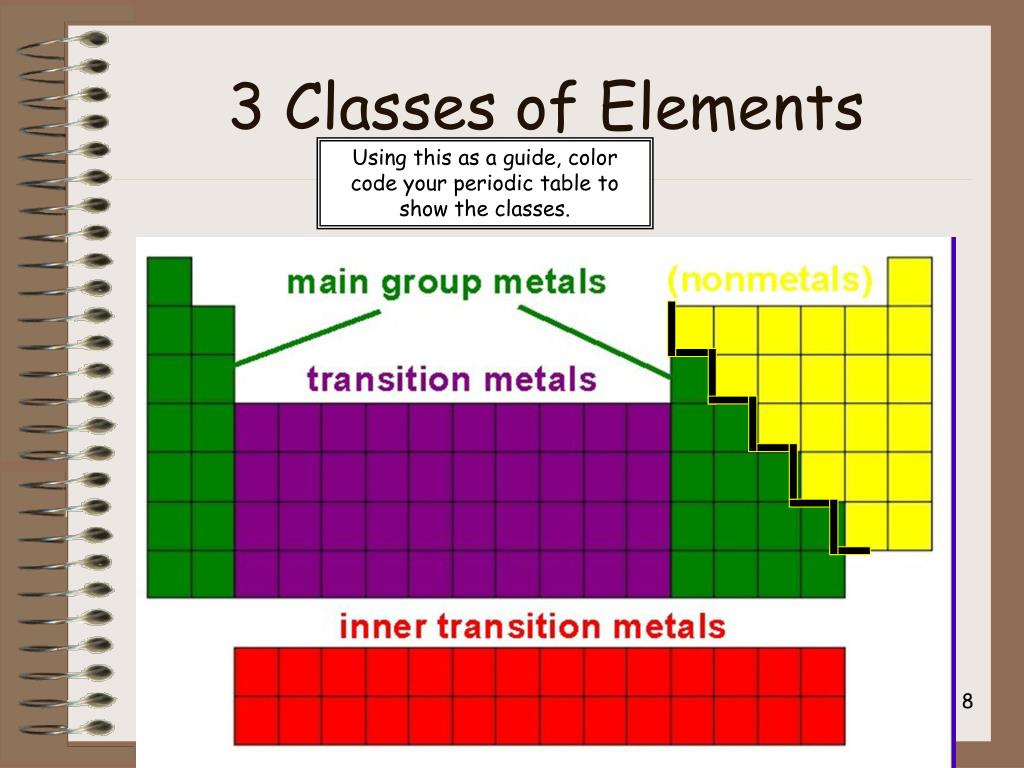
First up, we have the metals! These are the rockstars of the element world. Think gleaming gold jewelry, sturdy iron bridges, and the aluminum foil that magically makes leftovers disappear. Metals are like the popular kids in school – everyone wants to be them (or at least use them to build something awesome). They're generally shiny, good conductors of electricity and heat, and are usually pretty solid at room temperature (sorry, mercury, you're the quirky exception).
Must Read
But here's the fun part: metals aren't just about being strong and dependable. They can be surprisingly dramatic. Remember the exploding Mentos and Diet Coke experiment? That involves the metal sodium reacting violently with water! And then there’s iron, which, when combined with oxygen and water, throws a spectacular tantrum and turns into rust – a reddish-brown reminder that even the mightiest can have their off days.
Also, let's give a shout-out to the metals that are essential for life. Calcium makes our bones strong (so we can continue to be impressed by viral cat videos). Iron helps our blood carry oxygen (allowing us to actually see those cat videos). And potassium helps our muscles contract (so we can dramatically reach for the remote when the cat video ends). You could say metals are the unsung heroes of our daily existence, constantly working behind the scenes to keep us functioning.
The Shape-Shifters: Nonmetals
Next, we have the nonmetals. These are the chameleons of the element world. They don't follow the same rules as metals. Some are gases (like the oxygen we breathe and the nitrogen that makes up most of our atmosphere). Some are solids (like the carbon in diamonds and the sulfur in matches). And one is a liquid (bromine). They're generally poor conductors of electricity and heat and can be found in a wider variety of colors and appearances than metals.
Nonmetals might seem less impressive than their shiny metal counterparts, but they're secretly incredibly powerful. Consider carbon: it's the backbone of all organic molecules, meaning it's essential for life as we know it. And then there's chlorine, the stuff that keeps our swimming pools germ-free (and sometimes makes our eyes sting). Nonmetals might not be flashy, but they're absolutely crucial.

Think of the nonmetals as the quiet artists of the element kingdom. They create the stunning colors in fireworks (strontium for red, barium for green), and they form the delicate bonds that hold together our DNA. They’re the whisperers, the architects of life, the subtle forces shaping the world around us.
The In-Betweeners: Metalloids
Finally, we have the metalloids, also known as the semi-metals. These are the awkward middle schoolers of the element world, unsure of where they truly belong. They have properties of both metals and nonmetals, making them incredibly versatile (and sometimes a little confusing). Think of them as the jack-of-all-trades in the element club.
The most famous metalloid is probably silicon, the key ingredient in computer chips. Without silicon, we wouldn't have smartphones, laptops, or even toasters that know how to perfectly brown your bagel. Metalloids are the reason we can binge-watch cat videos in high definition!
Metalloids are also used in semiconductors, materials that conduct electricity under certain conditions but not others. This allows us to control the flow of electricity with incredible precision, leading to all sorts of technological marvels. So next time you're marveling at your smart fridge or your self-driving car, remember to thank the humble metalloids. They’re the reason our lives are so connected and, well, occasionally terrifyingly convenient.
So there you have it! Metals, nonmetals, and metalloids: the three main classes of elements, each with its own unique personality and quirks. They're the building blocks of everything around us, from the grandest skyscrapers to the tiniest cells. And while they might seem like abstract concepts from high school chemistry, they're actually the stars of a never-ending drama, constantly interacting and creating the world we know and love. Now, isn't that metal?
