What Are The Smallest Units Of An Ionic Bond

Hey there, science enthusiast! Ever wondered about the teeny-tiny Lego bricks that build the world around us? Okay, maybe not actual Lego bricks, but the smallest pieces that make up stuff like table salt? We're talking about ionic bonds today, and specifically, what the heck is the smallest unit of one!
Now, I know what you're thinking: "Ionic bonds? Sounds complicated!" But trust me, it's easier than parallel parking on a busy street. (And less stressful, unless you really love chemistry.)
Ions: Charged Up Particles!
First things first, let's talk about ions. Imagine atoms as tiny, usually well-balanced citizens. They have an equal number of positively charged protons and negatively charged electrons, so they're all chill and neutral. But sometimes, an atom gets a little… greedy. Or generous. And that’s where the fun begins!
Must Read
Some atoms really like to gain electrons, becoming negatively charged. These are called anions (think "an-IONS," like a negative onion makes you cry... okay, bad joke, I know!). Other atoms are happy to lose electrons, becoming positively charged. These are called cations (think "cat-IONS" – cats are always positive, right? Even when they’re knocking things off shelves?).
Opposites Attract: The Ionic Bond is Born!
So, what happens when a cation (positive) meets an anion (negative)? It's like magnets! They snap together! This electrical attraction is what we call an ionic bond. It's a strong bond, like the one between you and your favorite pizza. Okay, maybe not that strong, but pretty darn close!

For example, table salt, or sodium chloride (NaCl), is a classic example. Sodium (Na) loses an electron to become a Na+ cation, and chlorine (Cl) gains an electron to become a Cl- anion. Bam! They're attracted, and an ionic bond is formed.
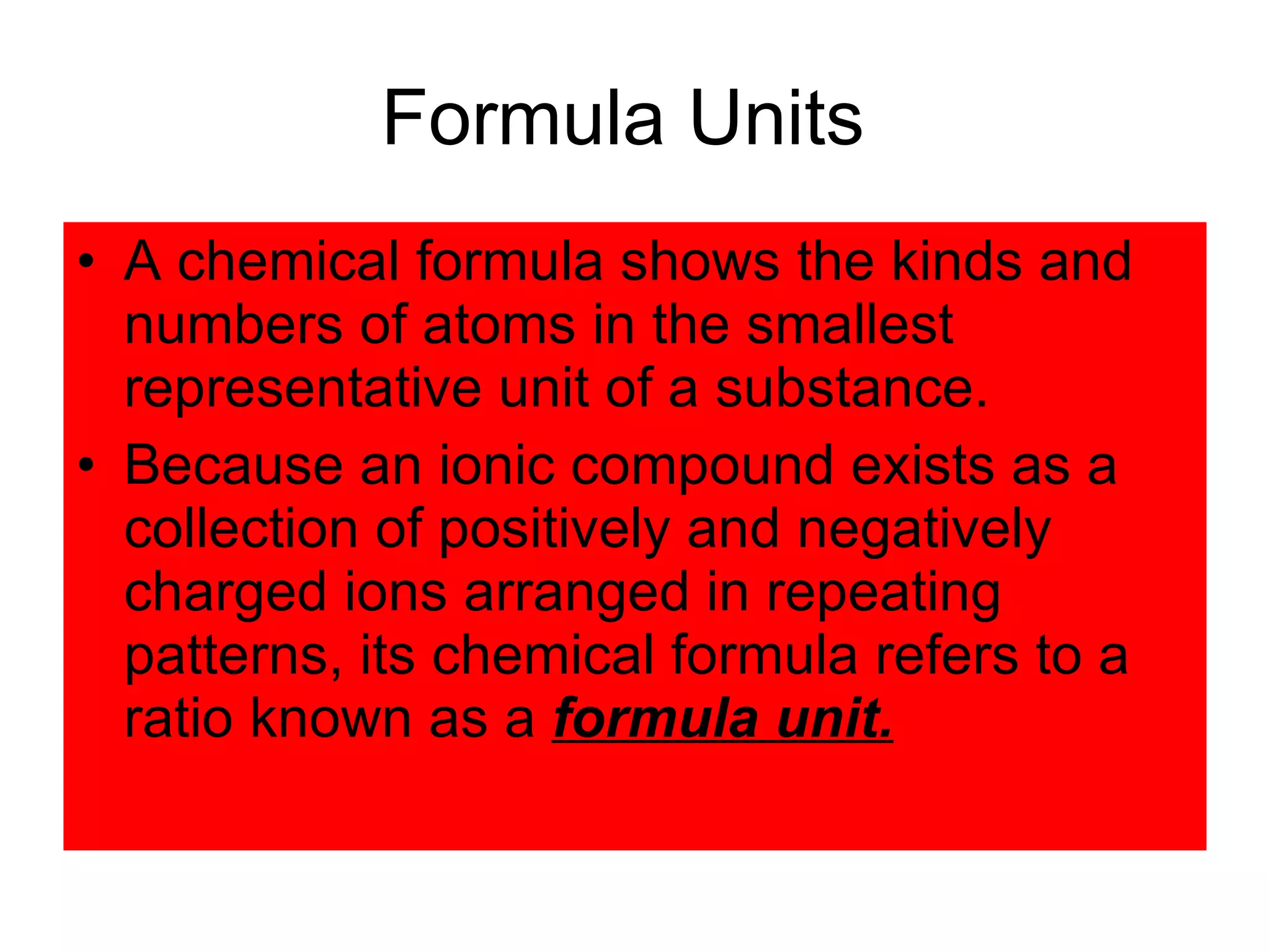
So, What's the Smallest Unit? A Formula Unit!
Here’s where things get a little bit… not complicated, just precise. You might be tempted to say the smallest unit of an ionic bond is simply one cation and one anion stuck together. And you'd be partially right. But technically, we call the smallest electrically neutral collection of ions that represents the chemical formula of an ionic compound a formula unit.
Think of it this way: ionic compounds don't exist as single pairs of ions floating around in space. They form a massive, repeating 3D structure called a crystal lattice. It’s like a giant, perfectly organized Lego structure. In our salt example, it's not just one Na+ next to one Cl-. It's a whole grid of them, all linked together.
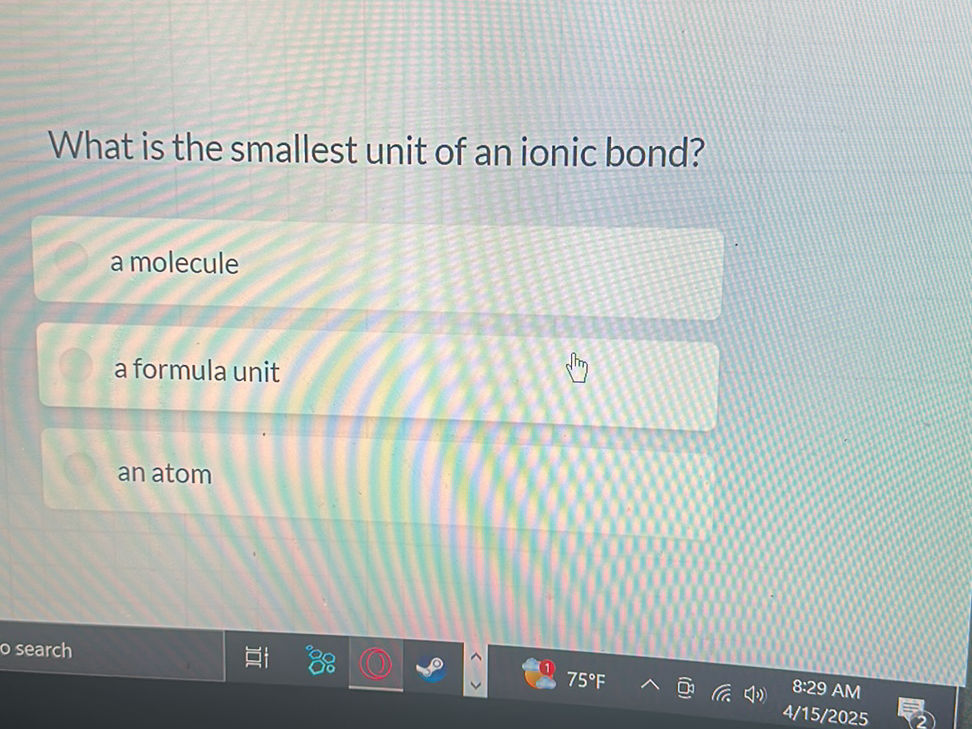
So, even though the bond exists between individual ions, the formula unit gives us the simplest ratio of ions that represents the entire compound. For NaCl, the formula unit is simply one Na+ and one Cl-. But for other compounds, like magnesium chloride (MgCl2), the formula unit is one Mg2+ and two Cl- ions. Because it takes two chloride ions to balance the 2+ charge of the magnesium ion!
Why is it Important?
Why bother with all this detail? Well, understanding the formula unit helps us understand how ionic compounds behave. It helps us predict their properties, like melting point and solubility. Plus, it just sounds really cool to know, right?

Bold statement: Grasping these seemingly small concepts is foundational to understanding chemistry. It's like learning your ABCs before you write a novel. Okay, maybe that’s a bit dramatic. But you get the point!
Let's be honest, chemistry might seem daunting at times, but breaking it down into these bite-sized pieces – the formula unit being one of them – makes it so much more approachable. Plus, knowing you can now impress your friends at the next dinner party with your newfound knowledge of ionic bonds? Priceless!
So there you have it! The smallest unit of an ionic bond, represented by the formula unit, is a key piece to understanding the amazing world of chemistry. Go forth and share your knowledge! You've got this!