What Are The Properties Of Transition Elements
Okay, so picture this: I'm at a science museum, right? Totally geeking out over this massive periodic table display. And my friend, bless her heart, she points to that big chunk in the middle – the transition metals – and goes, "So... what's the deal with these guys? They seem kinda…extra." And honestly? I didn't have a great answer then. But, oh boy, have I learned a thing or two since. Prepare for a deep dive!
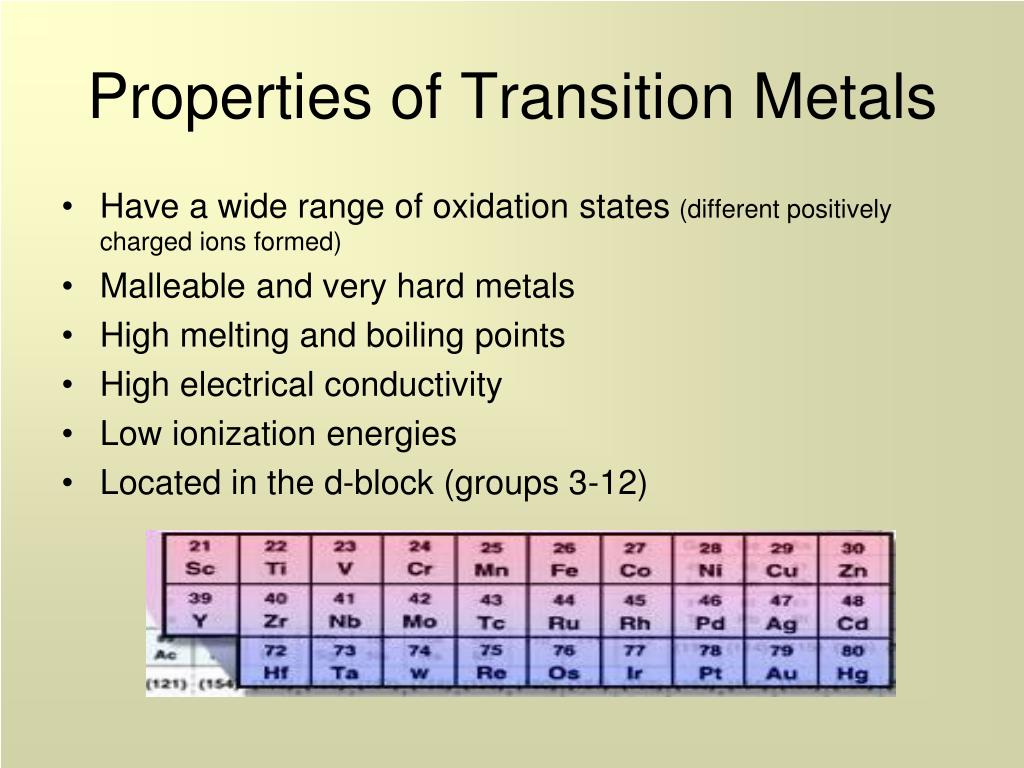
We're talking about elements that live in the d-block of the periodic table. (Remember that block? The one that kinda dips down?). Think iron, copper, gold, silver – the heavy hitters of the element world. But what makes them so special? What makes them transition from one side of the table to the other? That's what we're gonna unpack.
They're Colorful Characters (Literally!)
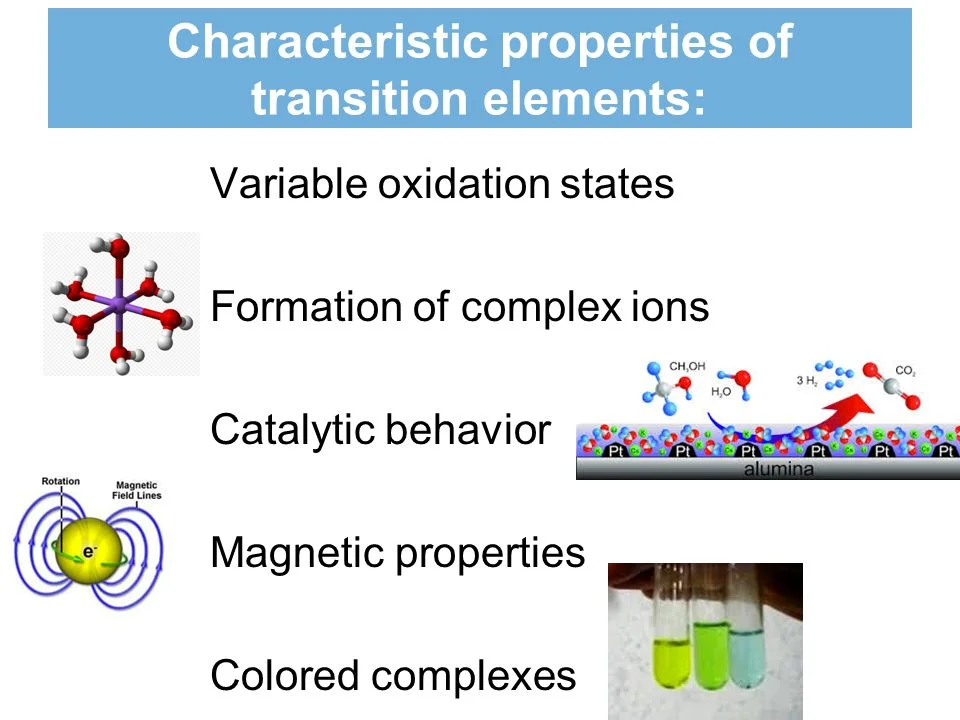
Seriously, have you seen some transition metal compounds? Vibrant blues, deep greens, rich purples... it's like a rainbow threw up in a chemistry lab (in a good way, of course!). This kaleidoscope of color comes down to how their d-electrons interact with light. These electrons can jump between different energy levels within the d orbitals, absorbing specific wavelengths of light in the process. The color you see is the light that isn't absorbed. Fancy, huh?
Must Read
Think about it: copper sulfate is blue, potassium permanganate is purple... the list goes on. Normal elements? Not so much. So, if you ever need to spice up a boring solution, just add a pinch of a transition metal compound. Voila! Instant artistic flair. Just kidding! Don't actually do that without adult supervision!
Multiple Personalities (Oxidation States, That Is)
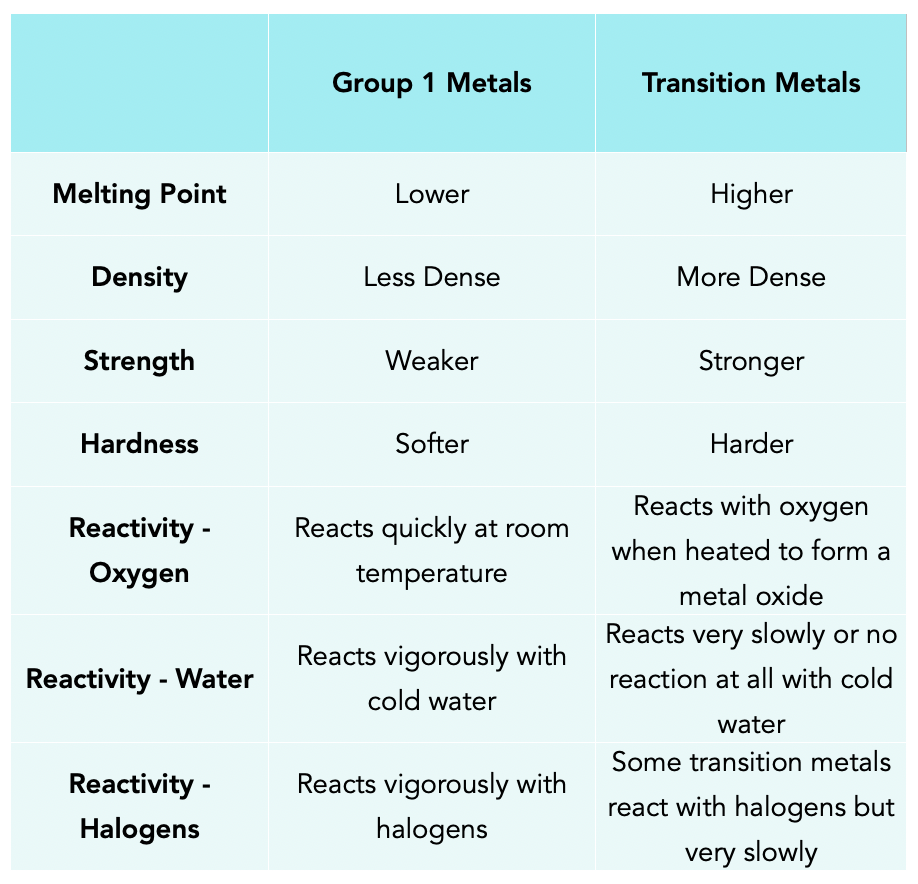
Unlike elements that stubbornly stick to one oxidation state (I'm looking at you, Group 1!), transition metals are all about options. Iron, for example, can be +2 or +3 (and sometimes even more!). This flexibility is because of the small energy difference between their (n-1)d and ns electrons. They can lose different numbers of electrons depending on the chemical environment.

This variability in oxidation states is crucial for their role as catalysts. (More on that later.) Think of it as being able to wear different hats depending on the job. A +2 hat for this reaction, a +3 hat for that one… versatile, right?
Magnetic Personalities
Some transition metals, especially those with unpaired electrons in their d orbitals, are magnetic. Like, stick-to-your-fridge magnetic. This is called paramagnetism. The more unpaired electrons, the stronger the magnetism. Iron, cobalt, and nickel are famous examples of ferromagnetic materials – the stuff magnets are made of.
And it's not just about sticking to your fridge. Magnetism plays a critical role in things like data storage (hard drives) and medical imaging (MRIs). So, next time you're scrolling through cat videos, remember to thank a transition metal.

Catalytic Converters
This is where things get really interesting. Transition metals and their compounds are amazing catalysts. A catalyst speeds up a chemical reaction without being consumed in the process. How do they do it? Remember those variable oxidation states and the ability to form complex ions? They provide a surface for reactants to bind to, weaken existing bonds, and facilitate the formation of new ones. Basically, they're like matchmakers for molecules. (Except way more efficient and less drama-filled.)
Think about the Haber-Bosch process for making ammonia (essential for fertilizers). It relies on an iron catalyst. Or the catalytic converters in cars, which use platinum, palladium, and rhodium to reduce harmful emissions. Without transition metals, many industrial processes would be slow, inefficient, or even impossible.
They Form Complex Ions (and They Like It!)
Transition metals love to hang out with other molecules or ions, forming what we call complex ions or coordination complexes. These complexes consist of a central metal ion surrounded by ligands (molecules or ions that donate electrons to the metal). These ligands can be anything from water molecules to chloride ions to ammonia.
These complex ions are not only beautiful (see: colorful compounds above), but they also play important roles in biological systems. For instance, hemoglobin in your blood is a complex ion containing iron, which carries oxygen throughout your body. Pretty vital, right? So, next time you're breathing, thank iron for being so sociable.
So, there you have it! Transition metals: colorful, versatile, magnetic, and catalytic. They're so much more than just that block in the middle of the periodic table. They're the workhorses of chemistry, playing critical roles in everything from industrial processes to biological systems. Now you're equipped to explain them much better than I was back in that museum!