
What Are The Physical Properties Of Metalloids

Ever heard the word "metalloid" and thought, "Huh? Sounds like something from a sci-fi movie?" Well, you're not alone! But trust me, they're way cooler and more down-to-earth than you might think. They're the quirky middle children of the element family, not quite metals, not quite non-metals, but possessing properties of both. Let's dive into their fascinating physical characteristics without getting too sciency, okay?
The "It Depends" Group: Appearance and Conductivity
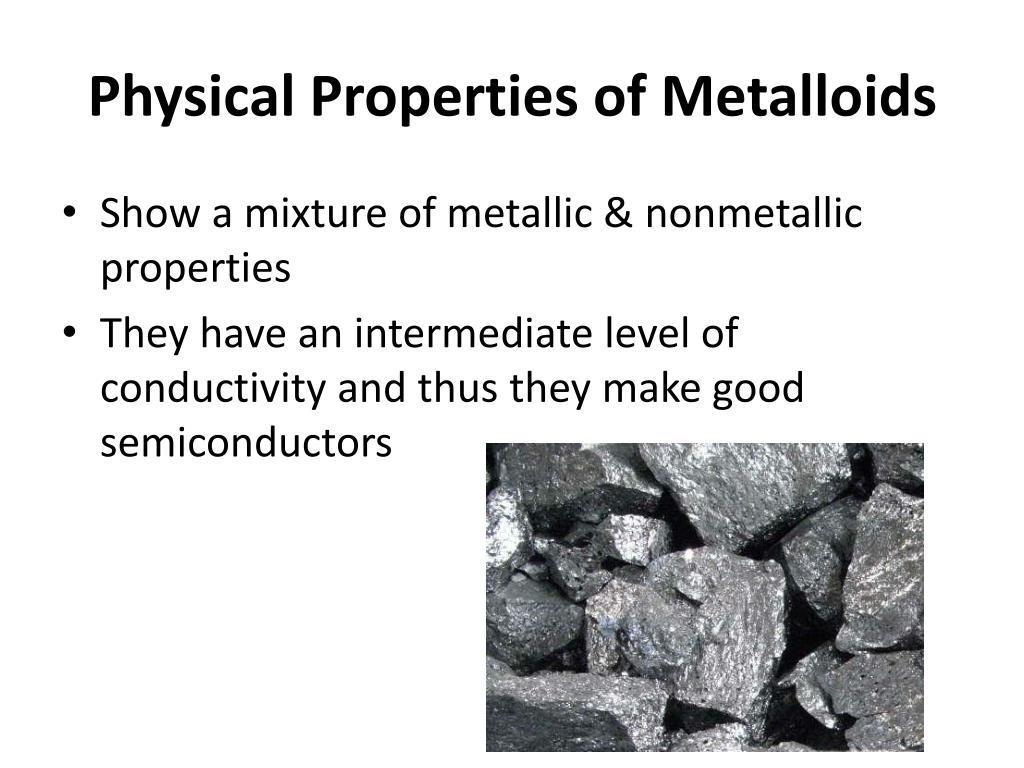
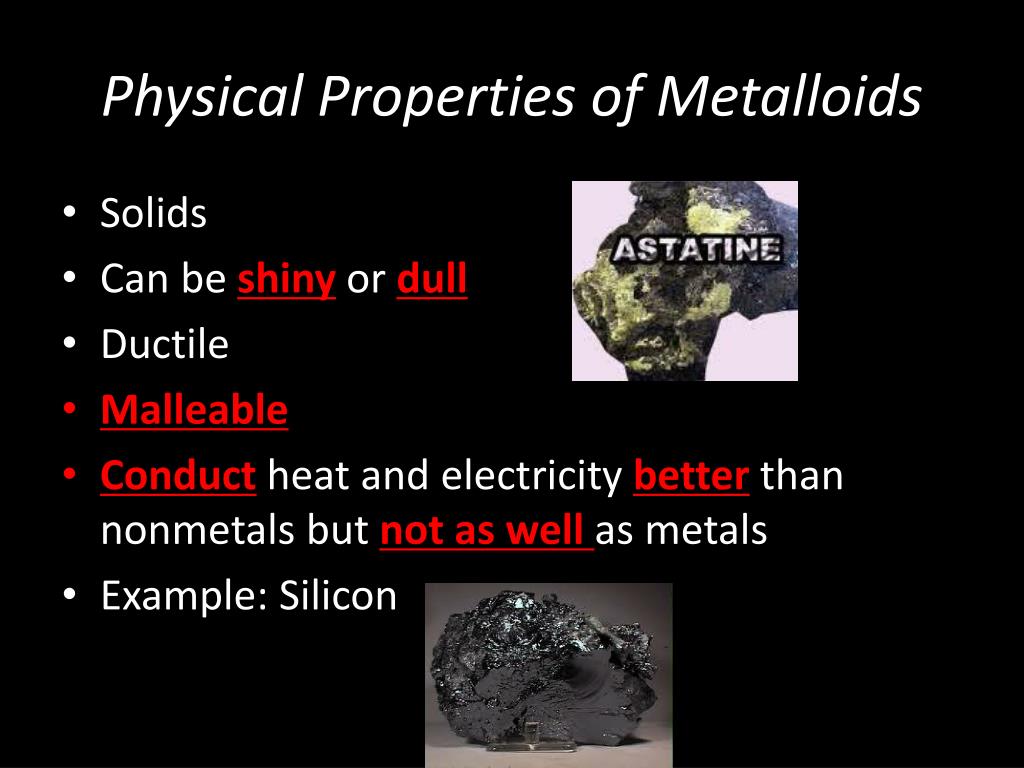
Imagine a chameleon. It changes its color depending on its surroundings. That's kind of like metalloids when it comes to appearance. Some, like silicon, are shiny and silvery-gray, almost metallic-looking. Others, like boron, can be dark and non-lustrous. So, unlike, say, gold which is always that distinctive yellow shimmer, metalloids keep you guessing.
Now, let’s talk about conductivity. This is where things get really interesting. Metals are like the star athletes of conductivity, easily allowing electricity and heat to flow through them. Non-metals are more like couch potatoes, resisting that flow. Metalloids? They're the ones in the middle, deciding when they want to run the marathon and when they want to binge-watch Netflix.
Must Read
Their ability to conduct electricity is temperature dependent. At low temperatures, they might act more like non-metals, resisting the flow. But crank up the heat, and suddenly, they’re letting electricity zip through! This makes them super useful as semiconductors. We’ll get to that shortly.
Hardness and Malleability: Think "Goldilocks Zone"
Think of a blacksmith hammering away at a hot piece of iron, shaping it into a horseshoe. That's metals' malleability at play – their ability to be hammered or pressed into shape without breaking. Non-metals, on the other hand, are often brittle. Think of trying to hammer a piece of charcoal; it would just crumble.

Metalloids generally fall somewhere in the middle. They aren't as easily shaped as metals, but they aren't as fragile as many non-metals either. They tend to be hard and somewhat brittle at room temperature.
Think of silicon. You can't exactly bend it into a pretzel, but it's also not going to shatter into a million pieces if you accidentally bump it. It's in that sweet spot – the Goldilocks zone of hardness and brittleness.

Density: Not Too Heavy, Not Too Light
Density is how much "stuff" is packed into a certain space. Think of a bowling ball versus a beach ball. The bowling ball is much denser; it has way more mass packed into a similar volume.
Metalloids tend to have densities that fall between those of metals and non-metals. They aren’t feather-light like some non-metals, but they also aren’t as heavy as dense metals like lead. It's another example of them being nicely balanced.
Why Should You Care? The Semiconductor Story
Okay, so why should you care about these slightly unpredictable, middle-ground elements? The answer lies in their ability to act as semiconductors. Remember how their conductivity changes with temperature? That's key!
Semiconductors are the unsung heroes of the modern world. They're the brains behind your phone, your computer, your car’s electronic systems, even your fancy coffee maker. Silicon, in particular, is the king of semiconductors.
Imagine trying to build a computer using only metals. You'd have electricity constantly flowing everywhere, all the time. Chaos! With semiconductors, we can precisely control the flow of electricity, turning it on and off to perform calculations, display images, and connect you to the internet.
Without metalloids, especially silicon, the digital revolution simply wouldn't have happened. No smartphones, no streaming videos, no online shopping. Suddenly, these "middle children" seem pretty darn important, right?
In a Nutshell
Metalloids are the chameleons of the element world. Their physical properties, like appearance, conductivity, hardness, and density, sit somewhere between those of metals and non-metals. But it's their semiconducting ability that makes them truly special, powering the technology that shapes our lives every single day. So, the next time you're scrolling through your phone, remember to give a little nod to the metalloids – the quiet workhorses of the digital age!