
What Are The 6 Layers Of The Sun
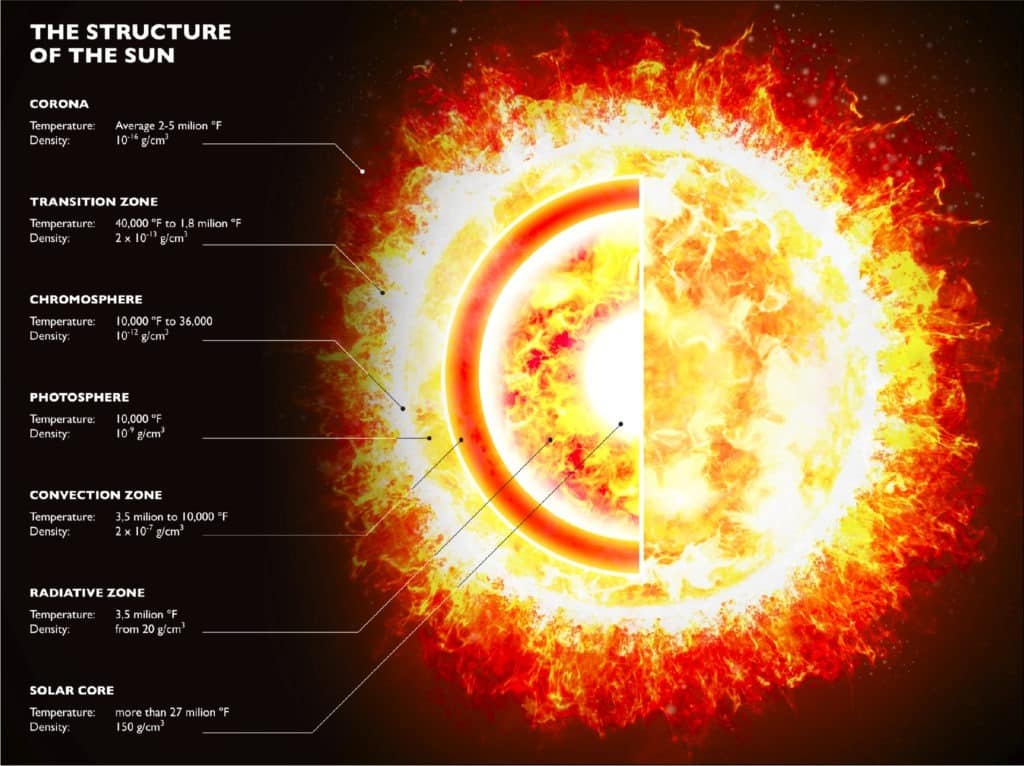
Okay, so picture this: the Sun. Big, bright, kinda obvious, right? But ever wonder what’s actually going on inside that giant ball of fiery awesome? It's not just a big, plain ol' sphere. Nope! Our star is actually a cosmic onion, packed with six distinct layers, each one wilder than the last. And trust me, peeling back these layers is way more fun than the kind that makes you cry!
Forget everything you thought you knew about "solid" celestial bodies. The Sun is a giant, dynamic, utterly fascinating plasma powerhouse. Let's dive in, shall we? Grab your cosmic shades, because it's about to get bright!
The Core: Where the Party Starts
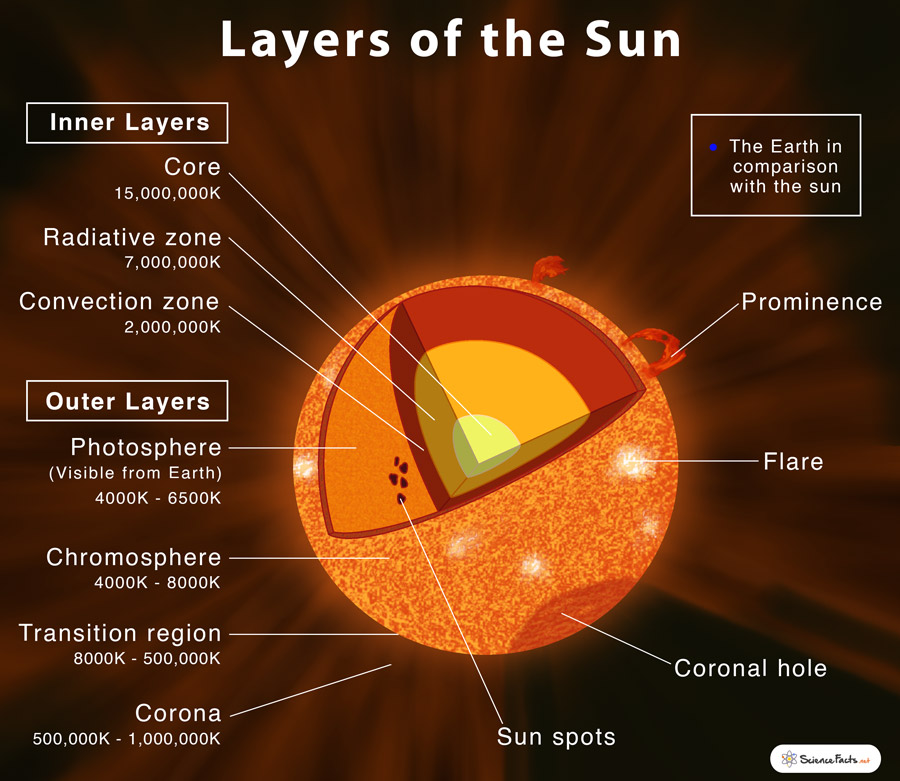
First up, right at the very heart of it all, is the Core. This isn't just a layer; it's the Sun's engine room, its super-hot, super-dense, nuclear-fusion party central! Think of it as the ultimate pressure cooker. Here, temperatures hit a mind-boggling 15 million degrees Celsius. That's hot enough to make atoms of hydrogen fuse into helium, releasing an unimaginable amount of energy. It's like billions of hydrogen bombs going off every single second! This is where all the Sun's light and heat are born. Without the Core, we'd just have a very chilly, very dark sky. Pretty crucial, right?
Must Read
It’s about 150,000 kilometers across, roughly 10% of the Sun's total diameter, but it holds a massive 40% of its mass. Talk about a heavyweight champion! This incredible density and heat create the perfect conditions for the universe's most epic reaction. It’s truly where the magic happens, giving our planet life. Pretty cool for a giant ball of gas, huh?
The Radiative Zone: A Cosmic Pinball Machine
Step outside the Core, and you hit the Radiative Zone. This layer is exactly what it sounds like: energy is transferred outwards through radiation. But it's not a quick trip! Imagine a photon – a tiny particle of light – trying to escape. It's like being stuck in the most chaotic pinball machine ever invented. These photons bounce around endlessly, colliding with other particles, getting absorbed, then re-emitted, in a completely random walk. It can take thousands, even hundreds of thousands of years for a single photon to make it through this zone!
So, the sunlight warming your face right now? Parts of it started its journey in the Core eons ago, before dinosaurs even roamed the Earth. Mind-blowing, isn't it? This zone is super dense, preventing the plasma from circulating freely, forcing the energy to radiate its way out slowly. It’s a testament to patience, cosmic style!
The Convective Zone: The Sun's Lava Lamp
Next up, we have the Convective Zone, and this is where things really start to bubble! Think of a giant, cosmic lava lamp, or a pot of water boiling furiously on a stove. Hot plasma from deeper within this zone rises, cools as it gets closer to the surface, then sinks back down, only to heat up and rise again. This continuous churning motion is called convection, and it’s super efficient at moving energy.

These rising and falling plumes of plasma are immense, some the size of small countries! They create a granular pattern on the Sun's surface, visible with special telescopes, like millions of tiny cells constantly popping and reforming. It's dynamic, it's energetic, and it's how the Sun's energy makes its final push towards the surface. So next time you see boiling water, think of our star's epic convective dance!
The Photosphere: What We See!
Okay, we're finally reaching the part you can "see"! The Photosphere is essentially the Sun's visible surface. This is where the plasma becomes transparent enough for the photons, after their epic journey, to finally escape into space. When you look at the Sun (safely, with proper filters, please!), you’re seeing the Photosphere.
It's not a solid surface, of course, but a relatively thin layer, only a few hundred kilometers thick. Here, temperatures drop to a comparatively chilly 5,500 degrees Celsius. This is also where those famous sunspots appear – cooler, darker regions caused by intense magnetic activity. They look like tiny blemishes, but some can be larger than Earth! The Photosphere is the layer that gives the Sun its characteristic bright, yellowish glow. It’s literally the face of our star!
The Chromosphere: The Shy, Red Layer
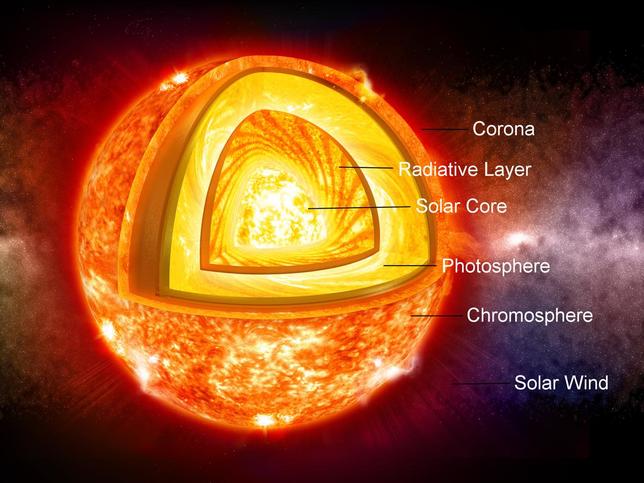
Just above the Photosphere lies the Chromosphere. This layer is typically invisible to the naked eye because the Photosphere is so much brighter, outshining it completely. But, during a total solar eclipse, when the Moon perfectly blocks the Photosphere, the Chromosphere briefly flashes into view as a stunning, reddish halo. Hence its name, "chromo" meaning color!
This layer is a bit of a mystery, hotter than the Photosphere but cooler than the layer above it, which is a bit of a cosmic head-scratcher. It's also home to dramatic jets of plasma called spicules, which look like fiery blades or grass shooting upwards. They can extend thousands of kilometers into space, lasting just a few minutes before collapsing back down. Think of it as the Sun's delicate, fiery "hair," only revealed on special occasions!

The Corona: The Sun's Fiery Crown
And finally, the outermost layer, the Sun's magnificent halo: the Corona. This is the Sun's extended atmosphere, a super-hot, super-thin, wispy plasma that stretches millions of kilometers into space. Like the Chromosphere, it's mostly hidden by the brilliant Photosphere, but it explodes into view during a total solar eclipse, looking like a glorious, shimmering crown of light.
Here's the quirky part: the Corona is much hotter than the surface of the Sun, reaching temperatures of millions of degrees Celsius! Why? Scientists are still trying to figure that out – it's one of the Sun's biggest puzzles! The Corona is also where the solar wind originates, a stream of charged particles that constantly flows away from the Sun, affecting everything from auroras on Earth to spacecraft far beyond our planet. It's wild, it's mysterious, and it's the Sun's ultimate display of power!
So there you have it! Six incredible layers, each with its own quirks and mind-boggling properties. From the atomic party in the Core to the mysterious, fiery crown of the Corona, our Sun is a truly magnificent, complex, and incredibly dynamic star. It's not just a yellow circle in the sky; it's a cosmic marvel constantly in motion, reminding us just how amazing our universe really is. Isn't that just a blast to think about?