
Van Der Waals Equation Of State
Hey! So, you ever wondered why some things are gases, some are liquids, and others are solids? It’s not just about temperature, you know? Like, duh, boiling water makes steam, but what else is going on?
Well, let's chat about something called the Van der Waals equation of state. Sounds intimidating, right? Don't worry, we'll break it down. It's actually kinda cool (in a nerdy, physics-y kinda way).
Ideal Gas Law? More Like Ideal Gas Lie!
Okay, so you’ve probably heard of the ideal gas law: PV = nRT. Pretty simple, right? Pressure times Volume equals the number of moles times the ideal gas constant times the Temperature. Easy peasy! But here's the thing: it's, well, ideal. Meaning it assumes all gas molecules are perfect little billiard balls with no volume and no attraction to each other. Does that really sound like reality? I didn’t think so.
Must Read
Real gases, unlike our "ideal" friends, actually do take up space! They also kinda like each other. I mean, they’re not gonna get married or anything, but they have these tiny, wee forces of attraction between them. These forces are called – you guessed it – Van der Waals forces! Aren't scientists creative with names?
Enter Van der Waals: The Reality Check
Johannes Diderik van der Waals (try saying that five times fast!) was a smart cookie. He was like, "Hold up! Let's tweak this 'ideal' nonsense and make it actually reflect reality."

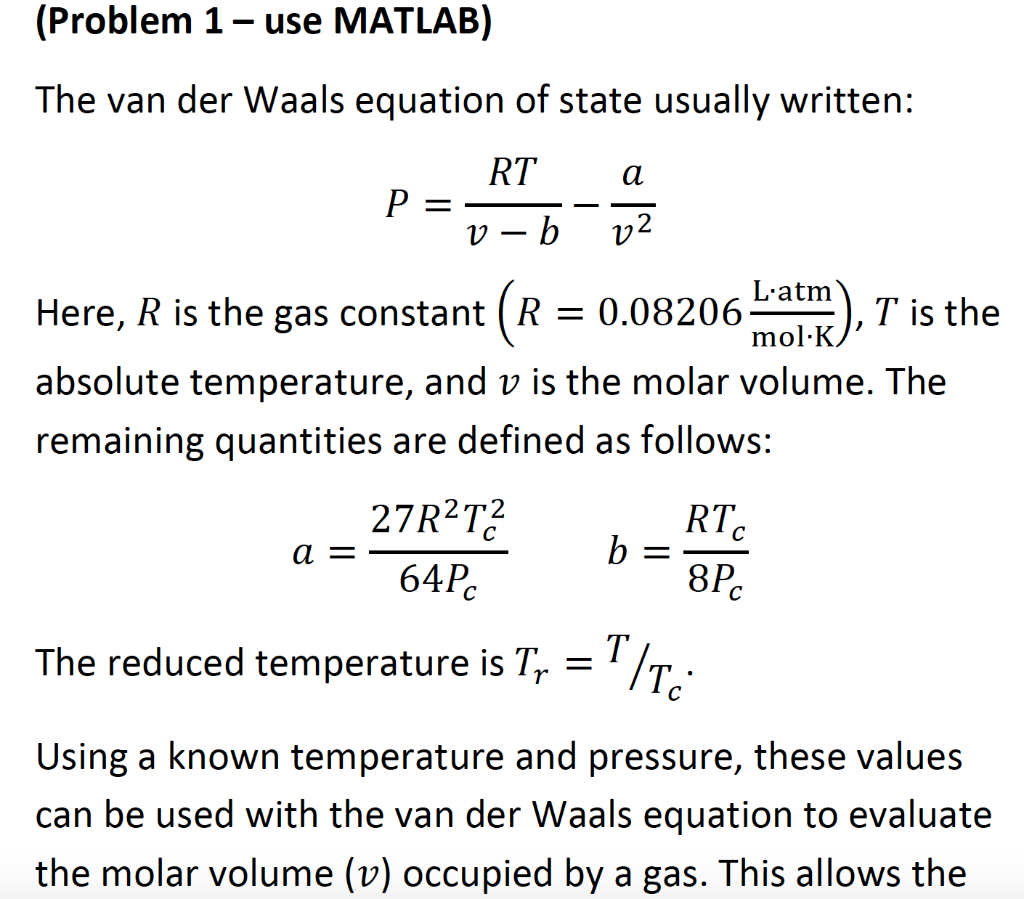
So, he came up with an equation that accounts for two things: the volume of the gas molecules themselves and the attractive forces between them.
Basically, he modified the ideal gas law. Instead of just V (volume), he subtracted a term that represents the volume occupied by the gas molecules. This is usually denoted as 'nb,' where 'n' is the number of moles and 'b' is a Van der Waals constant specific to each gas. So the gas now has less 'free space' to bounce around in, get it?

And what about those attractive forces? Well, he added a term to the pressure. Because the molecules are attracted to each other, they don't hit the walls of the container with as much force. This term is typically (an²/V²), where 'a' is another Van der Waals constant representing the strength of the intermolecular forces.
The Glorious (and Slightly Intimidating) Equation
So, what's the full Van der Waals equation? Drumroll please...
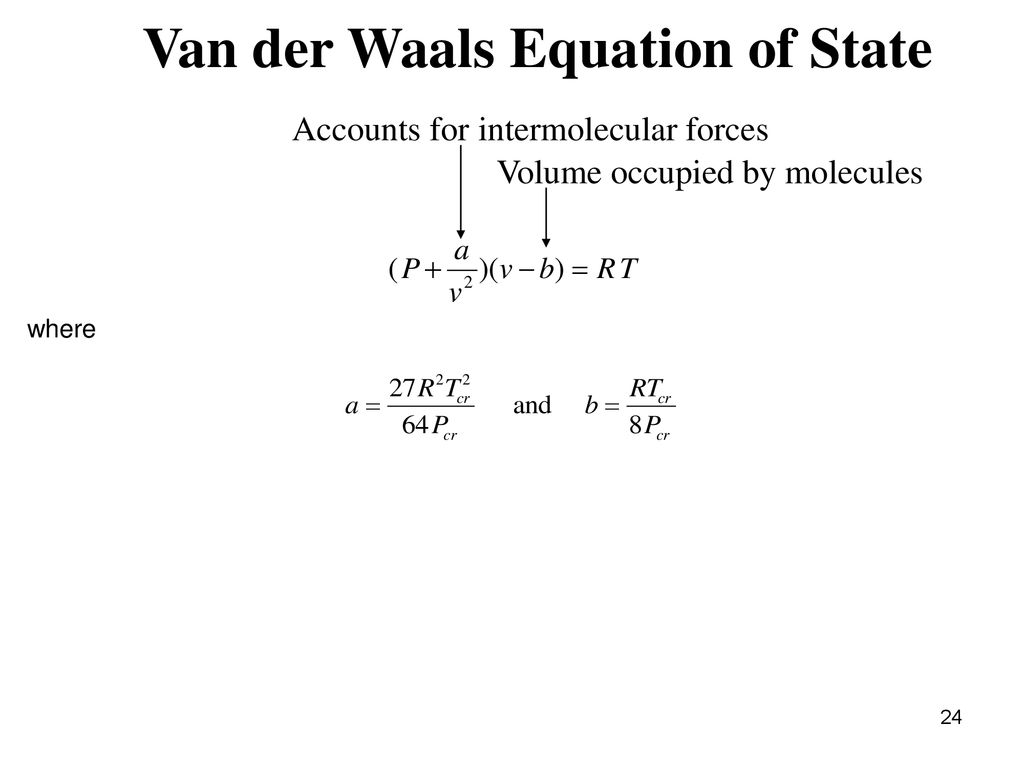
(P + an²/V²)(V - nb) = nRT
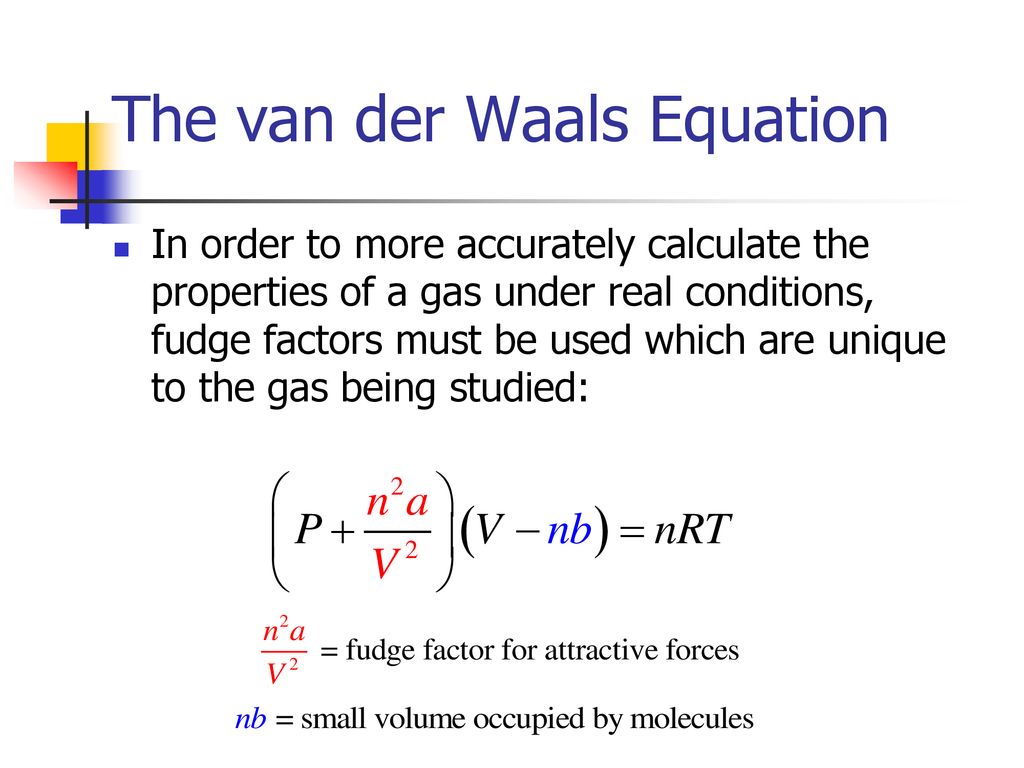
Whoa. Okay, don’t panic! It's just the ideal gas law with a couple of tweaks. See? Not so scary. Those 'a' and 'b' constants are different for every gas, because different gases have different molecular sizes and different strengths of attraction. You can usually find them in a table, so you don't have to memorize them (thank goodness!).
Why Bother? Is It Really That Important?
You might be thinking, “Okay, cool. But why should I care?” Well, the Van der Waals equation is way more accurate than the ideal gas law for real gases, especially at high pressures and low temperatures where those molecular interactions really start to matter.
Think about it: the ideal gas law kinda falls apart when you try to predict the behavior of a gas that's about to turn into a liquid, right? It’s like trying to describe a toddler's tantrum using only calm, logical statements. Just… doesn't work. Van der Waals helps us understand those situations a lot better. It helps us predict things like phase transitions (gas to liquid, liquid to solid) and the behavior of gases in extreme conditions.
So next time you're marveling at the fact that propane powers your grill or that liquid nitrogen can flash-freeze things, remember good ol' Van der Waals. He might not be a household name, but his equation helps us understand the weird and wonderful world of gases a little bit better. And isn't that worth celebrating?
Now, let's grab another coffee! What's next on our physics adventure?