
Temperature Of A Welding Arc
Okay, so picture this: You’re out in the backyard, it’s a bright, sunny day, and you, being the slightly mischievous scientist you are (admit it, we’ve all been there), decide to grab a magnifying glass. You focus the sun’s rays on a stray leaf, or maybe a piece of paper, and BAM! A tiny wisp of smoke, then a little charring, and if you’re patient enough, a small flame. Pretty cool, right? You just harnessed the power of the sun to create a concentrated point of heat, maybe a couple of hundred degrees Celsius, enough to kickstart a tiny fire. Impressive, for a Sunday afternoon.
Now, take that feeling of intense, focused heat, multiply it by… oh, I don’t know, a thousand, and then imagine it happening in a fraction of a second, with enough power to melt solid metal like butter. That, my friends, is getting us closer to the mind-boggling reality of a welding arc.
So, How Hot Are We Talking, Really?
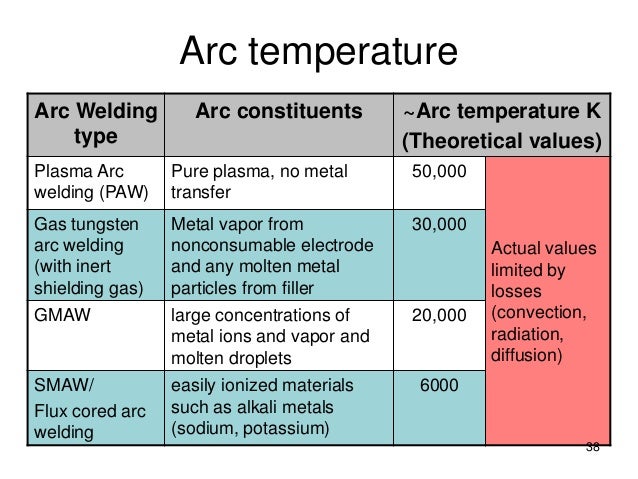
You might be thinking, "Ovens get hot, bonfires get hot, but metal melting hot? That's a whole different ballgame." And you’d be absolutely right. The temperature of a welding arc isn't just "hot"; it's in a league of its own. We’re talking anywhere from 6,000°F to 10,000°F (that's roughly 3,300°C to 5,500°C).
Must Read
Let that sink in for a second. To put it into perspective for you: the surface of the sun is about 9,940°F (5,505°C). That’s right. A welding arc can be as hot, or even hotter, than the surface of our nearest star! Isn't that just absolutely wild? When you see a welder at work, you're essentially watching someone manipulate a miniature sun to join pieces of metal together. It's less a tool and more a contained cosmic event.
Why Does This Extreme Heat Matter (and How Does it Get So Hot)?
This incredible heat isn't just for show; it's the entire point. When you strike an arc, you're creating an electrical discharge through a gas, turning it into what’s known as a plasma. This plasma channel is incredibly conductive and generates an immense amount of heat due to electrical resistance and the kinetic energy of the electrons and ions zipping around.

This concentrated, blistering heat is precisely what allows metal to melt almost instantly at the point of contact, forming the molten weld pool. This pool is where the magic happens, allowing the base metals and filler material to fuse together structurally. Without this extreme temperature, you wouldn't get the deep penetration, the strong bond, or the precise control needed for a quality weld. It’d just be a bunch of sparks and disappointment, and nobody wants that.
Think about it: the melting point of steel is around 2,500-2,800°F (1,370-1,540°C). Aluminum melts at a comparatively tame 1,220°F (660°C). Our arc temperatures are well above these points, ensuring rapid, efficient melting and a stable weld pool. It’s like using a laser to cut paper instead of scissors – extreme overkill, but incredibly effective for the job.

Safety First, Always!
Given these temperatures, it probably goes without saying, but it's super important to respect the power of a welding arc. Those bright flashes and intense heat aren't just pretty; they’re incredibly dangerous. This is why welders wear those big, dark helmets (to protect their eyes from the UV radiation that’s intense enough to give you arc eye, which is essentially a severe sunburn on your eyeball – trust me, you do not want that) and thick, protective clothing. The heat and UV radiation are no joke, folks. It’s not just the molten metal that’s dangerous; the arc itself is a force of nature.
So, the next time you see a welder, or even just hear the sizzle of an arc, take a moment to appreciate the incredible science and raw power at play. It's not just a spark; it's a controlled miniature sun, precisely manipulated to build and create, one super-heated, plasma-infused weld at a time. Pretty cool, huh? Makes that magnifying glass trick seem a little quaint now, doesn't it?

