Shielded Arc Welding Is Defined By The Following

Okay, so picture this: my grandpa, a man who could fix anything with duct tape and a squint, decided to teach me to weld. He handed me this crazy helmet, a rod that looked suspiciously like a coat hanger, and pointed at a pile of scrap metal. "Now, don't go blindin' yourself," he grumbled, before launching into what I later learned was a heavily simplified explanation of Shielded Metal Arc Welding (SMAW). It involved, and I quote, "sticking metal together with fire." Romantic, right?
Turns out, there's a little more to it than that. While my grandpa's "fire" description wasn't technically wrong, it glossed over the important bits. SMAW, also known as stick welding, is a whole process, carefully controlled, and surprisingly versatile. It's all about how that "fire" (the arc) is shielded.
So, what defines Shielded Metal Arc Welding?
Must Read
The Electrode: More Than Just a Stick
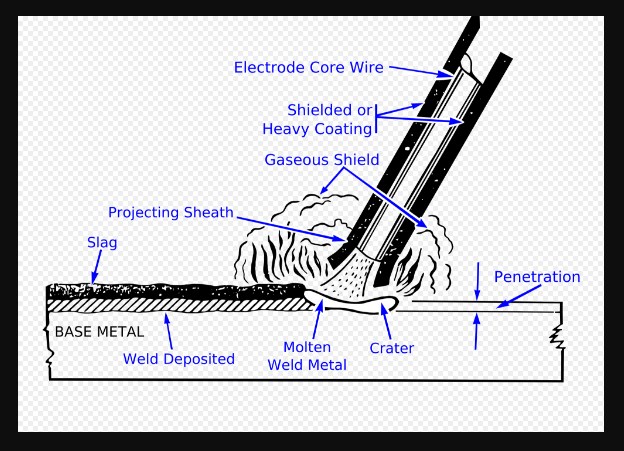
First and foremost, it's the electrode. Now, this isn't just any old metal rod. It's actually a consumable electrode, meaning it melts and becomes part of the weld. Think of it like adding a chocolate chip directly into your cookie dough – the electrode is the ingredient that bonds everything together. But here's the crucial part: the electrode is coated with a flux.
The flux is key. Seriously, it's the MVP of this whole operation. It's a chemical compound that serves several vital purposes. (We'll get to those in a sec.) Without the flux, you'd just have a molten puddle of metal exposed to the atmosphere, resulting in a weak, porous weld that's about as useful as a chocolate teapot.

Shielding Gas: The Invisible Guardian
This brings us to the "shielded" part of SMAW. As the arc forms and melts the electrode and the base metal, the flux decomposes. This decomposition produces a shielding gas, primarily carbon dioxide (CO2) and other gases, that surrounds the weld pool. This gas acts as a barrier, preventing atmospheric contaminants like oxygen and nitrogen from interfering with the weld. Imagine it as an invisible force field protecting your precious molten metal.
Why is this important? Well, oxygen and nitrogen can weaken the weld, making it brittle and prone to cracking. The shielding gas keeps these nasties away, ensuring a strong, sound weld. Think of it as the bouncer at a metal-joining party, keeping the unwanted guests out.

Slag: The Mess You Have to Clean Up
The flux also creates slag. Don't worry, it's not as gross as it sounds (though it can look pretty ugly). Slag is a layer of solidified flux that forms on top of the weld as it cools. This layer helps to further protect the weld from the atmosphere while it's cooling and also slows down the cooling rate, which can improve the weld's properties. It's kind of like a blanket for your weld.
Once the weld is cool, you gotta chip off the slag. It's a messy but necessary process. Think of it as unwrapping a present – the present is the beautiful, strong weld beneath.

So, to Summarize: The Defining Characteristics
In short, Shielded Metal Arc Welding is defined by:
- The use of a consumable electrode coated with flux.
- The flux's role in producing a shielding gas to protect the weld pool.
- The formation of slag, which further protects the weld and slows the cooling rate.
- The relatively simple and portable equipment required. (My grandpa could lug his setup anywhere! Okay, maybe not anywhere...)
These factors combine to make SMAW a versatile and widely used welding process, especially for outdoor applications and for welding thicker materials. Plus, it’s great for learning if you want to impress your grandpa (or anyone, really) with your metal-joining skills.
And hey, if I can (eventually) figure it out, so can you!