Shear Force And Bending Moment Diagram Calculator

Let's face it, the words "shear force and bending moment diagrams" aren't exactly party starters. Unless, of course, your parties involve structural engineers comparing cantilever beam anecdotes. But fear not! Even if you're not planning any beam-themed soirées, understanding these diagrams can be surprisingly useful, and thanks to technology, surprisingly easy.
Think of it like this: understanding how forces act on a beam is like understanding how the plot acts on a character in your favorite novel. The shear force is the character's immediate reaction to events, while the bending moment is the long-term consequence of those reactions. Now, wouldn't it be helpful to see that laid out visually?
Enter the Shear Force and Bending Moment Diagram Calculator! It's like having a cheat sheet to the structural integrity of…well, anything supported by a beam. These calculators are online tools, often free, that take the pain out of calculating these vital forces and displaying them in an easy-to-understand diagram.
Must Read
Why Bother? (Even If You're Not an Engineer)
Okay, so maybe you're not designing bridges or skyscrapers. But consider this: you're hanging a shelf. Knowing how much weight that shelf can hold safely depends, at least in part, on understanding shear force and bending moments. Over-engineer it, and you’ve got a behemoth bolted to your wall. Under-engineer it, and you've got a gravity-assisted implosion of your prized porcelain cat collection. The calculator can help you determine the ideal size and material for that shelf, preventing both aesthetic and feline tragedies.
Or maybe you’re just curious. Ever wondered how a diving board can withstand the force of a person launching themselves into a pool? Shear force and bending moment diagrams explain it all! They’re the unsung heroes behind every seemingly impossible feat of structural engineering.
How They Work: Demystifying the Magic Box
Most of these calculators operate on a pretty straightforward principle: "Garbage in, gospel out" (Okay, maybe not gospel, but pretty darn accurate!). You input the beam type (simply supported, cantilever, etc.), the length of the beam, and the location and magnitude of any applied loads (point loads, distributed loads, moments – don’t worry, the calculators usually have helpful descriptions). Then, with a click of a button, the calculator spits out the shear force and bending moment diagrams.
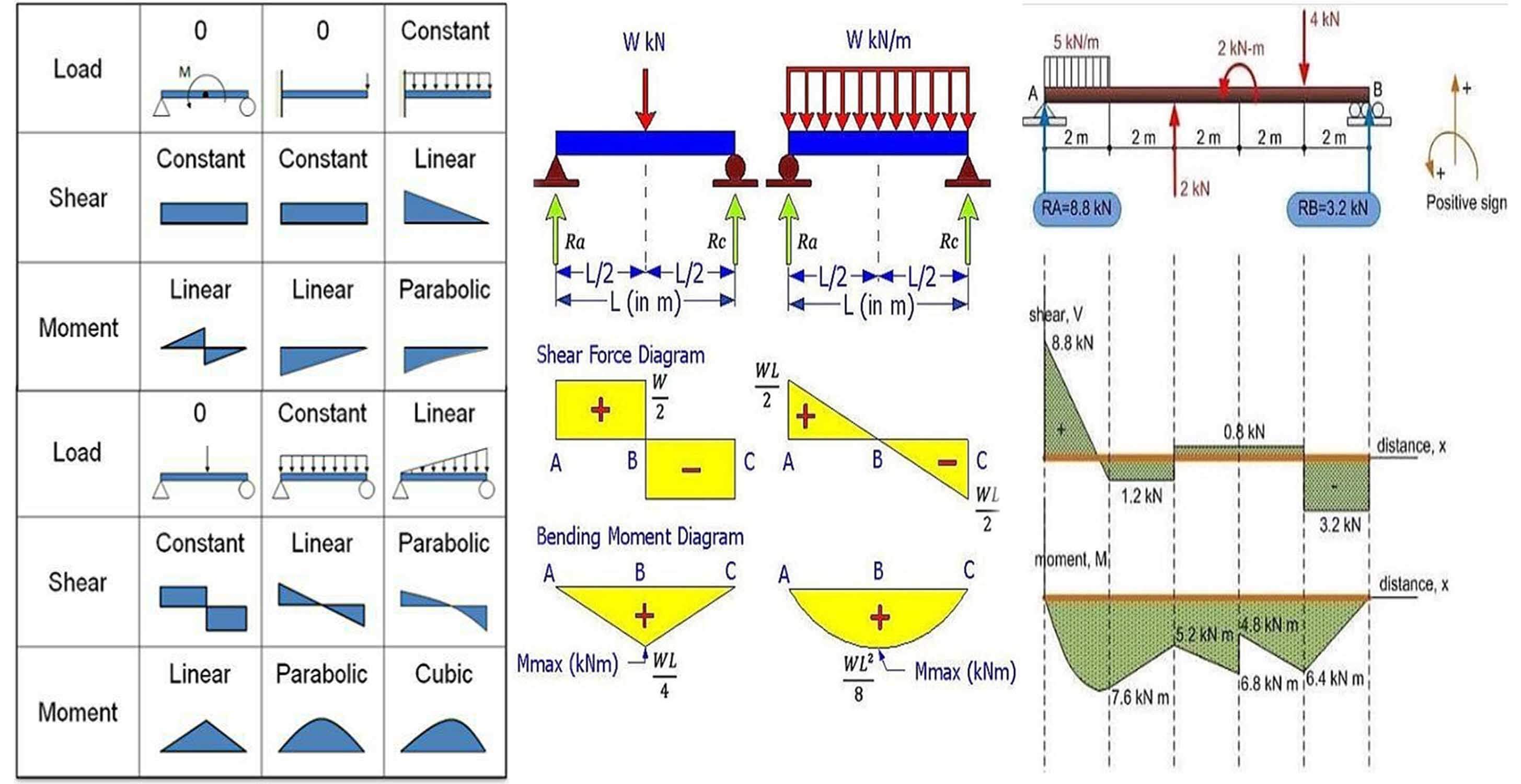
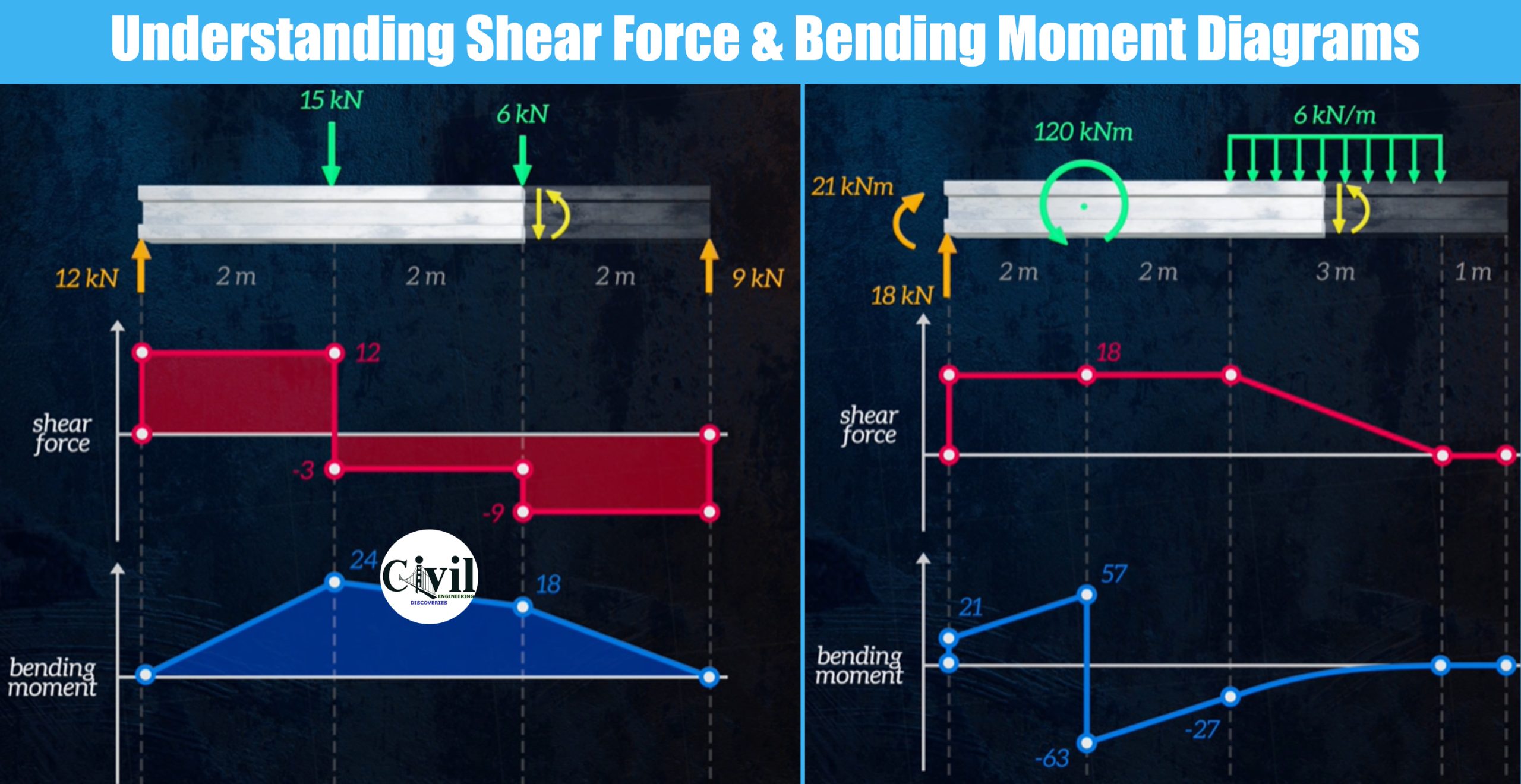
The diagrams themselves are visual representations of these forces along the length of the beam. The shear force diagram shows the internal shear force at any point, while the bending moment diagram shows the internal bending moment at any point. The maximum bending moment is particularly important, as it indicates where the beam is most likely to fail under stress.
![Shear Force And Bending Moment Diagram Calculator [diagram]](https://engineeringdiscoveries.com/wp-content/uploads/2020/10/EZHxPZ6XkAAHzQe-800x797.jpg)
Tips and Tricks for Maximum Diagramming Fun (Seriously!)
* Start simple: Begin with basic beam configurations and loading scenarios to get a feel for how the diagrams change. * Experiment with different loads: See what happens when you move a load closer to the support or add a distributed load along the entire beam. * Check your units: This seems obvious, but ensuring you're using consistent units (e.g., meters for length, Newtons for force) is crucial for accurate results. Remember the Mars Climate Orbiter debacle? Unit conversion errors cost NASA millions! * Use multiple calculators: Not all calculators are created equal. Compare results from a few different tools to ensure accuracy. * Don’t be afraid to consult resources: Many calculators offer tutorials and explanations of the underlying principles.A Little Pop Culture Connection
Ever seen a cartoon where a character steps onto a flimsy bridge that immediately bends precariously under their weight? That's a bending moment in action! While the cartoons often exaggerate the effect for comedic purposes, the underlying physics are very real. And now, you have a tool to analyze the "bendiness" of that hypothetical bridge!
From Beams to Balance: A Daily Dose of Structural Thinking
While you might not be calculating shear forces and bending moments daily, the underlying principles of load distribution and structural integrity are surprisingly relevant to everyday life. Think about packing a suitcase: distributing the weight evenly prevents excessive stress on one side, just like distributing a load on a beam. Consider also when you are moving houses, that is when understanding how beams hold the loads of building may be essential.
Understanding how structures work, even in a simplified way, can foster a greater appreciation for the built environment around us and provide an informed perspective on design decisions, from the furniture we choose to the buildings we inhabit. So, next time you see a bridge, a shelf, or even a diving board, remember the shear force and bending moment diagrams – the silent guardians of structural stability.