Prime Factorization Of 39

Ever felt like numbers are just… there? A jumble of digits with no hidden secrets? Well, prepare to have your mind slightly boggled! We're going to dive into the wonderful world of prime factorization, and specifically, we're going to crack the code of the number 39. Why 39? Because it's a perfect, manageable example that showcases the beauty and surprisingly useful nature of this mathematical concept. Think of it as detective work, but with numbers!
So, what exactly is prime factorization? Simply put, it's the process of breaking down a number into its prime number building blocks. Remember prime numbers? Those are numbers greater than 1 that are only divisible by 1 and themselves (like 2, 3, 5, 7, 11...). Think of them as the atoms of the number world. Prime factorization is finding out which of these atoms combine to create a specific larger number. The purpose? It reveals the underlying structure of a number, making it easier to work with in many situations.
Why bother with this, you might ask? Well, prime factorization has a surprising number of applications. In education, it's fundamental to understanding concepts like greatest common factors (GCF) and least common multiples (LCM) – crucial for simplifying fractions and solving various algebraic problems. Imagine trying to add fractions like 1/12 and 1/18 without knowing how to find the LCM efficiently! Prime factorization makes it a breeze.
Must Read
But it's not just for school! The principles of prime factorization underpin many technologies we use daily. For instance, cryptography, the science of secure communication, relies heavily on the difficulty of factoring very large numbers into their prime components. Think about online banking or secure websites – they use encryption methods that are based on the prime factorization of gigantic numbers. While we're dealing with a humble 39, the underlying concept is the same.

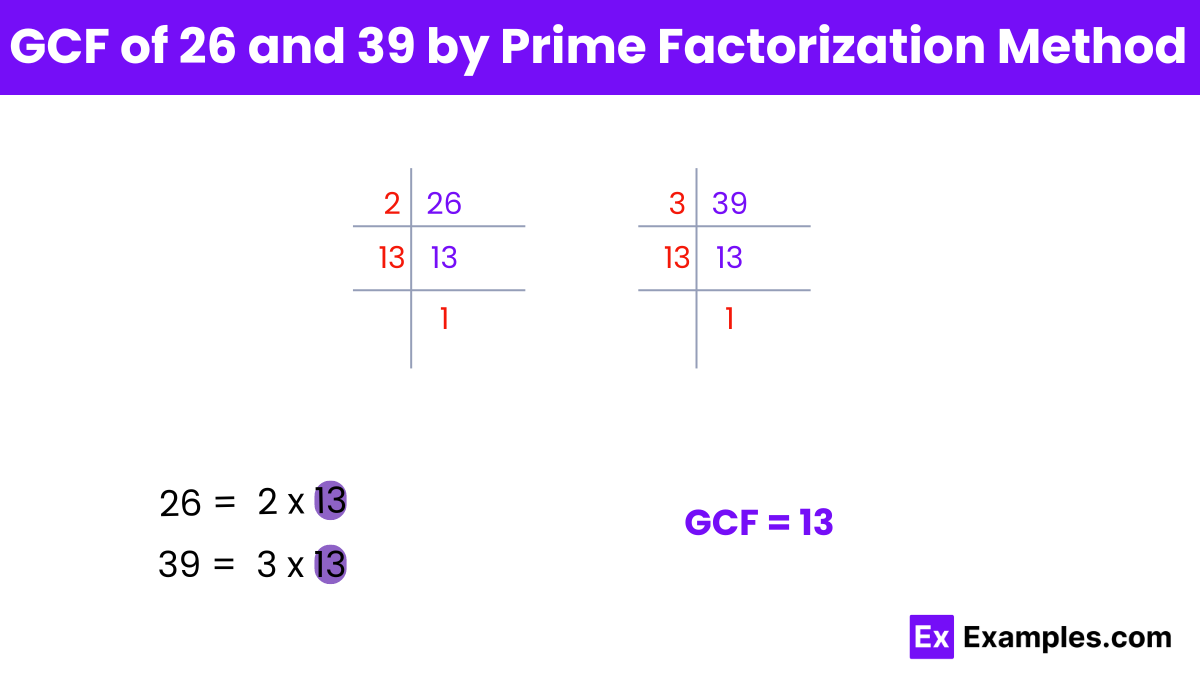
Okay, let's get back to 39! To find its prime factors, we need to ask ourselves: what prime numbers divide evenly into 39? We can start with the smallest prime number, 2. Does 2 divide evenly into 39? No. What about 3? Yes! 39 divided by 3 is 13. So, we have 3 x 13. Now, is 3 a prime number? Yes. Is 13 a prime number? Yes! Therefore, the prime factorization of 39 is simply 3 x 13. That's it! We've cracked the code.
Want to explore prime factorization further? Here are a few simple tips: start with the smallest prime numbers (2, 3, 5, 7...) and work your way up. Use a factor tree – a visual way to break down a number into its factors. There are also tons of online tools and calculators that can do the work for you, but try doing it manually first to really understand the process. Practice with different numbers. Start with small ones and gradually increase the challenge. You might be surprised at how quickly you become a prime factorization pro! It's a rewarding skill that unlocks a deeper understanding of the fascinating world of numbers.