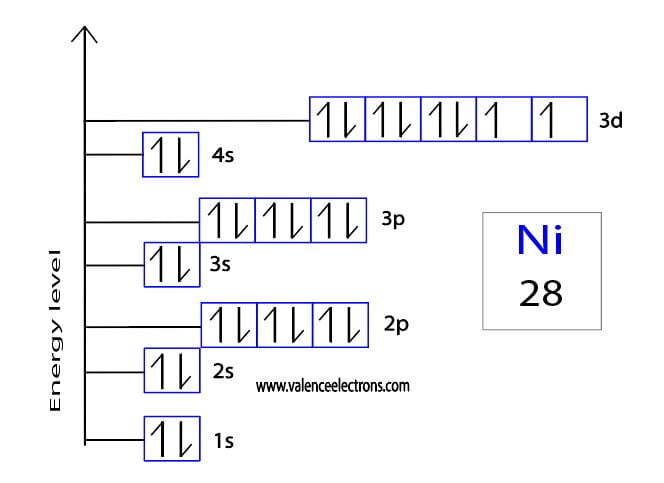
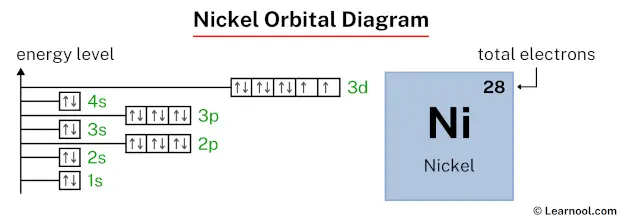
Orbital Diagram For Nickel
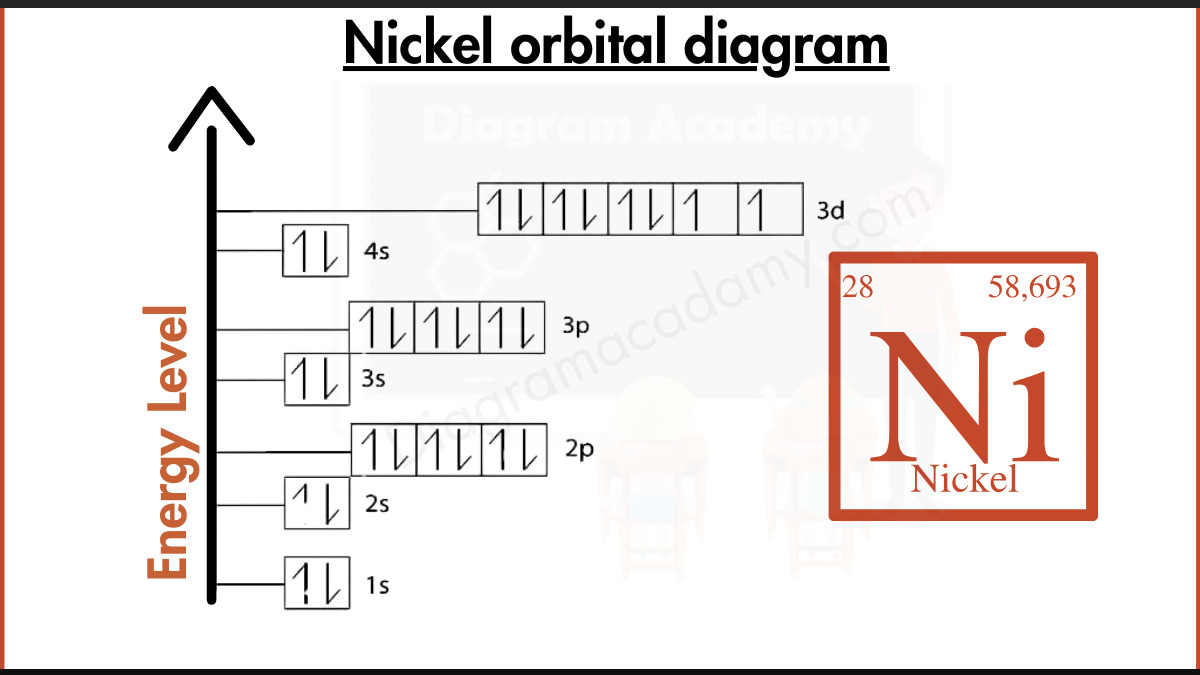
Ever wonder how scientists predict the wacky ways atoms behave? Or how they design new materials with specific properties? A secret weapon in their arsenal is the humble, yet powerful, orbital diagram! Now, I know what you're thinking: "Orbital diagram? Sounds about as exciting as watching paint dry." But stick with me, because understanding the orbital diagram for nickel, and other elements, is like gaining a superpower that lets you peek inside the very building blocks of reality. Think of it as molecular origami – a way to fold and visualize electrons to understand how they interact.
So, why bother with an orbital diagram, especially for something like nickel? Well, the benefits are surprisingly tangible. At its core, an orbital diagram visually represents the arrangement of electrons within an atom. Electrons, being negatively charged particles, dictate how atoms interact with each other. This interaction is the foundation of all chemical reactions, material properties, and even the biological processes that keep us alive! By understanding how nickel’s electrons are arranged, we can predict how it will react with other substances, what kind of compounds it will form, and even its magnetic properties.
In everyday life, nickel is found in countless applications, many thanks to understanding its electron behavior. Stainless steel, a common material in kitchens and construction, owes its corrosion resistance to nickel. Knowing how nickel bonds with iron and chromium at the atomic level allows engineers to create alloys that withstand harsh environments. Nickel-cadmium batteries, once a staple in portable electronics, relied on the controlled transfer of electrons during chemical reactions, all predicted and optimized using (you guessed it!) orbital diagrams and related concepts. Furthermore, nickel catalysts are essential in many industrial processes, such as hydrogenation (adding hydrogen to molecules), which is used in the production of margarine and various chemicals. Designing more effective catalysts hinges on understanding how nickel's electron configuration influences its interaction with reactants.
Must Read
Now, how can you make learning about and interpreting orbital diagrams more enjoyable and effective? First, don't try to memorize everything at once! Focus on understanding the basic principles, like the Aufbau principle (electrons fill orbitals in order of increasing energy), Hund's rule (electrons individually occupy each orbital within a subshell before pairing up), and the Pauli exclusion principle (no two electrons can have the same set of quantum numbers). Visualize the orbitals as boxes or circles, and the electrons as arrows pointing up or down to represent their spin. Use colored pencils or markers to differentiate between different energy levels and subshells. Online simulations and interactive tutorials can also be incredibly helpful in visualizing these concepts. Furthermore, start with simpler elements like hydrogen and helium before tackling more complex ones like nickel. And remember, practice makes perfect! Work through examples and try to predict the electron configurations of different elements. Embrace the challenge and think of it as solving a puzzle. Each successfully completed diagram is a step closer to unlocking the secrets of the atomic world!
So, the next time you encounter something made of stainless steel, or rely on a battery-powered device, remember the orbital diagram of nickel and the fascinating world it unlocks. It's a testament to how understanding the tiniest components of matter can lead to remarkable advancements in technology and beyond.