Ever peeked inside a gadget and wondered how all those tiny wires and components manage to stick together, making magic happen? Well, my friends, it's not actual magic – it's something even cooler! It's the unsung hero of the electronic world, a special kind of metallic "glue" called `solder`. And today, we're diving headfirst into the fascinating, melt-tastic world of a true legend: `60/40 solder`!
Meet Our Star: 60/40 Solder!
So, what exactly is this `60/40 solder` we're gushing about? Imagine a master chef, meticulously blending ingredients to create the perfect sauce. Our solder is an `alloy`, which is just a fancy word for a mix of different metals. In this case, it's a delightful blend of 60% tin and 40% lead. Think of it as the secret recipe that gives this particular solder its incredible superpowers.
This specific combination isn't random; it's a carefully chosen duo that gives `60/40 solder` its sweet spot for melting, flowing, and bonding. It’s been the go-to workhorse for countless electronics projects, from your grandma's trusty old radio to some of the intricate bits in modern devices (though newer lead-free options are becoming more common, `60/40` holds a special, nostalgic place in the hearts of many).
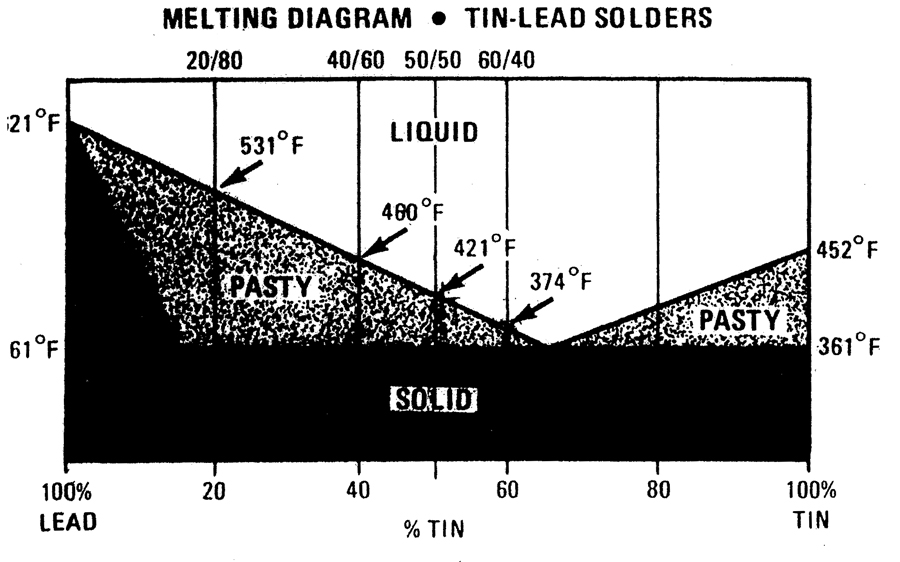
Now for the main event, the part that makes `60/40 solder` truly shine: its melting temperature! Unlike a pure metal that zaps from solid to liquid at one exact degree, our `60/40 alloy` has a small melting range. This is because it’s a mixture, like butter softening before it truly liquefies. But don't worry, it's a very helpful range, perfectly suited for its job!
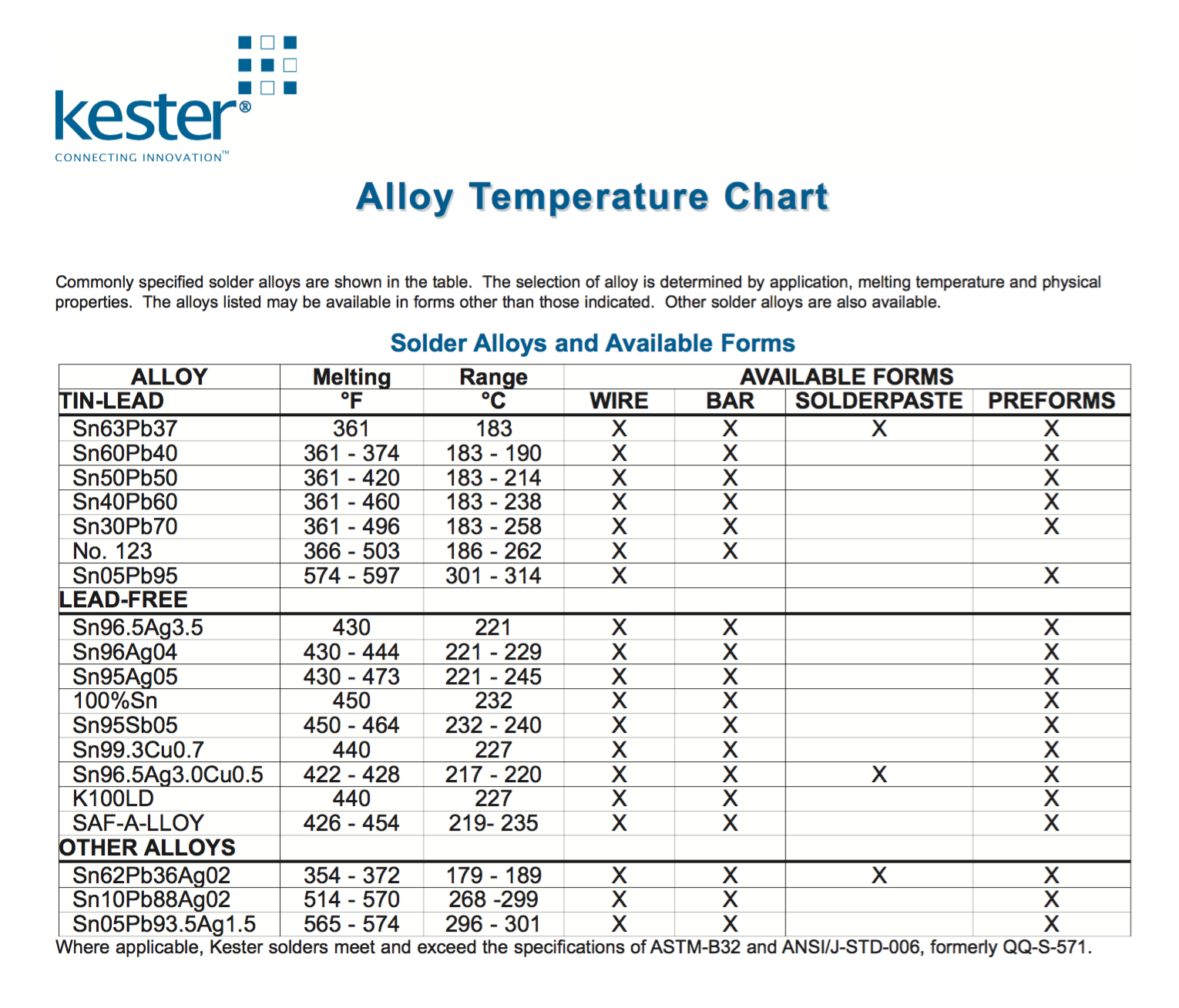
The melting point of `60/40 solder` dances between approximately `183 to 190 degrees Celsius` (that's about `361 to 374 degrees Fahrenheit`).
Soldering Temperature Guide at Ida Barrera blog
To put that in perspective, it's hotter than your oven set for baking cookies, but nowhere near the scorching heat of something like molten steel or actual lava (thank goodness!). It’s a temperature that's easily achievable with a standard soldering iron, making it incredibly accessible for hobbyists and professionals alike. Think of it like Goldilocks finding the porridge that’s "just right." Not too hot to be dangerous or difficult to work with, and not too cold to require extreme measures.
This range means it gets nice and gooey, flowing smoothly into tiny crevices and around wires, creating a super-strong, electrically conductive bond once it cools. It's the precise reason why all those tiny components in your smartphone don't just fall off when you accidentally drop it (not that we recommend trying!).
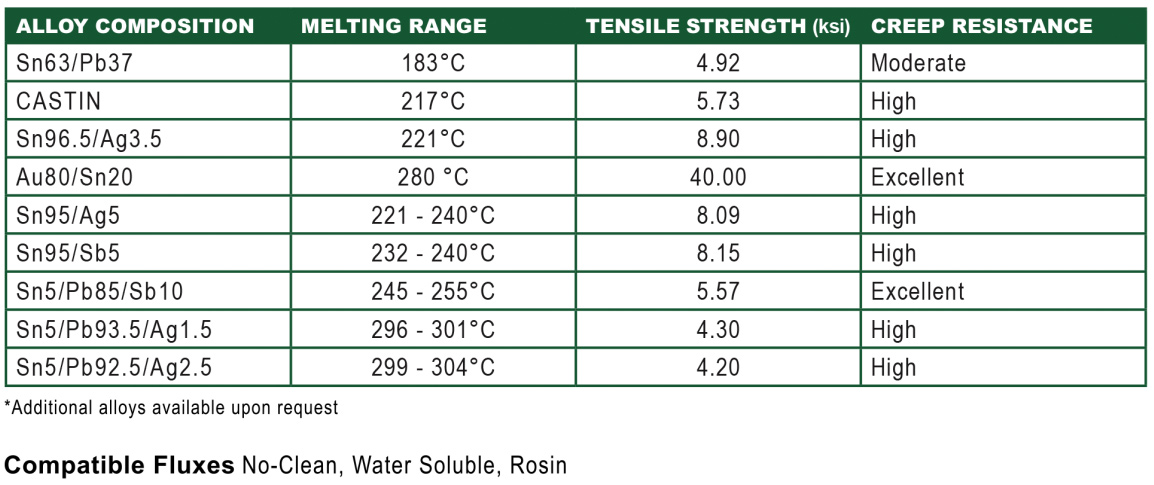
Soldering Wire Melting Temperature at Sara Rolando blog
Why Is This Melting Point So Important?
Imagine trying to glue two pieces of metal together with regular super glue. Not going to work, right? Solder is specifically designed to conduct electricity while holding things in place. The `183-190°C` melting point of `60/40 solder` is absolutely critical for a few reasons:
Precision: It allows technicians and enthusiasts to heat just a small area, attach components, and then let it cool quickly without damaging surrounding parts. It’s like performing delicate surgery with a warm, metallic precision tool.
Accessibility: This temperature is within the range of most affordable and common soldering irons. You don't need fancy, industrial-grade equipment to get started with `60/40 solder`. It’s the ultimate DIY dream metal!
Strong Bonds: When `60/40 solder` melts, it doesn't just sit on top of the metals it's joining. It actually forms a metallurgical bond, merging with the surface of the copper wire or component lead. This creates a connection that is both electrically sound and mechanically robust – a fancy way of saying it’s a brilliant conductor and it won’t fall apart!
A Little Bit of Magic in the Air
The whole process of soldering with `60/40 solder` feels a bit like magic. You touch the hot iron to the joint, feed in a thin strand of solder, and watch it instantly transform from a solid wire into a shimmering, liquid silver pool. It then flows as if by an invisible hand (that's `capillary action` at play!), wrapping around the components, and then, almost as quickly, solidifies into a shiny, permanent connection. It's a miniature, mesmerizing dance of heat and metal, all thanks to that perfect melting point.
So, What's the Takeaway?
Next time you marvel at your phone, fix a broken headphone jack, or even just consider the vast network of electronics around you, give a silent nod to the humble yet mighty `60/40 solder`. Its specific mix of tin and lead, and especially its `just-right melting point`, are fundamental to how our modern world operates. It's proof that sometimes, the smallest, most unassuming heroes are the ones holding everything together. So go forth, appreciate the subtle wonders, and maybe even try a little soldering yourself – it’s a melt-tastic experience!