
Melting Point And Boiling Point Of Magnesium
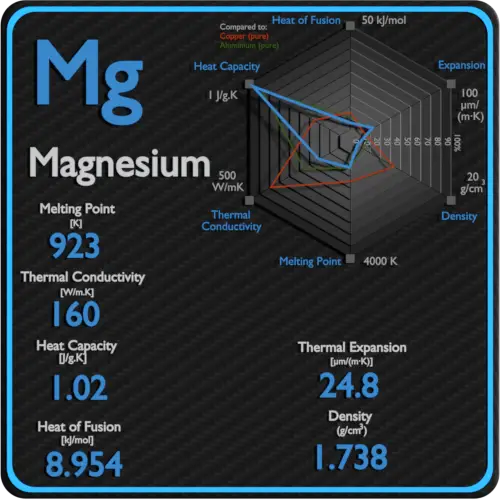
Ever wondered what it takes to make something like, say, magnesium, go from solid to liquid, or even all the way to gas? Prepare for a seriously hot adventure!
We're diving deep into the world of melting points and boiling points. Specifically, we're talking about the surprisingly interesting case of magnesium.
Melting Point: The Great Escape
Imagine a crowded dance floor. That's kind of what atoms in a solid are like. They're packed close together and vibrating in place. Now, turn up the music—that's heat!
Must Read
The more heat you add, the more those atoms start to wiggle and jiggle. Eventually, they get so wild they break free from their positions. This is when your solid starts to melt. For magnesium, this party gets REALLY good at around 650 degrees Celsius (1202 degrees Fahrenheit)!
Think about it. That's hot enough to bake a pizza... several times over! It's the temperature where solid magnesium throws off its rigid attire and starts flowing freely as a liquid.
But Why This Temperature?
Why 650°C and not, say, the temperature of your morning coffee? It all comes down to the forces holding those magnesium atoms together. These are metallic bonds.
Metallic bonds are like tiny magnets holding the atoms in place. They need a certain amount of energy (in the form of heat) to overcome these attractive forces and let the atoms slide past each other. Each element has its own unique level of “stickiness,” defining its melting point.
Isn’t it wild to think that specific temperatures are determined by atomic attraction? That’s the magic of chemistry!

Boiling Point: Going Airborne
Okay, so you've got your molten magnesium all nice and liquid. Now what? Well, crank up the heat even MORE! This is where things get truly explosive (not literally, but metaphorically!).
Remember those jiggly atoms? At a certain point, they gain enough energy to completely break free from each other. They overcome the last vestiges of attraction. They leap into the gaseous phase. This, my friends, is boiling. Magnesium's boiling point is approximately 1090 degrees Celsius (1994 degrees Fahrenheit).
Let that sink in for a moment. You'd need to heat it beyond the point where most ovens explode in order to convert molten magnesium into a gas.
Reaching for the Sky
Think of boiling as the ultimate freedom for magnesium atoms. No longer bound by any forces, they zoom around like tiny, energetic bees, each one minding their own business.
This temperature is far higher than its melting point. That's because getting a liquid to turn into a gas requires breaking even stronger bonds. Atoms in a liquid are still clinging to each other somewhat. To become a gas, they need enough energy to completely break free of this attraction.
Boiling isn’t just about temperature, it’s about liberation!
Why Should We Care About This?
So, why bother knowing the melting and boiling points of magnesium? Besides being cool cocktail party trivia, it actually has some pretty important applications.
Knowing these temperatures is essential in manufacturing, materials science, and even fireworks! Yep, magnesium is often used in fireworks to create those brilliant white sparks.
Without understanding its melting and boiling points, we couldn't safely and effectively use magnesium in these ways. A missed number could have disastrous consequences in manufacturing.
Practical Applications Abound
Consider metal casting. If you want to cast magnesium into a specific shape, you need to heat it to its molten state. But you also need to avoid overheating it to the point where it boils. Understanding the exact melting point ensures a smooth production process.
Similarly, in certain industrial processes, magnesium might be heated close to its boiling point to create vapor deposition for coatings. Precise temperature control is crucial to achieving a desired film thickness and ensuring uniformity.
From airplanes to electronics, magnesium helps to make our modern world possible. Mastering the knowledge of melting and boiling points is key to that use.

Magnesium: The Metal That Dares to Get Hot
Magnesium isn’t just some boring element on the periodic table. It's a fascinating substance with unique properties that impact our lives in numerous ways.
Its relatively high melting and boiling points are just one piece of the puzzle, but they are crucial for its applications. So next time you see a dazzling firework display, remember the humble element magnesium and its impressive journey from solid to gas.
Who knew that knowing a couple of temperatures could unlock such a world of possibilities? It's just more proof that science can be both fascinating and fun!
Beyond the Numbers: A Thought Experiment
Let's get philosophical for a second. Imagine magnesium atoms as tiny individuals, each with their own desire to be free. At room temperature, they are content with their close proximity to each other.
As the temperature rises, their desire for freedom increases, until at the melting point, they decide to loosen their grip. Then, at the boiling point, they can't take it anymore and they choose complete independence.
Okay, maybe I'm anthropomorphizing magnesium just a little bit but try to think of elements as having a personality! It makes learning a little more fun!

The Takeaway: Embrace the Heat!
The melting and boiling points of magnesium aren't just numbers. They represent a fundamental property of matter and the fascinating interactions between atoms.
By understanding these temperatures, we can unlock the potential of this amazing element. So, go forth and explore the world of chemistry. Be amazed by the extreme temperatures that shape our world.
Who knows? You might just discover your own hidden passion for the properties of magnesium!
Final Thoughts
The story of magnesium's melting and boiling points illustrates how seemingly simple concepts can have profound implications. Understanding these properties isn't just for scientists in labs.
It's for anyone who wants to understand the world around them a little bit better. So, next time you encounter magnesium (perhaps in a dietary supplement or a lightweight alloy), remember the heat it takes to transform this versatile element.
Hopefully, this has sparked a little curiosity in you. Maybe you'll even delve into other elements and their interesting properties!