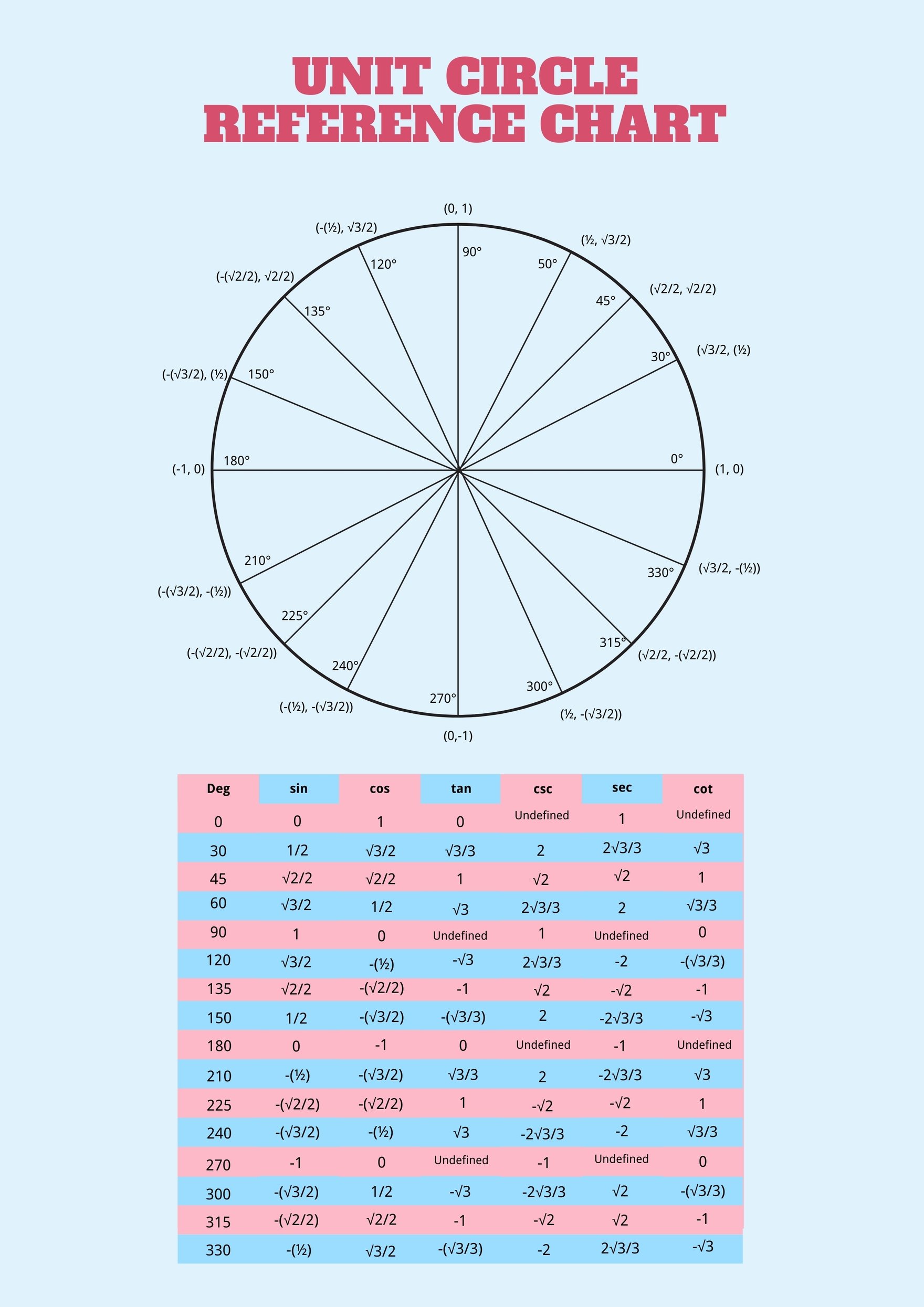
Length Of Random Chord On Unit Circle
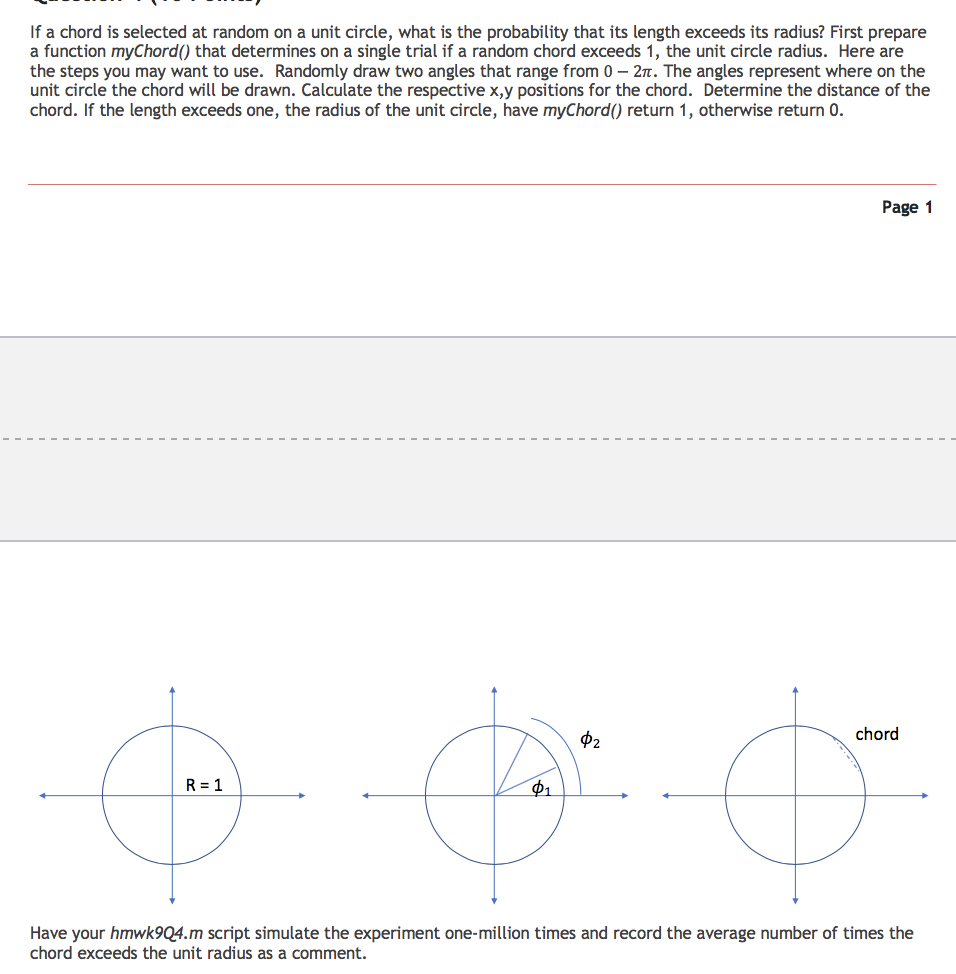
Imagine a pizza. A perfectly round, delicious pizza, fresh from the oven. Now, picture dropping a salami slice right on top. It lands randomly, cutting the pizza into two pieces. That salami slice, my friends, is our random chord on a unit circle!
We're calling our pizza a "unit circle" because, well, mathematicians love fancy terms. It just means our pizza has a radius of 1. Think of it like a perfectly measured, single-serving pizza. Now, the real question is: how long is that salami slice? Seems simple, right? Turns out, it’s surprisingly… complicated.
Here's the hilarious part. There isn't just ONE answer. Nope, we get multiple! It all depends on how you define "random" in the first place. It’s like asking “What's the best pizza topping?” You're gonna get a lot of strong opinions.
Must Read
The "Center" Approach
One way to be random is to pick a point randomly inside the pizza. Then, draw the salami slice so that point is right in the middle of it. This makes intuitive sense to many. After you do the math on this scenario, on average, your salami slice will be about 1.27 units long. Not too shabby for a random toss! It's longer than the radius of the pizza, which is kind of neat.
But hold on! Some people might shout, "That's not fair! Why does the point have to be inside the circle?" And they'd have a point.
![4.5 Geometric probabilities 1. (Random chord N1] In a | Chegg.com](https://media.cheggcdn.com/media/2fa/2fa70e75-e912-42cb-abe6-ec3f6f1cf790/phpO9dRwQ.png)
The "Endpoint" Approach
Another way is to pick two random spots on the edge of the pizza crust. Boom! Connect those spots with your salami slice. This is the "endpoint" method. Now you’re probably thinking that we'll get the same average length as before, but that’s not the case at all!
With this new interpretation of "random," the average length of the salami slice jumps to about 1.33 units. That's slightly longer than the first method. This demonstrates how sensitive the result is to how you define “randomness.”
The "Radius" Approach
Let's try one more way of creating a random line. Choose a radius (a line from the center to the crust) randomly. Then create the salami slice so it is perpendicular (at a 90-degree angle) to this radius. Now, the average length drops to… only 1 unit! Which also happens to be the radius of the pizza.
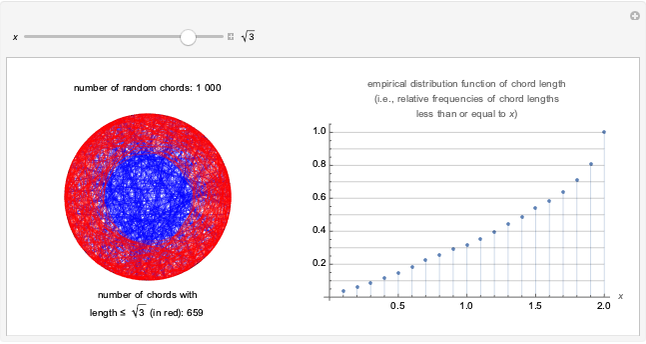
So, there you have it. Three different ways to define "random" and three different average lengths for our salami slice! It’s all a matter of perspective. This is what makes this problem so fascinating. It teaches us that even seemingly simple questions can have surprisingly nuanced answers. It also highlights the importance of carefully defining your terms – whether you're talking about pizza or complex mathematical concepts.
What’s the lesson in all of this? Math, like life, is about more than just the numbers. It's about how we ask the questions, what assumptions we make, and how we interpret the results. This problem is all about interpreting the concept of randomness. A simple question, as we’ve seen, can lead to a beautiful exploration of ideas!
Next time you're enjoying a slice of pizza, remember the random chord on a unit circle. It’s a reminder that even in the simplest of things, there’s often a hidden depth of mathematical wonder waiting to be discovered. And maybe, just maybe, you'll even impress your friends with your newfound knowledge. Just don't be surprised if they ask for a mathematical proof while you're trying to enjoy your pizza. After all, with math, there's always more to explore!
And who knows, maybe this will inspire you to cut your next pizza in a truly random way. Just try not to blame us if you end up with a slice that's all crust!
Remember to appreciate the beauty of math and the deliciousness of pizza! Maybe the universe is a bit like a pizza, perfectly round and ready to be explored, one salami slice at a time.