
Lanthanides And Actinides On The Periodic Table
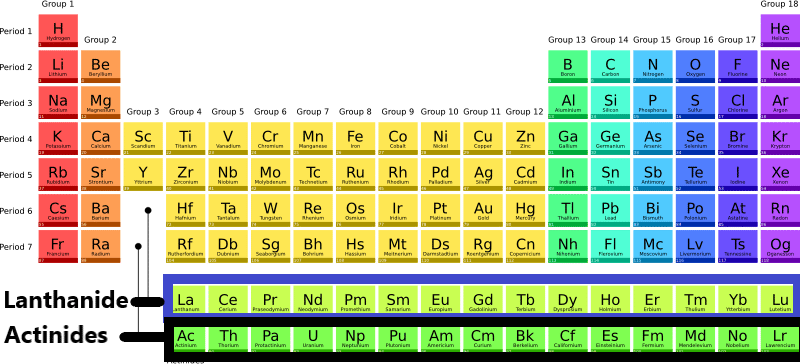
Ever glanced at the periodic table and noticed those two rows chilling at the bottom? Those are the Lanthanides and Actinides! They're a bit like the VIP section, separate from the main party. Let's dive into why they're so cool and what makes them special.
Lanthanides: The Shiny Inner Transition Metals
First up, the Lanthanides! These guys are also known as the rare earth elements. Don't let the name fool you, they're not that rare. They're just a bit scattered around and tricky to extract.
Think of them as the shiny, metallic introverts of the element world. They're all about those subtle differences. Each one has slightly different magnetic and optical properties.
Must Read
Why is that cool? Well, these subtle differences make them perfect for all sorts of tech. They're in your phone, your computer, and even some fancy magnets. Pretty important stuff, huh?
The Usual Suspects: From Cerium to Lutetium
Let's name a few, just for fun. There's Cerium, used in catalytic converters. And Europium, which makes the vibrant red in your TV screen. Not forgetting Neodymium, essential for super strong magnets.
These names might sound like something out of a fantasy novel. Which, let's be honest, adds to their appeal. Each element has its own unique "power."
Ever wonder why some rocks glow under UV light? Thank the Lanthanides! They're responsible for some seriously beautiful phosphorescent effects. Imagine having a glowing pet rock! Okay, maybe not a pet rock, but still...
They're also masters of disguise! The Lanthanides love to form colorful compounds. Depending on the element and what it's mixed with, you can get a whole rainbow of hues.
Think vibrant greens, deep blues, and passionate reds. It's like having a box of elemental crayons! This makes them super useful in pigments and dyes.

And get this: they're even used in medical imaging! Gadolinium, for example, is used as a contrast agent in MRI scans. It helps doctors get a clearer picture of what's going on inside your body.
Actinides: The Radioactive Rockstars
Now, let's move on to the Actinides! These are the more rebellious cousins of the Lanthanides. Why rebellious? Because they're all radioactive.
Don't freak out! Radioactivity isn't always a bad thing. It just means their nuclei are unstable and they release energy as they decay.
This energy can be harnessed for all sorts of applications. Of course, with great power comes great responsibility. Handling these elements requires careful precautions.
From Uranium to Lawrencium (and Beyond!)
The most famous Actinides? Probably Uranium and Plutonium. These are the powerhouses behind nuclear energy. They're also, sadly, known for their role in nuclear weapons.
But there's more to the Actinides than just nuclear bombs. Thorium, for instance, is being explored as a potentially safer and more abundant fuel source for nuclear reactors. Pretty cool, right?

Many Actinides are synthetic. That means they don't exist naturally and have to be created in a lab. Talk about scientific wizardry!
Creating new elements is like discovering new lands on a map. It pushes the boundaries of what we know about the universe. Scientists are always trying to synthesize heavier and heavier elements.
These elements often exist for only fractions of a second. But even in that fleeting moment, they provide valuable insights into the nature of matter.
Actinides have also found their way into smoke detectors. Americium is used in these devices to detect smoke particles. It's a tiny amount, but it's enough to save lives!
The radioactivity of Actinides means they're used in cancer treatment. Radiation therapy uses targeted radiation to kill cancer cells. It's a powerful tool in the fight against this disease.
Why Should You Care?
So, why should you care about these obscure elements at the bottom of the periodic table? Because they're everywhere! They're in the technology you use every day, the medicine that heals you, and even the smoke detector that protects you.

The Lanthanides and Actinides are a testament to human ingenuity. They show us how we can harness the power of the universe to improve our lives.
They also represent the endless frontier of scientific discovery. There's still so much we don't know about these elements. The possibilities are endless!
Next time you look at the periodic table, don't skip over those bottom rows. Give the Lanthanides and Actinides a second glance. They're more exciting than you might think!
They're a reminder that even the seemingly obscure corners of science can hold incredible wonders. Go explore them and see what you can discover!
Who knows, maybe you'll be the next scientist to unlock their secrets. The periodic table is waiting for you!
So there you have it. The Lanthanides and Actinides, explained without the confusing science jargon. Hopefully, I inspired you to investigate and delve into the world of the VIP section of the periodic table!

Let's look at more: One use for Lanthanides is in improving glass. When added to glass, Lanthanides improve the material's strength, heat resistance, and optical properties.
You know those green night-vision goggles used by law enforcement? Some of them rely on Lanthanides to see in the dark.
They're also used in industrial processes like petroleum refining. Lanthanides act as catalysts, speeding up chemical reactions that are critical to the process.
As for the Actinides, they aren't only used for dangerous purposes. They offer a lot of possibilities for future technologies and scientific advancements.
Scientists are constantly investigating them for next-generation batteries. The goal is to create batteries that are smaller, more efficient, and longer-lasting.
Research is being conducted on the use of Actinides to remove radioactive contaminants from the environment. Certain Actinides can bind with radioactive isotopes, making them easier to extract and dispose of.
The more research we do, the more uses we find for these elements.