
Is Volt Amps The Same As Watts

Ever stared at a power adapter or UPS, seeing both "Watts" and "Volt-Amps" (VA)? Did you wonder: "Are those... the same?"
Spoiler! They're not identical twins, but close cousins. Understanding their quirky relationship is surprisingly fun, I promise!
The Cast of Characters: Volts, Amps, and Their Pal Watts
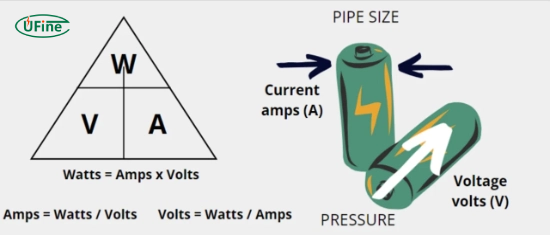
Electricity: a river. Volts are water pressure. Amps (Amperes) are flow—how much water moves.
Must Read
Watts are the real stars. They measure actual power consumed. This powers your lights, fan, phone. It's the "workhorse" power you pay for! Think: delicious beer. More beer, less foam, right?
Enter the Mysterious Volt-Amps (VA): Apparent Power
If Watts are beer, what are Volt-Amps (VA)? VA measures "apparent power." It's the total power flowing, even if some isn't useful. Your glass's entire contents – beer AND foam.
"Wait, what?!" you ask. Power flow without useful work? Welcome to alternating current (AC)! Things get wavy, out of sync.

The Dance of Power: Getting In Sync (or Not!)
In a perfect world (like a toaster), voltage and current waves perfectly sync. They rise and fall together. Watts and VA are practically the same! Power factor is 1, baby!
Many devices are complicated. Motors, computers, LED lights—they have coils or capacitors. These make voltage/current waves step out of sync. Energy flows, but not all is immediately useful. Some is stored, then sent back!
This "out-of-sync" power makes VA higher than Watts. The power company supplies total current (VA), even if not all converts to Watts.
The Unsung Hero (or Villain?): Power Factor!
The Watts/VA relationship is summed up by Power Factor. A number (0-1) telling you device power efficiency.
Watts = VA × Power Factor.
If Power Factor is 1 (our toaster), Watts = VA. If it's 0.7 (for motors), Watts are only 70% of VA. Mind blown? Their secret handshake!
:max_bytes(150000):strip_icc()/the-difference-between-watts-vs-volts-4767057_V3-9bb4bdf5c97d4f758cbc185d40376e89.png)
Why Does This Even Matter to You?!
Enough physics. Why care?
-
UPS Systems: Your UPS rated in VA (e.g., 1500VA) and Watts (e.g., 900W)? A UPS supplies the total current (VA) devices demand, even if some isn't immediate work. A 500W computer with low power factor might demand 700VA. Always check both!
-
Power Grid Efficiency: Power companies love high power factors! Low power factor devices mean utilities transmit more "apparent power" (VA) for the same "real power" (Watts). Bigger wires, more losses. Like a bigger truck for a smaller package due to packing peanuts!

Understanding the Fundamentals: Key Differences between Watts and Volts -
Appliance Ratings: Industrial equipment or household motors list VA. Knowing this helps understand actual load on wiring/circuits. Crucial for safety!
The Takeaway: More Than Just Numbers!
Volt-Amps same as Watts? Not exactly. But intimately related by the magical Power Factor! Watts are productive power (beer). VA is total power flow (beer and foam).
Like potential to lift weight (VA) vs. actual weight lifted (Watts). Potential exists, but factors (technique—our power factor!) determine outcome.
Next time you spot these terms, you'll see more than numbers. A fascinating dance of electricity, efficiency, and real "work." Pretty cool for something that just plugs in, huh?