Is Malleability A Chemical Or Physical Property

Ever bent a paperclip until it snapped? Or watched a blacksmith hammer a glowing piece of metal into a horseshoe? These simple acts touch upon a fascinating property of matter called malleability. But where does malleability fit in the grand scheme of science? Is it a chemical property, indicating how a substance reacts with others, or a physical property, describing its inherent characteristics? The answer, surprisingly, is the latter, and understanding why is a fun little journey into the heart of materials science.
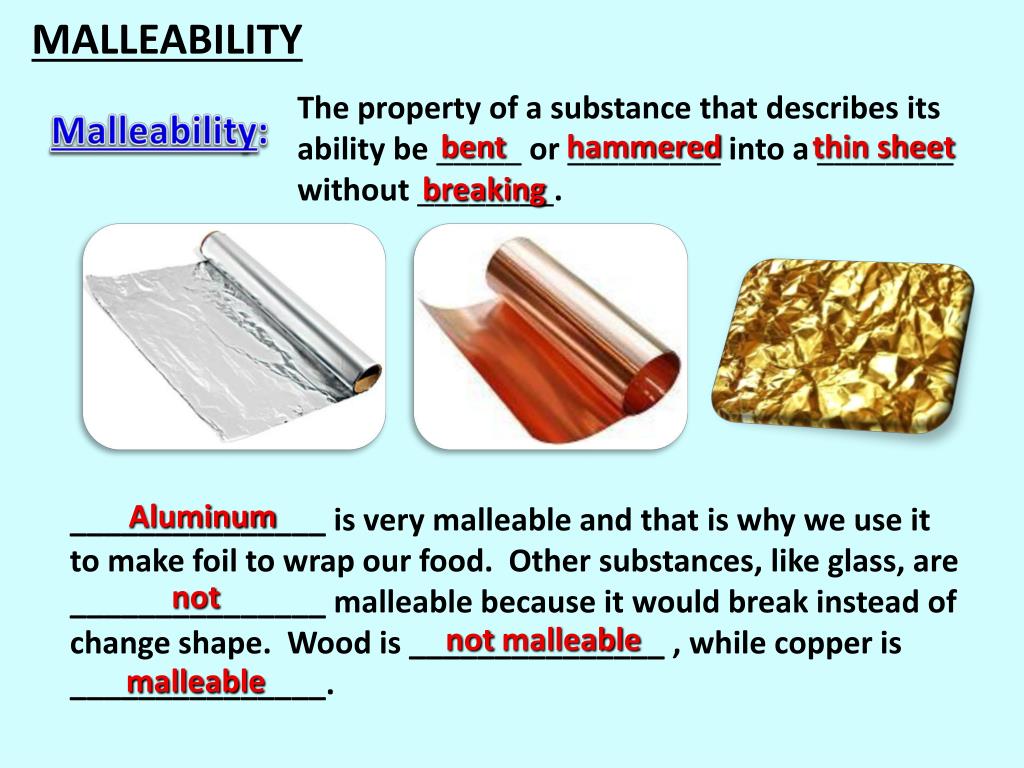
So, what exactly is malleability? Put simply, it's a substance's ability to deform under compressive stress – that is, to be hammered or rolled into thin sheets – without fracturing. This is a physical property because the process of hammering or rolling doesn't fundamentally change the composition of the material. Gold, for example, is incredibly malleable. You can beat it into gold leaf so thin it's practically transparent. The gold is still gold; its atoms haven't rearranged to form a new substance. Contrast this with, say, burning wood. Burning is a chemical reaction that transforms wood into ash, carbon dioxide, and other substances. The wood is no longer wood. Malleability, therefore, is about how a material responds to force, not about a chemical transformation.
Understanding malleability is useful in numerous ways. In education, it helps students grasp the difference between physical and chemical properties, a crucial concept in chemistry and physics. Learning about malleable materials can spark curiosity about material science and engineering, potentially inspiring future inventors and innovators. Think about the aluminum foil in your kitchen. Its malleability allows it to be formed into thin, flexible sheets perfect for wrapping food. Copper wires, essential for electrical conductivity, are also malleable, enabling them to be drawn into long, thin strands and bent to fit into complex circuits. Car bodies owe their shape to the malleability of steel, allowing it to be pressed and molded into aerodynamic designs.
Must Read
The benefits of malleable materials are huge. They're essential for manufacturing, construction, and countless everyday applications. The ability to shape metals into complex forms allows us to create tools, machines, and structures with tailored properties. From the tiny gears inside a watch to the massive beams that support a skyscraper, malleability plays a critical role. Without malleable materials, our world would look very different.
Want to explore malleability yourself? A simple experiment is to try bending different types of wire – copper, steel, aluminum. Observe how easily each bends and whether it breaks easily. Compare them! You can also try gently hammering a small piece of clay or playdough. Notice how it flattens and spreads without crumbling. Compare this to trying to hammer a piece of brittle material like dry plaster – it will likely shatter. By experimenting with different materials, you can develop an intuitive understanding of malleability and its importance. Think of it as a playful exploration of the amazing properties of the stuff around us!