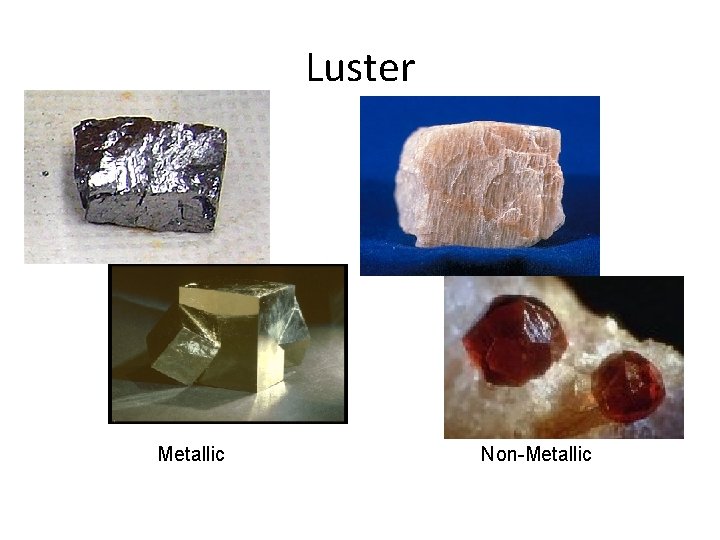
Is Luster A Metal Or Nonmetal

Have you ever caught the glimmer of a brand-new car, the sparkle of a favorite piece of jewelry, or the bright sheen of a polished apple? That amazing shine is something we all notice and often admire. It’s what makes things stand out!
There's a special word for this wonderful quality: luster. It describes how light bounces off the surface of an object. Think about it. Some things are super shiny, almost like a mirror. Others are dull, absorbing light instead of reflecting it. But here's a fun question, a real brain-teaser that might make you scratch your head:
Is luster a metal or a nonmetal?
Sounds simple, right? But take a moment. What comes to mind when you hear "shiny"? For most of us, our minds instantly jump to things like gold, silver, copper, or even the chrome on a bicycle. These are all definitely metals. They're famous for their incredible shine, aren't they?
When you picture a gold coin, it practically glows. A silver spoon, fresh from a wash, practically winks at you. That brilliant, reflective quality is often called metallic luster. It’s why we love these materials for decorations, jewelry, and even fancy kitchenware. Metals just have that "wow" factor because of their amazing ability to catch and reflect light. They seem to have their own inner light sometimes!

The Great Reveal!
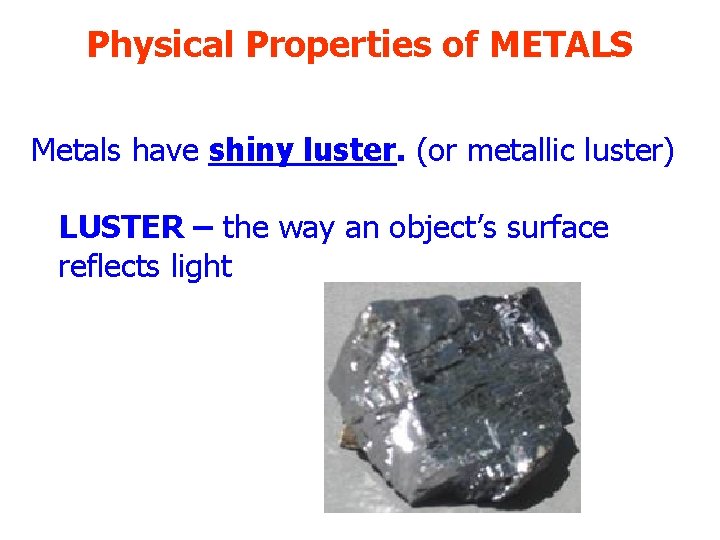
So, does that mean luster itself is a metal? Well, here's where the fun really begins, and it's a little bit of a trick question! The truth is, luster isn't something you can hold in your hand. It's not a physical object or a material at all. Instead, it's a property. Think of it like a descriptive word, an adjective, rather than a noun.
Imagine describing a blanket. You might say it's soft, warm, or fuzzy. Softness isn't the blanket itself; it’s a way to describe how the blanket feels. In the same way, luster is a way to describe how a material looks when light hits it. It's a characteristic, a quality, a visual trait.
Not Just Metals Can Shine!
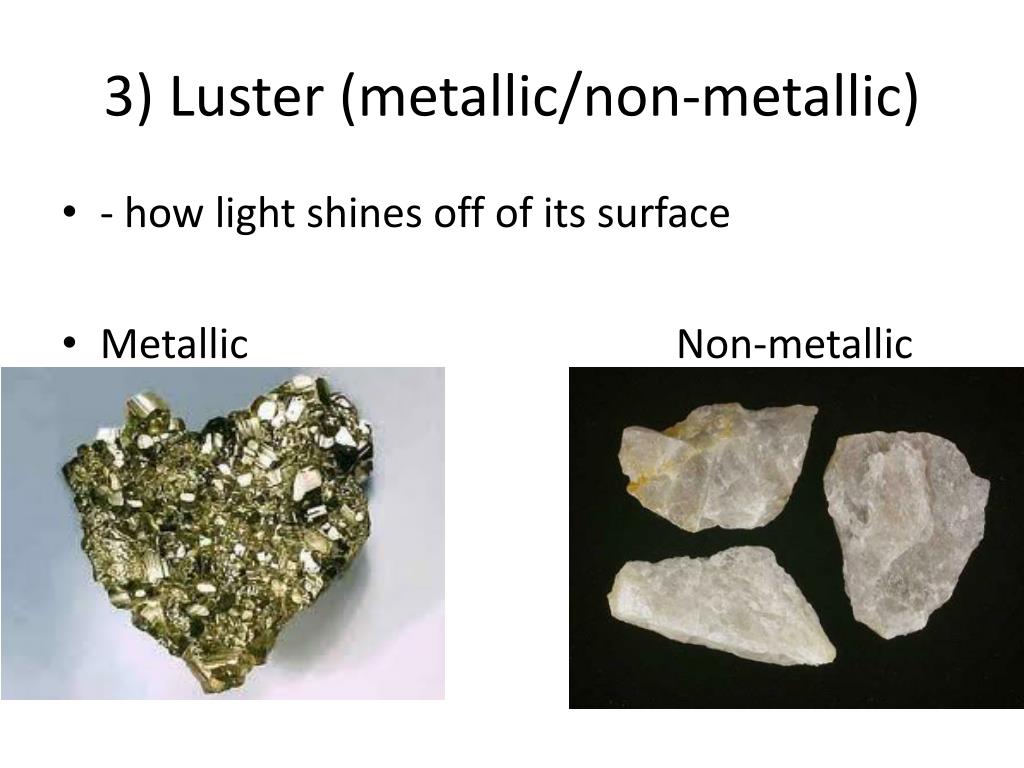
While metals are the superstars of shine, they aren't the only ones that can put on a light show! Take a look at a diamond. Is a diamond a metal? Nope! Diamonds are pure carbon, which is a nonmetal. Yet, a well-cut diamond sparkles like crazy, doesn't it? It has what's called adamantine luster – a brilliant, almost glass-like shine.
What about the lead in your pencil? That's actually graphite, another form of carbon and a nonmetal. If you look closely at the tip of a pencil, especially a new one, it has a subtle shine, a kind of dull metallic look. This shows that even nonmetals can exhibit a form of luster, though it might not be as dazzling as gold.
And then there are plenty of nonmetals that have no shine at all. Think about wood. Most wood is pretty dull, right? Or rubber. Does a rubber band sparkle? Not usually! These materials are often described as having a dull or earthy luster – which basically means they don't reflect much light at all.
Why This Is So Entertaining!
Understanding what luster truly is makes us look at the world a little differently. It turns a simple observation into a fun detective game! You start noticing the distinct types of shine everywhere. The high polish of a ceramic tile versus the soft sheen of silk fabric. The brilliant gleam of a glass window versus the subtle shimmer of a smooth stone.
It's a great conversation starter at parties. "Hey, what kind of luster does that have?" It reminds us that appearances can be deceiving, and that understanding the simple definitions of words can unlock new ways of appreciating the world around us.
So, the next time you see something incredibly shiny, or wonderfully dull, remember that you're observing its luster. And you now know the secret: luster isn't a metal or a nonmetal. It’s a fantastic way to describe how any material interacts with light, making our world a more vibrant and interesting place, one sparkle at a time! Go ahead, look around you – what kind of luster can you spot?