
Interest Rate Td Ameritrade Margin Account

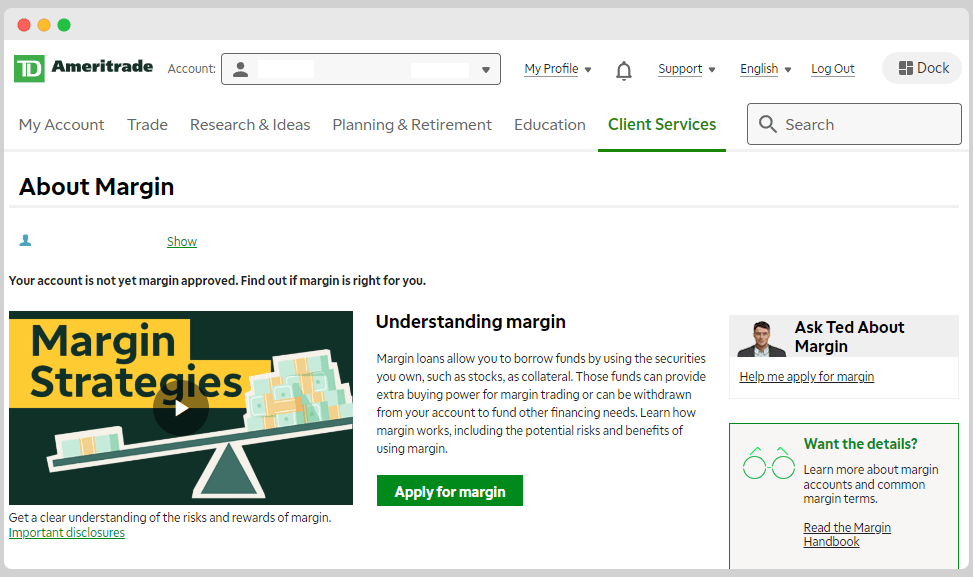
Ever feel like your money is just sitting there, twiddling its thumbs? You're investing, that's great! But what if you could, like, borrow against those investments? That's where a margin account with TD Ameritrade comes in. Think of it as giving your money a rocket booster... with a little seatbelt called "interest."
The Margin Account: It's Not Free Money!
Okay, so imagine you have a collection of vintage Beanie Babies worth $10,000. (Hey, no judgement! They might be worth something someday...maybe.) A margin account is like a pawn shop, but instead of pawning your precious plushies, you're using your investments as collateral. TD Ameritrade says, "Alright, Beanie Baby enthusiast, we'll lend you a portion of that value, say, $5,000."
Cool, right? Instant buying power! But here's the catch (and there's always a catch, isn't there?): They're going to charge you interest on that borrowed $5,000. Think of it like renting the money.
Must Read
Interest Rates: The Sneaky Rent
Now, interest rates are like the weather in Chicago – they change all the time. One day it's sunny and low, the next it's a blizzard of percentages! These rates depend on a bunch of complicated factors, like the Fed Funds rate (don't worry about that for now!), the size of your margin balance, and even TD Ameritrade's internal voodoo economics (just kidding... mostly!).
The bigger your loan, sometimes the lower the rate. It's like buying in bulk at Costco – the more you buy, the cheaper each item gets. So, borrowing $50,000 might get you a slightly better rate than borrowing $5,000. But remember, it's still money you have to pay back!

The Danger Zone: Margin Calls!
Here's where things can get a little spicy. Imagine your Beanie Baby collection suddenly loses value. Maybe a new documentary reveals they're actually dust mite magnets. Suddenly, your $10,000 collection is worth only $6,000. Yikes!
TD Ameritrade gets nervous. They lent you $5,000 based on that $10,000 value. Now, your collection barely covers the loan! They issue a margin call. This is essentially a polite (but firm) request to deposit more money into your account or sell some of your investments to bring your account back into good standing. Ignore it, and they might just sell your Beanie Babies for you! (Okay, they'll sell your stocks, but the analogy is funnier with Beanie Babies.)
Margin: A Tool, Not a Toy
Using margin can be a powerful tool to amplify your returns. If your investments go up, you make even more money! Think of it as turbocharging your portfolio. But, and this is a big BUT, it can also magnify your losses. If your investments tank, you lose even more. It's like putting a rocket booster on a skateboard – exciting, but potentially disastrous if you don't know what you're doing.
Before diving into margin, do your homework! Understand the risks, the interest rates, and the dreaded margin calls. Maybe even practice with a paper trading account first. Treat margin with respect, and it can be a valuable addition to your investing toolkit. Ignore the risks, and you might end up wishing you'd just stuck with the thumb-twiddling.
The Humorous Side of Interest
Let's be honest, nobody loves paying interest. It's like paying for the privilege of having more money (which you then have to pay back!). But, hey, at least it's predictable (kind of!). And think of all the financial literacy you're gaining! You're practically a rocket scientist of finance now... almost.
"Investing should be more like watching paint dry or watching grass grow. If you want excitement, take $800 and go to Las Vegas." - Paul Samuelson
While Samuelson suggests avoiding excitement in investing, using margin does add a layer of, well, excitement. Just remember to buckle up, understand the risks, and maybe keep a close eye on the Beanie Baby market. You never know when they might make a comeback!
