
How To Tell What Size Ac I Have

Alright, let’s talk ACs. Specifically, the mysterious case of “What size is my air conditioner, anyway?” It’s one of those things you don’t think about until you absolutely have to. Like when your old unit finally kicks the bucket (usually on the hottest day of the year, naturally) or you’re trying to be a responsible homeowner and replace a filter. Suddenly, you're faced with numbers and jargon that feel like they're written in a secret alien language. Don't sweat it – literally! We're going to crack this code together, no engineering degree required.
Think of it like buying shoes. You wouldn't try to squeeze into a size 6 if you're a size 10, right? (Unless you enjoy extreme discomfort and eventual blisters.) The same goes for your AC. An air conditioner that's the wrong size for your home is like trying to cool a ballroom with a desk fan, or trying to chill a closet with a giant industrial chiller. It just doesn’t work, and you end up feeling either perpetually sticky or like you're living in an arctic tundra, neither of which is ideal.
Why Does AC Size Even Matter? (Spoiler: It Really Does!)
If your AC is too big, it’s going to blast cold air so fast that your house hits the thermostat setting before it’s had a chance to properly dehumidify the air. This leads to that clammy, sticky feeling even though it’s technically cool. It also "short cycles," meaning it turns on and off constantly, which is terrible for energy efficiency and puts extra wear and tear on the unit. It's like a sprinter running a marathon – lots of bursts, but not sustainable or effective for the long haul.
Must Read
On the flip side, if your AC is too small, it’s going to run, and run, and run… and probably never quite catch up. You’ll be pouring money into electricity bills, and your home will still feel a bit warm, especially on those truly scorching days. It’s like trying to bail out a leaky boat with a teacup. You’re putting in the effort, but you’re just not winning the battle against the heat.
The Secret Language: BTUs and Tons
Okay, so how do they measure these things? You’ll typically hear two terms: BTUs and Tons. BTUs (British Thermal Units) are a measure of heat removal. A higher BTU number means more cooling power. Think of it like horsepower for your car – more horses, more oomph!
Then there are "Tons." No, we're not talking about heavy machinery here. One "ton" of cooling is equal to 12,000 BTUs per hour. So, a 3-ton AC unit can remove 36,000 BTUs of heat per hour (3 x 12,000). Most residential ACs fall between 1.5 to 5 tons. These are the numbers we’re ultimately looking for!
The Great Sticker Hunt: Where to Find the Clues
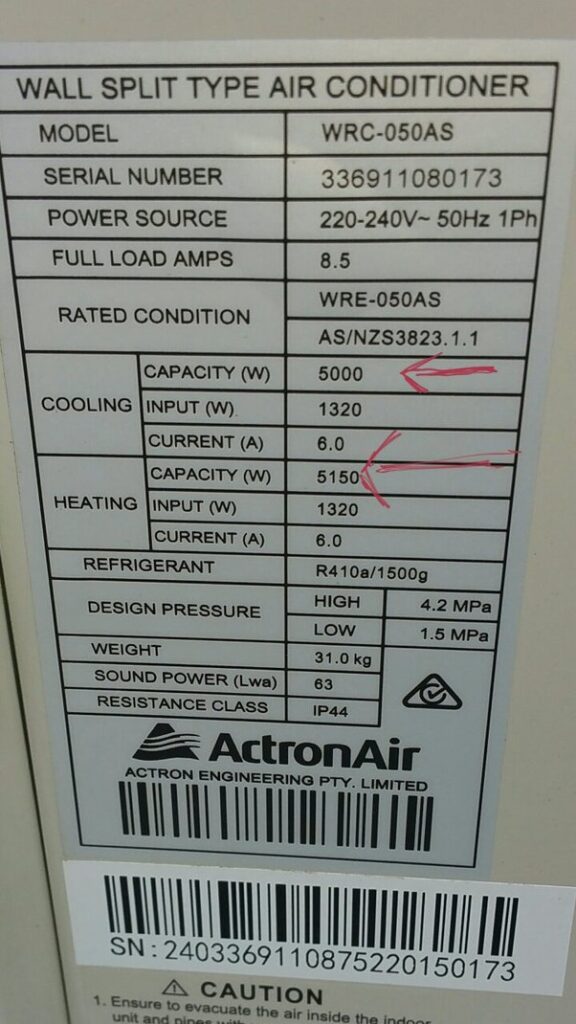
Your AC unit is probably hiding its size right there on its body, just waiting for you to find it. Think of it like a secret tattoo. You’re looking for the nameplate or sticker, which usually contains a treasure trove of information, including the model and serial number.

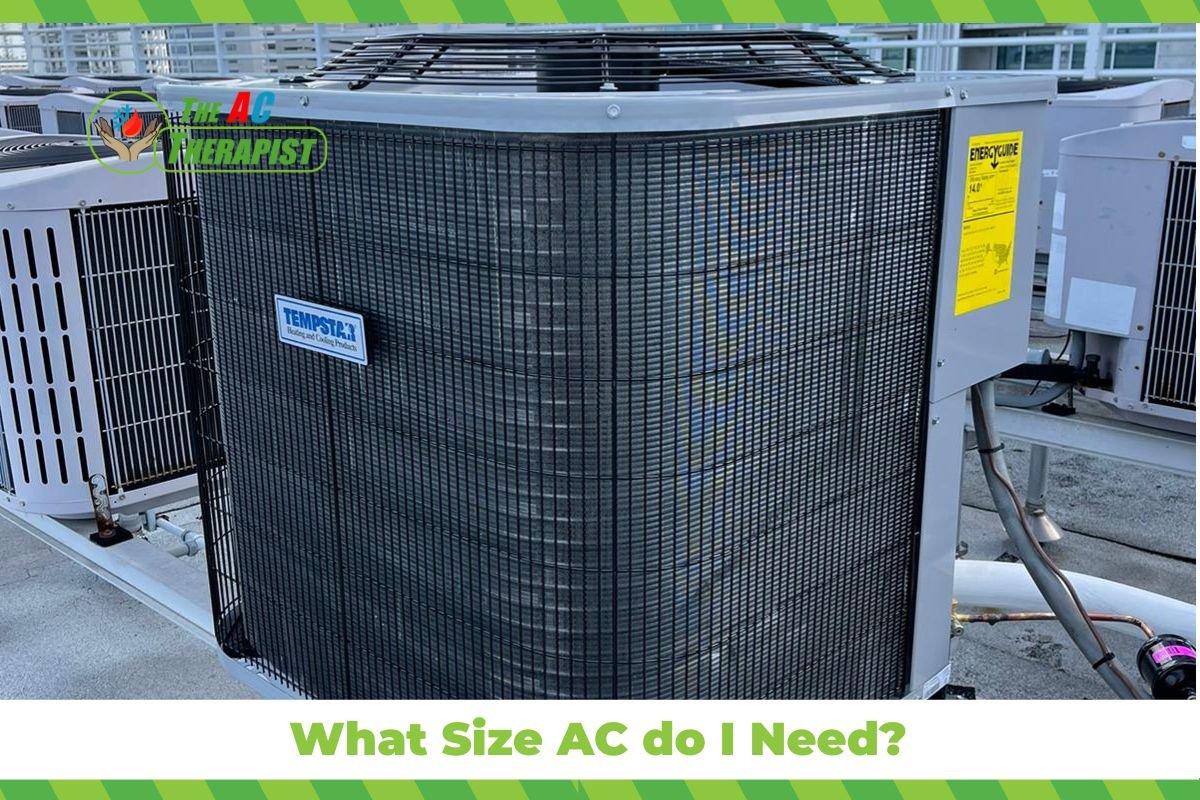
Start with your outdoor unit (the big boxy thing that sits outside your house). Look on the back, sides, or near where the refrigerant lines connect. Sometimes it’s on a metal plate, sometimes it's a sticker that’s seen better days. Grab your phone flashlight; it might be dusty or faded.
Don't forget the indoor unit! That's the part tucked away in your closet, attic, or basement. It's usually a tall, narrow furnace-looking thing with a coil on top. The sticker might be on the side, inside the access panel, or near the fan motor. Sometimes, getting to it feels like an Olympic sport, but usually, a quick peek around will reveal it.

Decoding the Da Vinci Code (aka The Model Number)
Once you’ve found that elusive sticker, you’ll see a bunch of letters and numbers. Don't panic! You’re looking for a specific sequence within the model number. Manufacturers are pretty consistent, even if it looks like a random string of characters at first glance.
Look for a two-digit number, often a multiple of 6, 12, 18, 24, 30, 36, 42, 48, or 60. This number, when divided by 12, will give you the tonnage. For example:
- If you see '24' in the model number (e.g., ABC-24-XYZ), that typically means 24,000 BTUs, which is a 2-ton unit (24 / 12 = 2).
- See '36'? That's 36,000 BTUs, so a 3-ton unit (36 / 12 = 3).
- What about '48'? Bingo! 48,000 BTUs, a 4-ton unit (48 / 12 = 4).
- And '60'? You guessed it: 60,000 BTUs, making it a hefty 5-ton unit (60 / 12 = 5).
Sometimes, the numbers might be slightly different, like '036' for 36,000 BTUs. The key is to look for those numbers related to BTUs.
The Sticker is Gone! Or Unreadable! Now What?
Ah, the classic curveball! Don’t worry, it happens. Maybe the sticker peeled off in a heatwave, or someone painted over it (a homeowner’s horror story!). Here are your fallback options:
- Check Your Manuals/Records: If you're super organized (or have digital copies from a previous homeowner), the size might be in the original installation documents or owner's manual.
- Call the Pros: This is probably the easiest route. An HVAC technician can usually figure out your AC size pretty quickly. They might even have a trick or two up their sleeve for identifying older units. Think of them as the Sherlock Holmes of home comfort!
- Measure Yourself (The Old School Way): You can estimate by measuring the square footage of your home and using an online BTU calculator, but this is less precise and shouldn't be your first choice for definitive sizing, especially for replacement. It's more of a ballpark figure.
There you have it! No more guessing games or feeling bewildered when a technician asks about your AC’s tonnage. You're now equipped with the knowledge to decode those cryptic numbers and understand what makes your home cool (or not-so-cool). Knowing your AC’s size isn’t just trivia; it’s a crucial bit of information for maintenance, repairs, and ensuring your home stays perfectly comfortable, without breaking the bank. Go forth, confident AC size detective!