How To Read Meter Of Electricity

Ever stared at your electricity meter like it's a cryptic alien device, humming secrets you’re not privy to? Fear not, my friend! Today, we’re going to decode that mysterious box and turn you into an energy-reading superhero. Seriously, knowing how to read your own meter is like gaining a secret superpower, giving you the inside scoop on your home’s energy adventures!
The Digital Dynamo: Your Easiest Ally
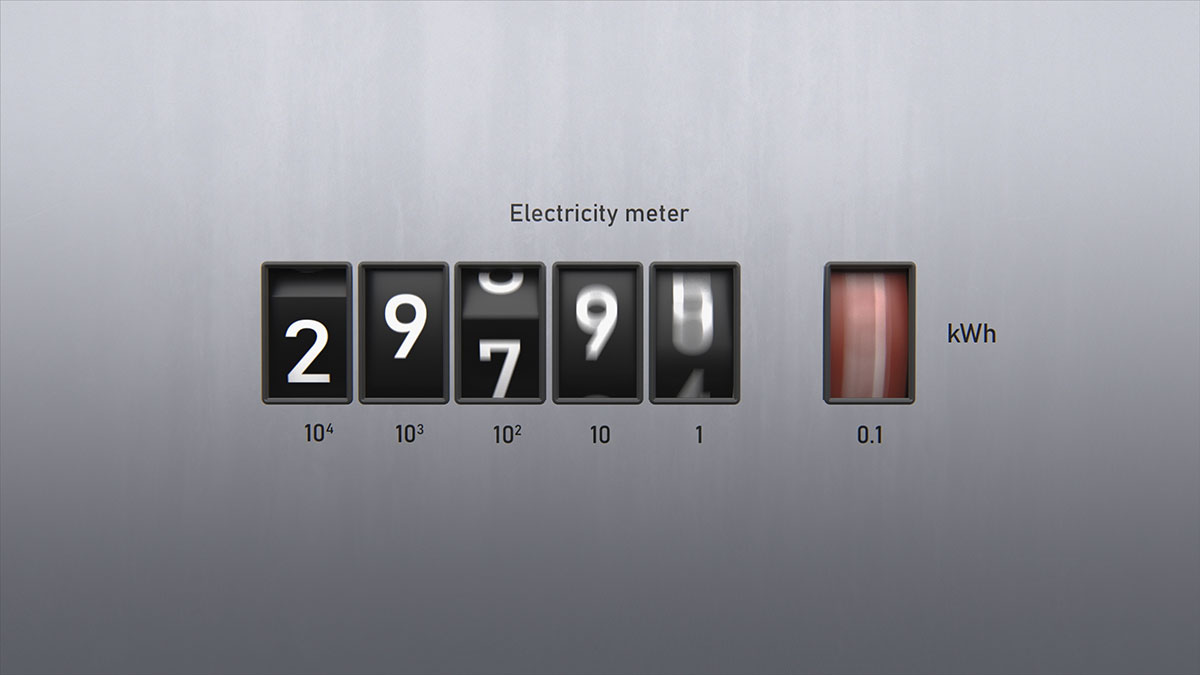
Okay, let's start with the easiest one, the digital meter. These are the cool kids on the block, practically shouting their numbers at you. You’ll usually see a neat, glowing display showing a series of digits. Your mission, should you choose to accept it (and you should!), is simply to write down what you see, usually from left to right.
It’s like reading a digital clock, but instead of telling you the time, it's telling you your home's grand energy saga in kilowatt-hours (kWh)! No pointers, no guesswork, just pure, unadulterated numbers. If you have one of these, give yourself a high-five and a gold star. You're already an expert!
The Analog Adventure: Taming the Tiny Clocks
Now, for the true adventurers, the classic, charming, and sometimes utterly bewildering analog dial meter. These have a series of little clock faces, usually four or five of them, ticking away like tiny, busy bees. Don't let them intimidate you! We're going to break it down.
Your Golden Rule for Each Dial
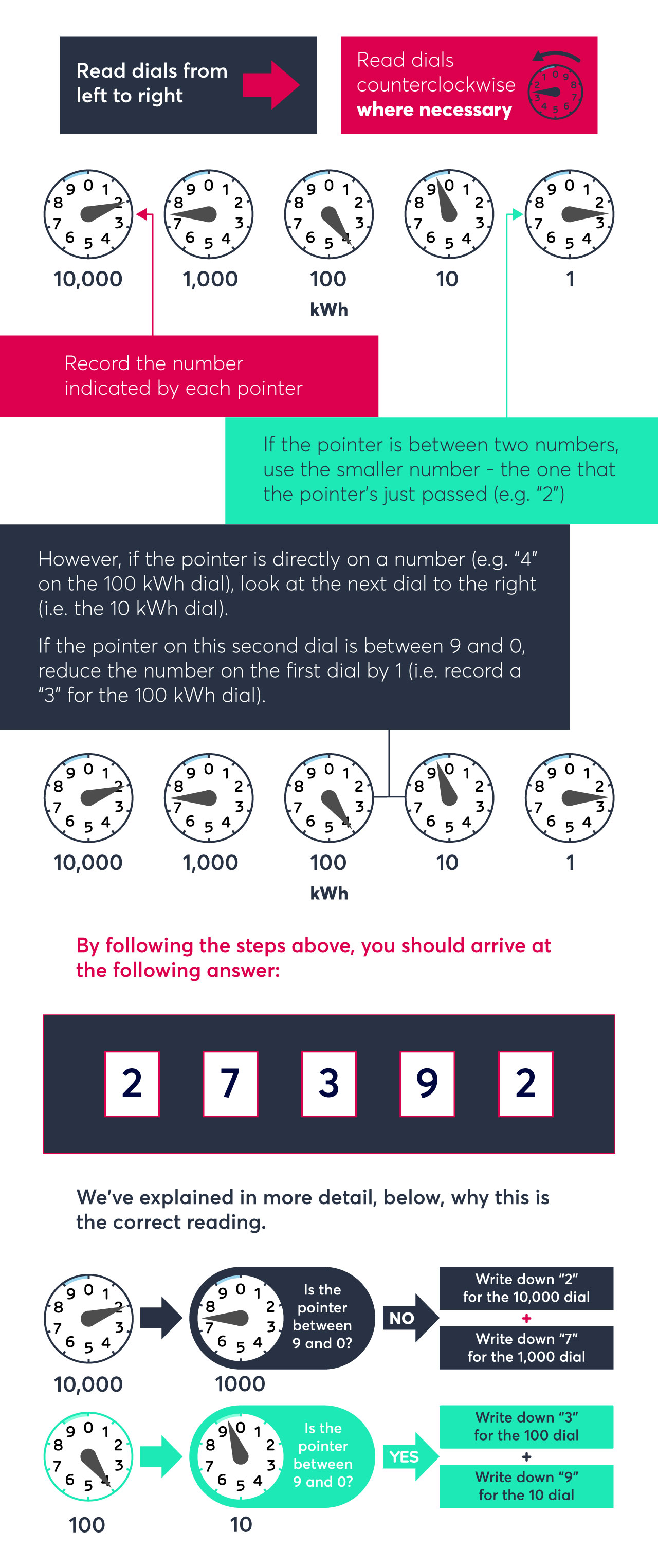
Imagine each dial is a mini-clock, but with numbers 0 to 9 instead of 1 to 12. And here's the golden rule, the secret handshake of meter readers: Always read the number the pointer has just passed, not the one it's approaching.

- Think of it like a car odometer – you read the number fully displayed, even if the next digit is peeking out from below.
- If the pointer is nestled between, say, 3 and 4, you read it as 3. Easy peasy!
- What if the pointer is between 9 and 0? Ah, a trickster! You read this as 9. Why? Because it hasn't quite reached the 0 yet, which represents the start of the next full rotation. It's still in its '9' phase, just about to flip over. This is the trickiest bit, but you'll nail it!
Reading Them All Together, Left to Right!
You’ll read these tiny clock faces from left to right, just like you read a thrilling novel. The first dial gives you your thousands, the second your hundreds, and so on, down to your single units. Write down each number you read, in order.
There's one more subtle maneuver you need to master, a ninja move for when a pointer is sitting directly on a number. Let's say a pointer is pointing right at the '4'. Is it a 4? Maybe! But we need to be sure. This is when you peek at the dial to its right.

- If that dial's pointer has passed zero (i.e., it's on 1, 2, 3, etc.), then your '4' is a true, proud 4. Phew!
- But! If the dial to its right hasn't quite made it past zero yet (it’s still on 9, or heading towards 0 from 9), then your '4' is actually a '3' in disguise! Sneaky, right? This is the only time you second-guess a pointer directly on a number. It means the previous dial hasn't quite completed its rotation to reach the '4' mark properly.
This might sound like a riddle wrapped in an enigma, but trust me, after doing it once or twice, it clicks! It's like learning to ride a bike; a little wobbly at first, then suddenly you're cruising!
You're a Meter-Reading Maestro!
Congratulations! You've just unlocked the secrets of your electricity meter. Whether you have the straightforward digital display or the charmingly intricate analog dials, you now possess the knowledge to read them with confidence. Take a deep breath, channel your inner detective, and approach your meter.
Don't be afraid to take a photo of your meter for your records, or even draw out the dials if it helps you visualize. Practice makes perfect, and soon you'll be zipping through those numbers like a pro, feeling utterly empowered knowing exactly what your home's energy consumption story is. Go forth and conquer, you magnificent meter reader! The power (pun intended!) is now in your hands.