
How To Measure Fillet Weld Size
Ever looked at a sturdy metal fence, a beautiful wrought-iron gate, or even the frame of your trusty bicycle, and wondered, "How do they make that so incredibly strong?" Well, dear reader, a huge part of the magic lies in something called a fillet weld. And guess what? Understanding how to measure these little marvels isn't just for engineers in hard hats – it’s a fascinating skill that can make you see the world (and all its incredible metalwork) in a whole new, much more appreciative light!
Forget dry textbooks and intimidating diagrams for a moment. We’re going to dive into the surprisingly fun world of fillet weld measurement. Why fun? Because it’s all about precision, craftsmanship, and the satisfaction of knowing something truly important. Plus, it gives you bragging rights at your next BBQ when you can casually observe, "That's a pretty decent 1/4-inch fillet weld on that grill frame, wouldn't you say?"
What in the World is a Fillet Weld, Anyway?
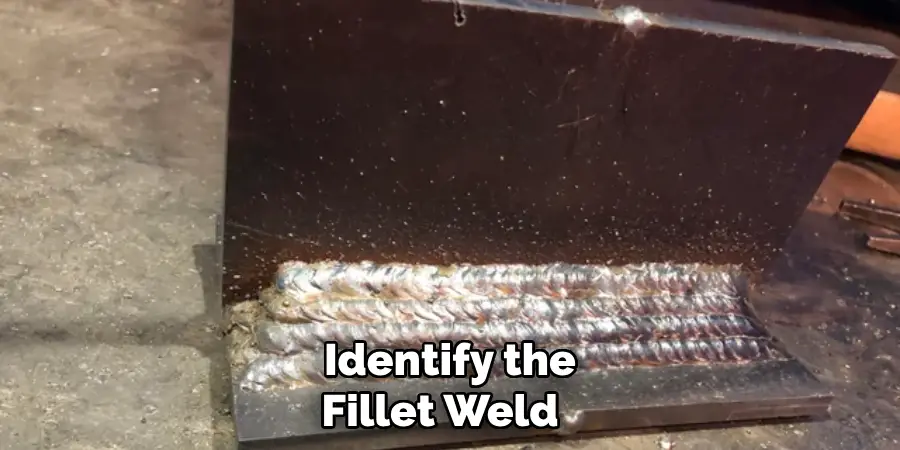
Imagine you're trying to join two pieces of metal at an angle, usually 90 degrees. A fillet weld is that triangular bead of molten metal that fuses them together in the corner. Think of it like super-strong, super-hot glue that literally becomes one with the metal. It’s the unsung hero holding countless structures together, from the mighty girders of a skyscraper to the delicate joints on a piece of art. Without good fillet welds, things, well, fall apart. And nobody wants that!
Must Read
The strength of a fillet weld, and thus the strength of the entire structure, depends significantly on its size. Too small, and it might snap. Too big, and you're wasting material and time. So, getting it just right is crucial. And that, my friends, is where our fun measuring adventure begins!
The Two Big Players: Leg Size and Throat Size
When we talk about measuring a fillet weld, there are primarily two dimensions we're interested in: the leg size and the throat size. Don't worry, these aren't nearly as complicated as they sound!
1. The Leg Size: Your Go-To Measurement
The leg size is probably the easiest and most common way to talk about a fillet weld. Imagine that triangular cross-section of the weld. The leg size is simply the length of the "legs" of that triangle – the distance from the root (the very corner where the two metals meet) to the toe (the edge where the weld metal meets the base metal) on each side.

For an ideal, perfectly shaped fillet weld (what we call a convex weld with equal legs), both legs should be the same length. So, if someone says, "It's a 1/4-inch fillet weld," they’re usually referring to the leg size. It's like asking for a "medium" coffee – everyone knows what you mean!
Why is it important? Because leg size is often specified in blueprints and codes. It’s the most straightforward way to visually inspect if a weld meets the basic requirements.
2. The Throat Size: The Real Strength Indicator
Now, for the slightly more advanced (and arguably more important) measurement: the throat size. While the leg size tells you how big the weld looks from the outside, the throat size tells you how much actual metal is doing the work.
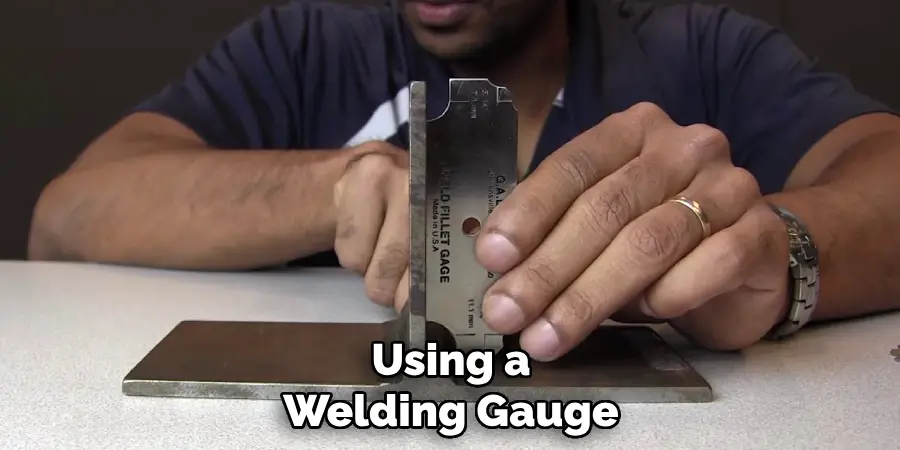
Imagine a line drawn from the root of the weld, perpendicular to the weld face. That shortest distance is the throat. It's the thinnest, strongest cross-section of the weld, and it's what truly resists the forces trying to pull your metal masterpiece apart.
Why is it important? Because the throat size is directly related to the weld's strength. A larger throat means a stronger weld. You might have a big, chunky weld with a deceptively small throat if the shape isn't right. That's why being a weld measurement detective is so rewarding – you uncover the truth!
Your Secret Weapon: The Fillet Weld Gauge!
Forget your grandpa’s dusty old ruler for this job (unless you're measuring a very rough estimate). The professional (and frankly, the most fun) way to measure fillet welds is with a specialized tool called a fillet weld gauge.
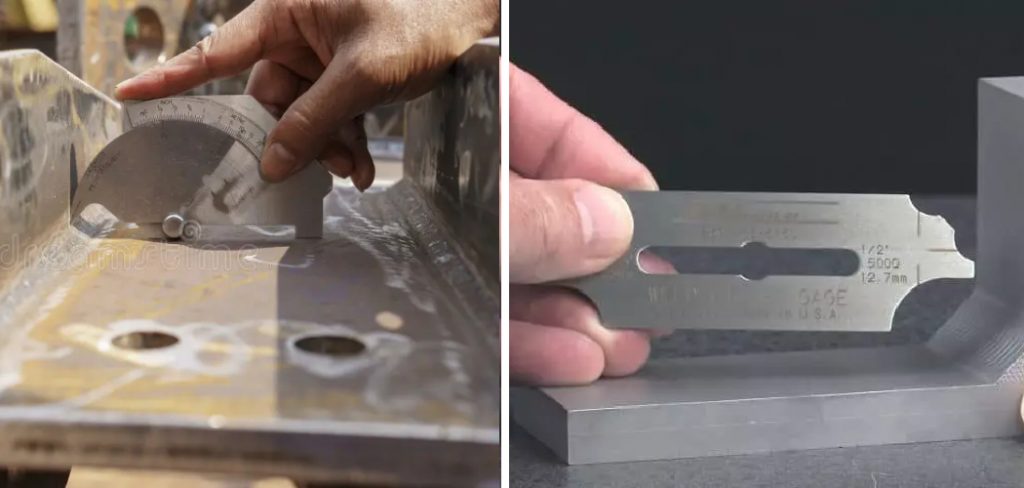
These ingenious little devices come in various shapes and sizes, but they all serve the same purpose: to quickly and accurately determine the leg and sometimes the throat size of a weld. Many of them look like a small fan of metal blades, each precisely machined to a specific dimension.
How to use it (the really satisfying part!):
- First, clean your weld. Dirt and spatter will give you false readings. We're aiming for precision, remember?
- Grab your fillet weld gauge. You'll have blades marked with different sizes (e.g., 1/8", 3/16", 1/4", etc.).
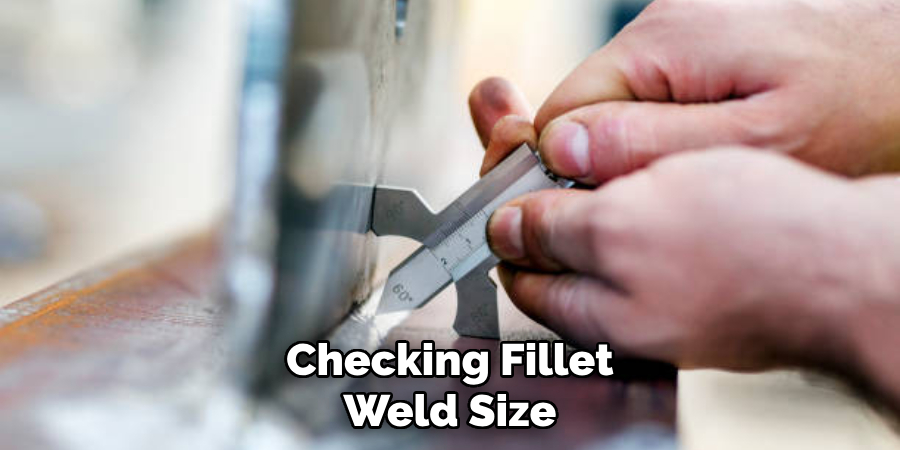
- For leg size, pick a blade that matches a potential leg size. Slide it against one leg of the weld. If it fits perfectly, touching the root and the toe without any gaps, bingo! You've found your leg size. If not, try the next size up or down until you find the closest fit. It’s like solving a tiny puzzle!
- Some gauges also have a way to measure the throat size directly or can help you identify if the weld is convex (curved outward) or concave (curved inward), which impacts the effective throat. Matching these profiles to the gauge is where you really start to feel like a pro.
It’s not just about finding the right number; it’s about understanding the subtle nuances of the weld's profile. Is it too convex? That might mean a slightly larger leg but a smaller effective throat. Is it concave? That often means a smaller throat and potential weakness. With a gauge, you gain an immediate, tactile understanding of these critical details.
Why This Is More Than Just a Technicality
So, why bother learning this seemingly niche skill? Because understanding how to measure a fillet weld is about appreciating integrity, safety, and craftsmanship.
- You'll see the world differently: Suddenly, every metal structure will tell a story. You'll notice good welds, poor welds, and appreciate the immense skill that goes into creating strong, reliable connections.
- Empowerment: Knowing a practical skill, even a small one like this, builds confidence. You understand a tiny piece of the complex puzzle that keeps our world running.
- Problem-solving: It’s a mini-detective game. Is that patio chair wobble due to a faulty weld? Now you have a way to start investigating!
- Appreciation for detail: In a world that often celebrates the big picture, mastering small, precise details is incredibly rewarding.
Learning to measure a fillet weld isn't just about steel and numbers; it's about connecting with the human ingenuity behind every welded structure, big or small. It’s about understanding that strength isn't accidental, but the result of careful design and execution.
So, the next time you encounter a piece of welded metal, don't just walk past. Take a moment. Look closely. Imagine the process, the heat, the skill. And maybe, just maybe, consider picking up a fillet weld gauge yourself. You might just discover a new passion for precision, a deeper appreciation for the world around you, and a surprisingly fun way to connect with the unsung heroes of engineering. The journey of learning is always an uplifting one, and who knows where this tiny step might lead? Happy measuring!