
How To Get The Coefficient Of Static Friction
Ever wondered why that stack of books stays put on your slightly-tilted shelf? Or why your car doesn't just slide uncontrollably every time you hit the brakes? The unsung hero working behind the scenes is something called the coefficient of static friction. Sounds like a mouthful, right? Don't worry, it's not as intimidating as it seems! Think of it as a secret handshake between two surfaces, determining just how much resistance they offer before one starts slipping.
So, What Exactly Is It?
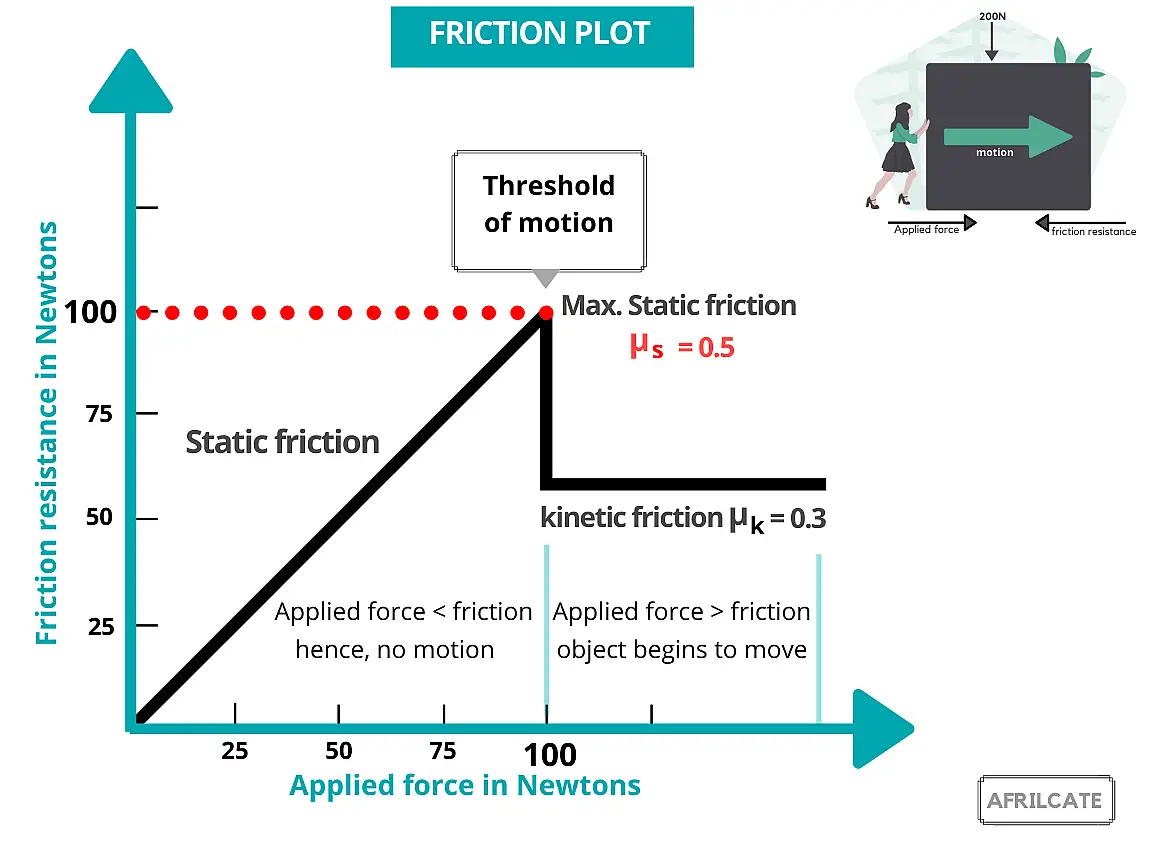
Imagine pushing a heavy box across the floor. At first, it doesn't budge. That's static friction doing its job. The coefficient of static friction (μs) is a number that tells you how strong this "sticking" force is. A higher coefficient means more force is needed to get things moving. It's a dimensionless quantity, meaning it doesn't have units like meters or kilograms. It's just a ratio. Think of it like a batting average in baseball – it gives you a sense of performance, but it's not a physical measurement.
Different materials have different coefficients. Rubber on dry asphalt has a high coefficient, which is why your car tires grip the road so well. Ice on ice? Not so much – hence the skating rinks and, unfortunately, the occasional winter fender-bender.
Must Read
The Nitty-Gritty: Finding That Coefficient
Alright, let's get down to business. How do we actually find this elusive coefficient of static friction? There are a few ways, both practical and theoretical.
The Inclined Plane Method: Your DIY Physics Lab
This is a classic experiment you can even try at home (with supervision, of course!). You'll need:
- A flat surface (a plank of wood works great)
- The object you want to test (that stack of books, perhaps?)
- Something to raise one end of the surface (books, blocks, etc.)
- A protractor (or a phone app that measures angles)
Here's the breakdown:
- Place the object on the flat surface.
- Slowly raise one end of the surface, creating an inclined plane.
- Keep raising it until the object just starts to slide. This is the critical angle!
- Measure the angle of the incline using your protractor.
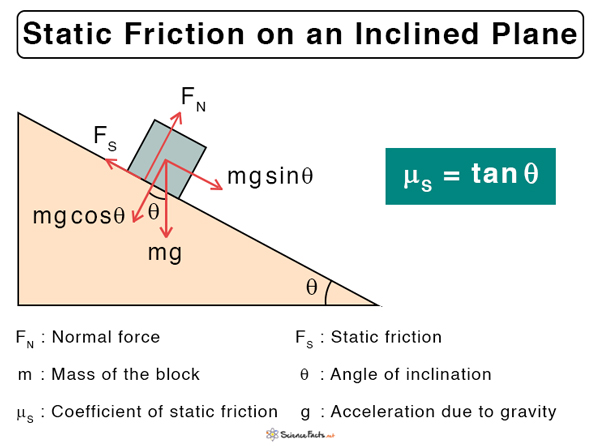
- Now, the magic: the coefficient of static friction (μs) is equal to the tangent of that angle (tan θ). So, μs = tan θ. Dust off those trigonometry skills!
Think of it like this: you're increasing the component of gravity pulling the object down the plane until it overcomes the static friction holding it in place. That angle at the tipping point gives you the information you need.
The Force Method: Measuring the Push
Another way is to directly measure the force needed to start the object moving. You'll need:
- The object you want to test.
- A flat, horizontal surface.
- A force gauge (or a spring scale).
- A way to apply a horizontal force to the object (a string attached to the force gauge).
Here's the process:
- Place the object on the horizontal surface.
- Attach the force gauge to the object.
- Slowly increase the force you're applying until the object just starts to move.
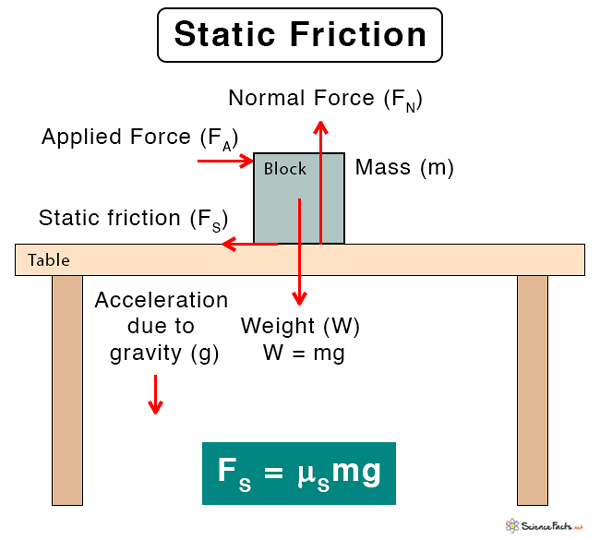
- Record the force reading on the gauge just before movement. This is the maximum static friction force (Fs).
- Measure the normal force (N) acting on the object. This is usually just the object's weight (mass x gravity).
- The coefficient of static friction (μs) is then calculated as: μs = Fs / N.
Think of it like breaking down a door. You keep pushing harder and harder until you overcome the resistance, and the door finally gives way. The force you exerted right before the breakthrough is key.
Real-World Implications and Fun Facts
Understanding the coefficient of static friction is crucial in many fields. Engineers use it to design brakes, tires, and even clothing! It helps determine how much force is needed to hold things in place or to prevent slippage.

Did you know? The coefficient of static friction can even be affected by temperature and surface cleanliness! A dusty surface might have a lower coefficient than a clean one. And the same materials can have different coefficients depending on the conditions.
Ever watch those incredible rock climbers scaling seemingly impossible cliffs? They're masters of understanding static friction, using specialized shoes to maximize their grip on the rock.
A Little Reflection
The coefficient of static friction might seem like an abstract concept, but it's a fundamental force shaping our daily experiences. From walking without slipping to driving safely, it's a silent partner ensuring stability and control. So, next time you're admiring a gravity-defying feat or simply enjoying a smooth ride, remember the unsung hero: the coefficient of static friction. It's a reminder that even seemingly simple things are governed by fascinating scientific principles.