Ever looked at a magnificent slice of pizza, a perfect wedge of cake, or even a section of a circular garden bed and wondered, "How big is that exact pointy bit?" Not the cheesy surface, not the crumbly edge, but that delightful angle right at the center?
Well, prepare to unlock a truly glorious secret! We're talking about finding the angle of a sector, and it's less like rocket science and more like a delightful treasure hunt.
Imagine you're the grand architect of fun, and you've got a giant, perfectly round party cake. You've cut a slice, and oh, what a slice it is! You know its delicious area, and you know the total area of the whole magnificent cake. This, my friends, is all you need to find that elusive central angle.
The "Area" Adventure: When You Know How Much Goodness is on Top!
Think of it like this: your slice is a fraction of the whole. A delicious, edible fraction! If your slice takes up, say, one-eighth of the entire cake, then its angle must be one-eighth of the total degrees in a circle, right? Absolutely! And a circle, in its complete, harmonious glory, always has 360 degrees.
So, step one is finding that fraction. You take the area of your sector (your glorious slice) and divide it by the area of the entire circle (the whole magnificent cake).
Angle of Sector = (Area of Sector / Area of Whole Circle) × 360 degrees
But wait! How do you find the area of the whole circle if you just have your slice? Easy peasy, lemon squeezy! You just need to know the radius. The radius is just the distance from the very center of the cake (or pizza, or garden) straight out to its edge. It’s like the secret handshake of circles!
Once you have that magical radius, the area of the whole circle is found with a legendary formula: π (Pi) multiplied by the radius squared. Yes, radius squared means the radius multiplied by itself! So, if your radius is 10 inches, the squared part is 100. Simple!
Let’s say you have a segment of a circular pie, and its area is 25 square inches. You also know that the pie has a radius of 8 inches. What’s the angle of your super-special pie slice?
First, let's find the area of the whole pie. That's π multiplied by (8 inches × 8 inches). So, π × 64 square inches.
Using π as approximately 3.14159, the whole pie's area is about 201.06 square inches.
Now for the ratio! Your slice's area (25 sq in) divided by the whole pie's area (201.06 sq in) gives us about 0.1243. This is your fraction!
Finally, multiply that fraction by 360 degrees! 0.1243 × 360 degrees equals approximately 44.75 degrees. There you have it! A 44.75-degree angle slice of pie.
You've just performed a mathematical marvel!
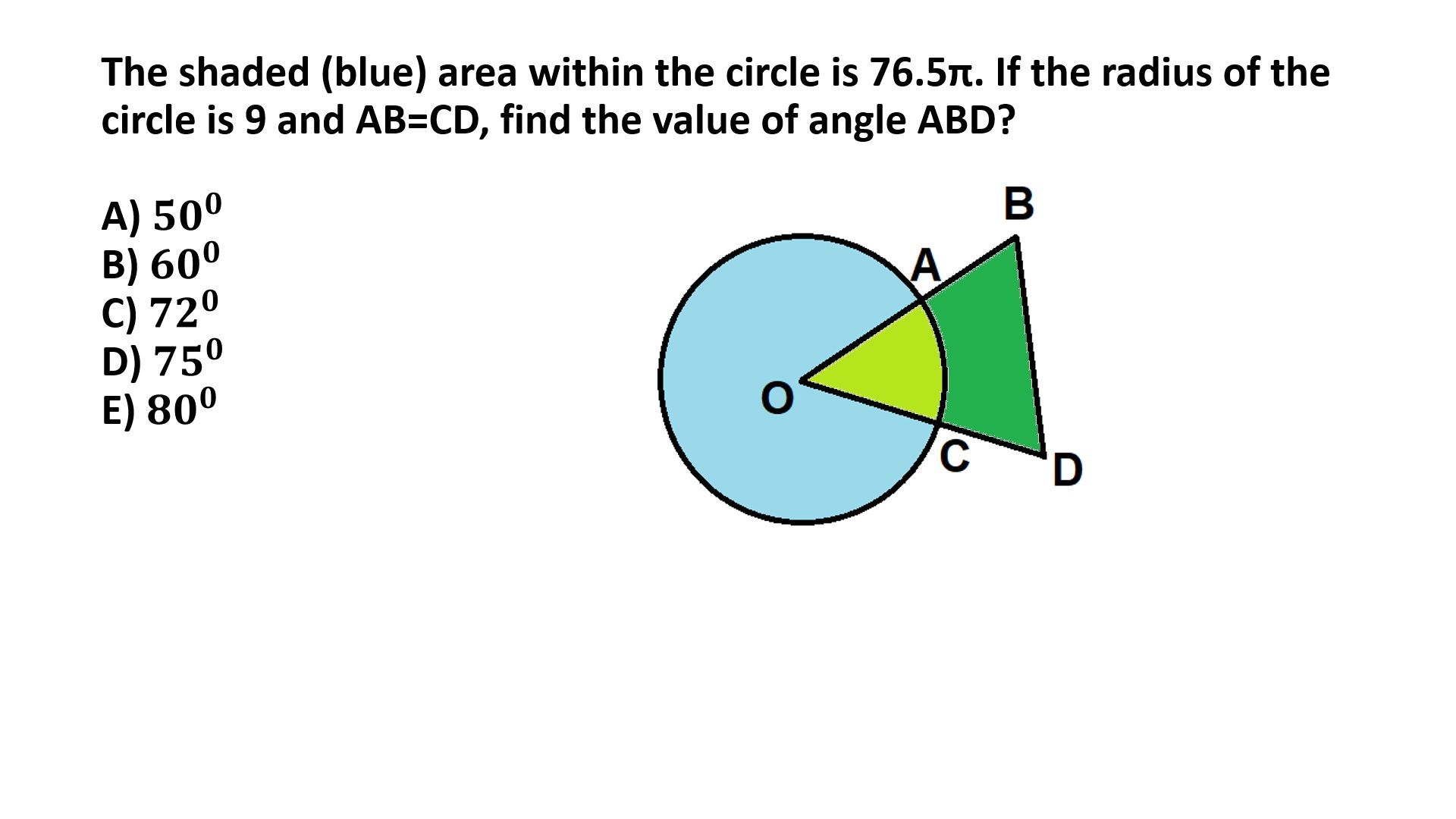
A problem on circle sector area/sector angle | Scrolller
Feel the power? You just measured a slice using nothing but its surface area and the radius of its grand, circular parent! It's like having X-ray vision for angles!
The "Arc Length" Adventure: When You Know the Crusty Edge!
But what if you don't know the area of your slice? What if all you know is the length of its curved edge, its delightful crust, its magnificent outer boundary? This, my friends, is called the arc length.
And guess what? We can still find that central angle with astonishing ease!
Imagine you're walking along the curved edge of a grand, circular race track. You've only walked a certain segment of the bend. You know the length of your stroll (the arc length), and you know the total length of the entire track's outer edge (its circumference).
Just like before, your segment's length is a fraction of the whole track's edge. Take that fraction and multiply by 360 degrees, and BOOM! Angle found!
Angle of Sector = (Arc Length of Sector / Circumference of Whole Circle) × 360 degrees
Now, how do we find the circumference of the whole circle? Ah, another glorious secret involving our old friend, the radius! The circumference is simply 2 × π × radius. Yes, twice our favorite magical constant, multiplied by the distance from the center to the edge!
A Crispy Example for the Arc Length Method!
Let's imagine a magnificent frisbee, and a tiny, playful squirrel has chewed along its edge, creating an arc length of 12 inches. You measure the frisbee's radius, and it's a perfect 7 inches. What's the angle of the squirrel's snacking sector?
First, let’s find the circumference of the whole frisbee. That’s 2 × π × 7 inches. So, 14π inches.
This is approximately 43.98 inches.
Now for our delightful fraction! The squirrel’s nibble length (12 inches) divided by the whole frisbee’s circumference (43.98 inches) gives us about 0.2728.
Finally, multiply that fraction by 360 degrees! 0.2728 × 360 degrees equals approximately 98.21 degrees. Ta-da! The squirrel created a sector with an angle of almost 98.21 degrees.
Angle Sector Photos and Premium High Res Pictures - Getty Images
Who knew squirrels were geometry gurus?
The Dynamic Duo: Radius and Pi!
Notice a pattern? Both methods heavily rely on the radius, that humble line from the center to the edge, and π (Pi), the eternal ratio of a circle's circumference to its diameter. These two are the unsung heroes of circular geometry, making all these angle-finding adventures possible!
They are like the dynamic duo of the circle world, always there to help you unlock its secrets. Treat them with respect, for they hold the keys to understanding all things round and wonderful!
Your New Angle Superpower!
There you have it! Whether you know the area of your sector or its delightful arc length, finding that central angle is now firmly within your grasp. It's all about ratios, fractions, and our beloved 360 degrees.
You now possess a glorious superpower, a secret tool to precisely understand slices, wedges, and curved segments of all kinds. Go forth and amaze your friends with your newfound angle-calculating prowess! You are officially a master of sectors!
So next time you're eyeing that perfect piece of pie, you won't just see dessert; you'll see a thrilling mathematical puzzle just waiting for you to solve with a twinkle in your eye and a formula in your heart!