
How To Convert Ac To Dc Current

Ever plug something into the wall and then connect it to your phone or laptop, noticing that chunky little box (or "power brick") in between? It’s not just there for decoration, trust me. That humble brick is actually a tiny, unsung hero, performing a crucial feat of electrical alchemy: converting AC to DC current. And honestly, it’s a pretty cool party trick if you ask me!
So, let's unpack this a bit. When we talk about electricity, there are two big players: Alternating Current (AC) and Direct Current (DC). Think of them like two very different personalities. AC is the wild child, constantly changing its mind, flowing back and forth in a wobbly wave pattern. It’s what comes out of your wall sockets, great for transmitting power over long distances and powering big appliances like your fridge or oven.
Then there’s DC, the more disciplined, straightforward sibling. It flows in one consistent direction, like a river always heading downstream. And guess what? Almost all our personal electronics – your phone, tablet, laptop, smart home gadgets – absolutely love DC. They can’t stand AC’s flip-flopping ways. It’s like trying to feed a baby solid food when it only wants milk. So, how do we get our fickle wall current to play nice with our sensitive tech?
Must Read
The Great Divide: Why Bother with DC?
It’s a fair question, right? If AC is so good at traveling far, why do we need to convert it? Well, imagine trying to power a delicate electronic circuit with current that's constantly reversing direction 50 or 60 times a second. It would be an absolute mess! These gadgets need a steady, predictable flow of electricity to function properly, to charge their batteries, and to keep their tiny brains whirring without getting confused.
So, that's where the conversion magic happens. It's essentially about taking that energetic, back-and-forth AC signal and transforming it into a smooth, one-way DC street for our devices.
The One-Way Street: Introducing the Diode
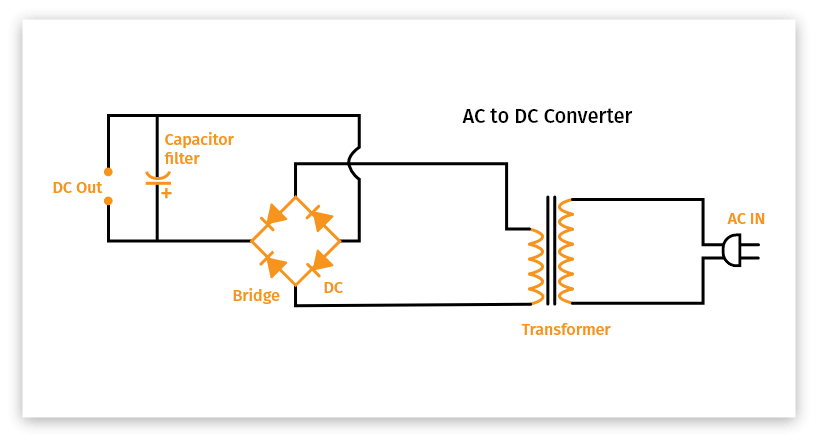
At the heart of this transformation is a fantastic little component called a diode. Think of a diode like a super-exclusive bouncer at a club, or a one-way valve in a pipe. It only allows current to flow in one direction. If the electricity tries to go the other way, the diode simply says, "Nope! Not today!"
When you put a diode in the path of AC current, it effectively chops off half of the AC wave. Remember how AC goes back and forth? The diode lets one half of the wave through (say, the positive bit) but blocks the other half (the negative bit). What you’re left with is a pulsating, bumpy stream of electricity that only flows in one direction. It’s not quite DC yet – it’s still very much a bumpy ride – but it’s a huge step!

Smoothing Things Out: Enter the Capacitor
Okay, so we've got our electricity flowing in one direction, thanks to our diligent diode. But it's still pretty jumpy. Imagine trying to drink water from a tap that only squirts for half a second at a time, then pauses, then squirts again. Not ideal for a steady drink, right?
This is where another superstar component, the capacitor, comes into play. Think of a capacitor like a tiny, super-fast-charging battery or a small water reservoir. When the electricity is flowing (during the "on" part of our bumpy DC), the capacitor quickly charges up, storing some of that energy. Then, when the electricity briefly dips or pauses (during the "off" part), the capacitor discharges its stored energy, filling in the gaps and smoothing out those bumps.

With a capacitor on the job, that choppy, pulsating DC starts to look a lot more like a smooth, consistent flow. It's like taking a bumpy dirt road and paving it over, giving you a much nicer, more stable journey for your electrons.
The Whole Kit and Caboodle: Power Supplies
In most power bricks, you'll find a few more tricks. Often, instead of just one diode, there are four of them arranged in something called a bridge rectifier. This clever setup ensures that both halves of the AC wave are utilized, but always directed to flow in the same "positive" direction, making the output even more efficient before the capacitor kicks in to smooth things out.

Sometimes, there's also a component called a voltage regulator. This is like a careful nanny, ensuring that the DC voltage is not only smooth but also at the exact right level for your device. Too much voltage can fry your electronics, too little and they won't work!
Why Is This All So Cool?
It might sound a bit technical, but think about it: this ingenious process is happening billions of times every second, all around the world, making our modern lives possible. Every time you charge your phone, power up your laptop, or use any device that plugs into the wall but runs on a battery or low voltage, you're relying on this AC-to-DC conversion.
It's the invisible bridge that connects the robust, long-distance power of our electrical grids to the delicate, precise needs of our personal technology. Without it, our gadgets would either be permanently tethered to clunky, room-sized power converters, or simply wouldn't exist as we know them. So, the next time you plug in your phone, give a little nod to that power brick. It’s doing some pretty essential, subtle, and frankly, super smart work to keep your digital world humming!