
How To Cancel Out Natural Log
Alright, settle in, grab your imaginary coffee. Today, we're tackling one of those math concepts that, for many of us, feels a bit like trying to pronounce a Swedish furniture instruction manual: the Natural Logarithm. Or, as it's affectionately known to its friends and foes, ln(x).
Now, I know what you're thinking. "Logs? Aren't those things that float down rivers? Or where squirrels hide their nuts?" Close! But no. In the world of math, a logarithm is basically the answer to the question: "To what power must we raise a certain base to get a certain number?" For instance, log base 10 of 100 is 2, because 10 to the power of 2 is 100. Easy peasy, lemon squeezy.
But then, along came the natural log. It's special. Its base isn't 10. It's not 2. It's a mysterious, slightly quirky number known as e. And no, that's not a typo for 'e-mail' or 'extraordinary'. It's just 'e'.
Must Read
Meet Our Quirky Friend, e
Picture e as the eccentric billionaire of the number world. It's approximately 2.71828... and it just keeps going, never repeating, like that one relative who tells endless stories at Thanksgiving. e pops up everywhere in nature: population growth, radioactive decay, compound interest (the good kind, where your money makes more money!). It’s the number behind continuous growth, always growing at a rate proportional to its current value. It’s like a super-enthusiastic plant that just can't stop sprouting new leaves.
So, when you see ln(x), what you're really seeing is "log base e of x." It’s asking, "To what power do I need to raise e to get x?" And sometimes, you're faced with an equation that has this ln(x) chilling out, minding its own business, and you just want it GONE. Vanished. Poof! Like that last slice of pizza you were saving. How do we cancel this mathematical enigma out?

The Great Escape: How to Make ln(x) Disappear
Here’s the secret, and it’s surprisingly elegant, like a perfectly executed magic trick. To cancel out a natural logarithm, you need its archenemy, its perfect foil, its soulmate (depending on how you look at it): the exponential function with base e. Or, as we call it in the biz, ex.
Think of it like this: the natural log and the exponential function with base e are like a lock and its perfectly matched key. Or maybe a highly skilled ninja and their equally skilled anti-ninja counterpart. When they meet, they don't fight; they simply... neutralize each other. They resolve into something beautifully simple.

Let’s say you have ln(x). You want to get rid of that pesky ln part. What do you do? You make it the exponent of e! It's like sending ln(x) on a rocket ship powered by e. So, if you have ln(x), and you apply e to the power of that whole thing, you get eln(x). And guess what that equals?
Wait for it... x! Mind blown, right? It's like saying, "What do I need to raise e to, to get x?" and then immediately doing that operation. They just undo each other, leaving you with the original number you started with. It's like putting on socks, then immediately taking them off. You're just left with your feet!

The same thing works in reverse! If you have ex and you want to cancel out that mighty e, you simply take the natural logarithm of the entire expression. So, ln(ex) equals... you guessed it... x! It’s wonderfully symmetrical. They’re like two sides of the same mathematical coin, perpetually cancelling each other out to reveal the core value beneath.
Why Is This So Important (Beyond Just Annoying Your Math Teacher)?
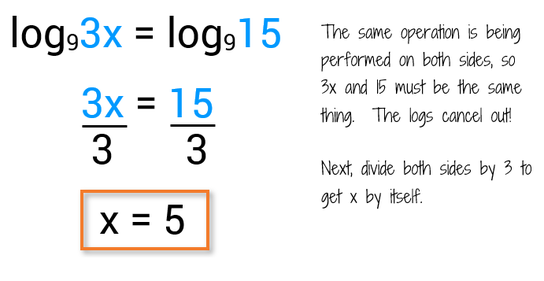
This cancellation trick isn't just a party trick for math nerds. It's incredibly powerful! When you're solving equations involving exponential growth or decay (remember that plant or that bank account?), you often end up with an e to some power. To isolate the variable in that exponent, you whip out the natural log, apply it to both sides of your equation, and BOOM! The e vanishes, leaving your variable free and clear to be solved.
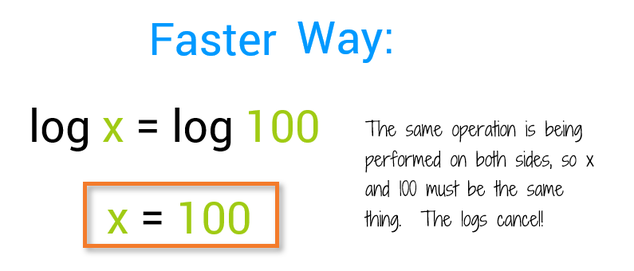
Conversely, if your variable is trapped inside a natural log, you use the exponential function with base e. You raise e to the power of everything on both sides, and POOF! The ln disappears, freeing your variable once more. It's like having a universal key for two very specific mathematical locks.
And here's a fun fact about our friend e: it's not just irrational (like π, its digits go on forever without repeating), but it's also transcendental. This means it's not the root of any non-zero polynomial equation with rational coefficients. Fancy pants! Basically, it's a number that's truly unique and can't be pinned down by algebra in the usual way. Pretty cool for a number that's just chilling between 2 and 3, right?
So, the next time you encounter a natural log or an exponential function with base e, don't sweat it. Just remember their secret handshake: applying one undoes the other, leaving behind the juicy bits you actually want to work with. It's simple, elegant, and once you get it, it opens up a whole new world of solving equations. Now, who's up for another imaginary coffee?